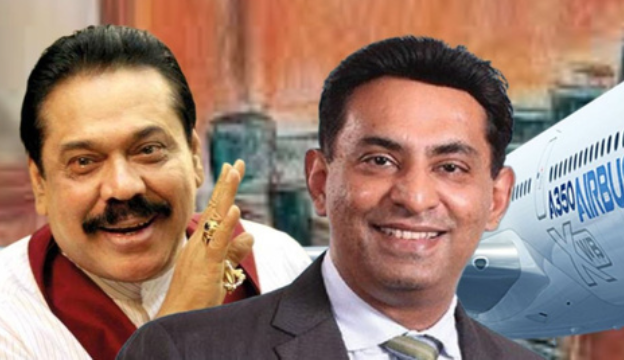
Be that as it may, politics has always struggled with funerals.
Because death possesses an extraordinary ability to soften memory, blur accountability and temporarily suspend the harshness with which societies ordinarily judge public controversy. That is human. It is understandable. Compassion at moments of grief is part of civilization itself.
But public-interest journalism operates under a different obligation.
Submit Your Press Release
Get your company news, announcements, launches, appointments and events in front of a wider audience.


Facts remain stubborn things.
And in matters involving allegations of corruption, state decision-making and the use of public power, there can be no convenient “colour washing” merely because a central figure is no longer alive to answer questions.
Which is precisely why former President Mahinda Rajapaksa’s appearance paying last respects to former SriLankan Airlines CEO Kapila Chandrasena carried political and symbolic consequences far larger than perhaps intended.
Because whether fair or unfair, justified or exaggerated, Kapila Chandrasena was widely perceived in the public imagination as very much a “Rajapaksa man” – a senior state-sector executive whose rise, positioning and visibility were closely associated with the Rajapaksa-era political establishment and its wider ecosystem of state power.
That perception matters.
Not because political association itself proves wrongdoing. It does not.
Nor because personal loyalty automatically establishes corruption. It cannot.
But because public trust in governance depends heavily upon whether political power and commercial decision- making become too intertwined inside state institutions handling billions in public assets and strategic contracts.
And that brings Sri Lanka directly back to the uncomfortable issue that still remains unresolved in the minds of many citizens:
what exactly happened to the alleged Airbus-related bribe funds reportedly linked to Sri Lanka’s aircraft procurement process?
The figure most often discussed publicly was approximately US$2 million.
That question did not disappear with death. Nor should it.
Because the issue was never merely about one individual alone. The larger issue concerns systems – political systems, procurement systems, oversight systems and state-enterprise cultures capable of enabling enormous decisions involving public money with insufficient transparency and inadequate insulation from political influence.
That is the true public-interest dimension.
Over the years, Sri Lanka has repeatedly witnessed how concentrated political power, weak institutional independence and state commercial activity can combine into an environment where decision-making becomes dangerously opaque. Large contracts emerge. Strategic assets shift direction. Procurement decisions accelerate. Yet public scrutiny often arrives far too late, if at all.
And perhaps that is why the Kapila Chandrasena story continues carrying emotional and political weight far beyond the individual himself.
Because many Sri Lankans increasingly suspect the country’s deeper problem was never simply corruption at the level of personalities.
It was the architecture enabling it.
An architecture where state corporations became extensions of political influence. Where board appointments often reflected political comfort as much as professional independence. Where losses were socialized onto taxpayers while decision-making power remained concentrated within small political and administrative circles.
That reality inevitably revives one of the oldest debates in modern economics and governance:
should governments be directly running commercial enterprises at all?
There is a strong argument that governments have no real business being in business.
The role of the state, according to that philosophy, should primarily be to regulate fairly, facilitate efficiently, create infrastructure, enforce law and maintain a level competitive environment – not necessarily to function as airline operator, hotel manager, shipping trader or commercial entrepreneur.
Critics of excessive state ownership argue that once political structures directly control commercial entities, commercial logic itself becomes vulnerable. Appointments become politicized. Procurement becomes exposed.
Loss-making entities survive through taxpayer support. Accountability weakens because political loyalty and institutional oversight begin overlapping.
Of course, reality is more complicated than ideological slogans.
Pure free-market capitalism does not exist anywhere in completely untouched form. Even the world’s largest capitalist economies deploy heavy state intervention when strategically necessary.
The United States bails out banks and industries when crises emerge. Europe subsidizes sectors continuously. China – despite its communist origins under Mao Zedong and Zhou Enlai – operates one of the most aggressively state-guided market systems in modern history while simultaneously embracing fierce commercial competition and private capital.
So the real debate is not simplistic privatization versus socialism. The real question is competence, transparency and insulation from abuse of power. Can state institutions operate commercially without becoming political instruments?
Can procurement systems remain independent when billions are involved? Can public enterprises genuinely resist the gravitational pull of political patronage?
Sri Lanka’s history unfortunately suggests those safeguards have often proved fragile.
Which is why the public interest in the Chandrasena matter does not end with condolences, funerals or political symbolism. If anything, the opposite may be true.
Because once the central individual is gone, the country is left confronting something even larger: the system itself.
And systems do not attend funerals.
They remain behind, still shaping how power, money and public assets continue to intersect in Sri Lanka long after the individuals themselves are gone.