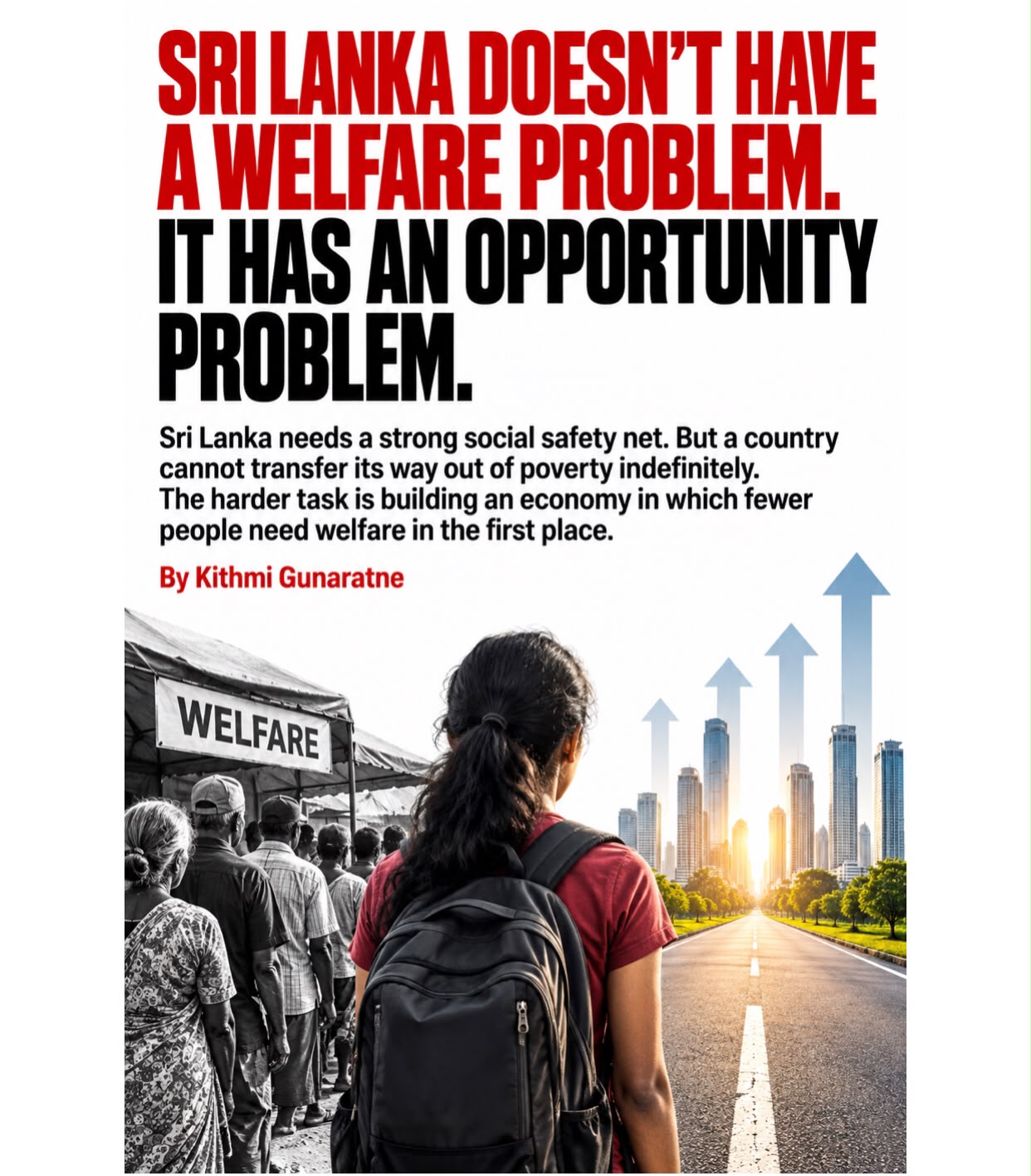
Sri Lanka needs a strong social safety net. But a country cannot transfer its way out of poverty indefinitely. The harder task is building an economy in which fewer people need welfare in the first place.
By Kithmi Gunaratne
For decades, Sri Lankan governments have responded to poverty with a familiar political vocabulary: subsidies, allowances, relief packages, Samurdhi, Aswesuma and repeated promises of programmes for those struggling to survive. When food becomes unaffordable, assistance is increased; when electricity prices rise, relief is discussed; when farmers struggle, subsidies return to the political agenda.
Submit Your Press Release
Get your company news, announcements, launches, appointments and events in front of a wider audience.


Much of this is necessary. A society in which the poorest are abandoned to hunger, illness or destitution is neither economically sensible nor morally defensible, particularly after an economic crisis that destroyed household incomes and pushed previously secure families into vulnerability.
Yet beneath Sri Lanka’s endless arguments over welfare lies a more difficult question: why do so many people continue to need it?
The deeper problem is not simply whether welfare payments are large enough or sufficiently well targeted, but whether the economy gives people realistic pathways out of dependency. Social protection can prevent a family from falling into destitution. It cannot indefinitely compensate for an economy that fails to generate enough productive employment, reward skills, support small businesses or allow people outside the country’s wealthiest areas to participate fully in economic life.
Sri Lanka’s recovery illustrates the contradiction. Inflation has fallen dramatically from its crisis extremes, macroeconomic stability has improved and growth has returned. Yet recovery at the level of the state is not necessarily recovery at the level of the household. The World Bank estimated poverty remained at 24.5% in 2024 under its $3.65-a-day poverty measure, approximately twice its 2019 level, while real wages remained below pre-crisis levels.
Poverty is usually discussed through income: determine who falls beneath a threshold and decide what assistance should reach them. But poverty is also about what people are actually able to do with their lives.
Can a young person in Monaragala acquire the skills required for a well-paid job without moving to Colombo? Can a woman in a rural village transform a home-based enterprise into a business with reliable access to finance and markets? Can a farmer move from subsistence agriculture into higher-value production? Can a graduate find employment that makes meaningful use of years of education?
These are not primarily questions about welfare. They are questions about opportunity.
The missing jobs
Sri Lanka has achieved relatively strong educational and health outcomes. But human development becomes economically frustrating when education does not translate into productive employment. The state can educate someone for more than a decade, subsidise university education and provide healthcare, only to watch that person conclude that the most rational economic decision is to leave the country.
Migration itself is not a failure. It can transform families, create international networks and generate valuable remittances. The problem arises when migration becomes less a choice than an escape route from an economy incapable of rewarding people’s skills.
The scale of the challenge is increasingly difficult to ignore. In April, the World Bank warned that nearly one million young Sri Lankans are expected to enter the labour market over the coming decade, while without stronger investment and growth only around 300,000 new formal jobs would be created.
That gap cannot realistically be closed through welfare payments.
Successful social protection should therefore be measured partly by how effectively people capable of economic participation can eventually move beyond it. That requires a bridge between welfare and employment: vocational training connected to industries actually hiring, affordable finance for viable small businesses, reliable transport, childcare, digital infrastructure, export opportunities and investment outside Colombo.
A cash transfer can help a household buy food this month. It cannot create the job that raises household income next year. Training programmes achieve little if people complete them only to discover there are no employers seeking their skills. The test should not simply be how many people participated in a programme, but how many obtained stable employment, increased their earnings or built businesses capable of surviving without continuing assistance.
The women Sri Lanka’s economy leaves behind
The opportunity deficit is particularly visible in women’s participation in the economy. Sri Lanka has educated generations of women, yet their labour-force participation remains far below that of men. World Bank data drawing on ILO estimates put female labour-force participation at about 31% in 2025, compared with roughly 68% for men.
Sri Lanka cannot seriously discuss increasing national productivity while such a large share of its educated population remains outside the labour market. Childcare, elder care, workplace safety, flexible employment, public transport and access to finance may appear to be social-policy questions, but they are also economic infrastructure.
The same applies to women’s entrepreneurship. Providing equipment, training or a small loan may help, but production is only one part of an economic chain. A rural producer also needs working capital, logistics, buyers, packaging, quality standards and access to larger markets. The difference between persistent poverty and a sustainable enterprise may not be charity at all. It may simply be market access.
Geography still determines opportunity
Economic possibility also continues to depend heavily on where someone is born. Access to high-quality schooling, English education, professional networks, technology, finance, transport and higher-value employment remains uneven.
Talent may be distributed throughout the island, but opportunity is not.
This is why development interventions can address the visible symptoms of deprivation without changing the structure surrounding them. Equipment can help a farmer. A sewing machine can help someone begin earning. A scholarship can transform a life. But sustainable economic mobility requires an ecosystem in which education connects to employment, production connects to markets and entrepreneurs can obtain finance without already possessing substantial wealth.
If a young person receives vocational training in an industry with few vacancies, the state has issued a certificate without creating an opportunity. If a family receives financial assistance but confronts the same structural barriers five years later, welfare may have prevented extreme hardship while development has failed to create mobility.
Recovery cannot end with macroeconomic stability
Sri Lanka had little choice but to stabilise its economy after the catastrophe of 2022. Fiscal discipline, debt sustainability, government revenue, investment and foreign reserves matter. Without macroeconomic stability, the poor are often among the first to suffer from inflation, shortages and collapsing public services.
But stability is a foundation rather than the final purpose of economic policy.
The next stage of recovery must therefore be judged by different questions: whether real household incomes rise, whether productive jobs are created, whether small businesses become medium-sized businesses, whether women can enter and remain in the workforce, whether young people believe they can build meaningful careers here and whether a child’s economic prospects become less dependent on geography and family income.
Welfare is not the enemy
None of this is an argument for dismantling Aswesuma or withdrawing support from vulnerable households. With poverty still severely elevated after the crisis, dismantling the social safety net would be reckless.
The false choice is between welfare and opportunity. Sri Lanka needs both, but they perform different functions.
Social protection prevents people from falling through the floor; economic opportunity gives them a staircase.
The mistake is allowing the first to substitute permanently for the second.
That means moving away from one of the persistent habits of Sri Lankan politics: seeing poorer citizens primarily as beneficiaries to whom something must periodically be distributed. They are also workers, farmers, parents, entrepreneurs, students, craftspeople, caregivers, graduates and potential employers.
Once policy begins viewing people through that lens, the question changes from how much assistance a household should receive to what prevents that household from achieving greater economic security.
For one family the barrier may be childcare; for another transport, credit, land ownership, inadequate schooling, poor English or digital skills, disability, discrimination or simply the absence of decent jobs. Removing those barriers is considerably harder than depositing the same payment every month.
But development was never supposed to mean the efficient administration of poverty. Its purpose is to expand people’s capacity to escape it.
Sri Lanka’s recovery should not produce a state whose balance sheet improves while too many of its citizens remain economically trapped. The country will continue to need welfare because there will always be people who require the protection of the state. But the greater ambition should be to ensure poverty does not become an inherited condition and welfare does not become the closest thing millions of citizens have to an economic policy.
Sri Lanka does not need to choose between protecting people and empowering them. It needs a social safety net strong enough to protect people when they fall, alongside an economy capable of giving them the education, infrastructure, finance, employment and market access necessary to build something better.
Until those opportunities exist beyond Colombo, beyond privileged families and beyond those fortunate enough to leave the country, Sri Lanka will continue spending enormous political energy deciding how poverty should be managed rather than confronting the more difficult question of how people can permanently escape it.
Sri Lanka does not have too much welfare. It has too little opportunity.