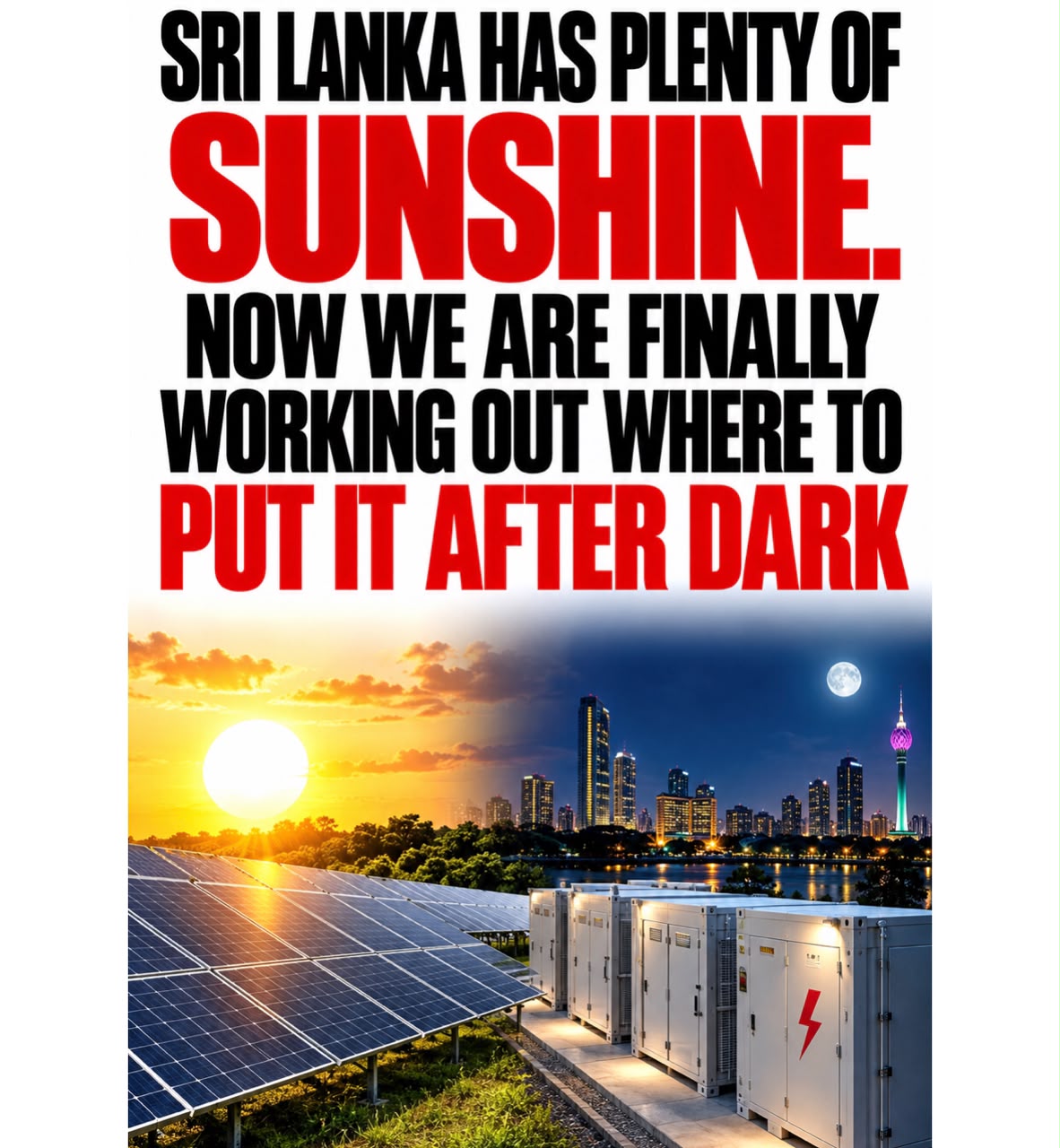
Solar power has always had an inconvenient problem: the sun produces electricity when it chooses, not necessarily when Sri Lanka needs it. A new generation of battery-storage projects could begin changing that equation.
Sri Lanka’s renewable-energy debate has spent years concentrating upon how much solar and wind power the country can generate. That was only half the problem.
The other half was what to do with the electricity once it had been generated.
Submit Your Press Release
Get your company news, announcements, launches, appointments and events in front of a wider audience.


A solar panel is wonderfully predictable in one respect. It produces power when there is sunlight. Unfortunately, electricity demand does not conveniently disappear when the sun goes down.
That mismatch has become increasingly important as Sri Lanka adds more renewable generation to its electricity system. During periods of strong sunshine, solar production can be plentiful. Several hours later, households return home, lights come on, air conditioners and appliances are used and evening demand rises just as solar generation disappears.
Traditionally, another source of generation has had to fill that gap.
Battery Energy Storage Systems, or BESS, offer a deceptively simple alternative. Electricity produced when renewable generation is plentiful can be stored and released when the grid actually needs it.
Sri Lanka is now beginning to build that missing part of the renewable-energy equation.
A series of battery-storage projects is moving forward alongside renewable generation, with private-sector energy companies positioning themselves for a market that could become increasingly important as the country’s solar capacity expands.
The implications extend beyond simply storing a little electricity for later.
Electricity grids must constantly balance supply and demand. Too little generation is a problem, but too much electricity arriving at the wrong time can also destabilise a system. Large batteries can absorb surplus power, respond rapidly to changes in demand and provide flexibility that conventional generation cannot always match.
That matters particularly for renewable energy because neither the sun nor the wind accepts instructions from the Ceylon Electricity Board.
A thermal power station can be told to increase or reduce generation. A cloud passing across a solar installation does not consult the system operator first.
Battery storage therefore makes renewable power considerably more useful.
It may also change the economics.
Sri Lanka has repeatedly debated expensive thermal generation required during periods of high demand. If electricity generated cheaply from sunshine can be stored during the day and discharged during the evening peak, the comparison is no longer simply solar versus coal, gas or oil.
It becomes solar plus storage versus conventional generation.
That does not automatically make batteries the cheapest solution. Large-scale storage has substantial capital costs, batteries degrade over time and projects must be properly designed around their expected charging and discharge cycles.
There are also questions Sri Lanka should ask before embracing another technology with evangelical enthusiasm.
Who owns the batteries? Who pays for them? How are storage providers compensated? What happens when batteries eventually require replacement? What environmental rules govern their disposal or recycling? And are procurement arrangements competitive enough to ensure that consumers receive the benefit rather than simply financing another guaranteed return for investors?
These questions matter because Sri Lanka has a remarkable ability to turn sensible infrastructure into expensive infrastructure through poor procurement.
But the underlying technology solves a very real problem.
The country has abundant sunlight. Rooftop solar has expanded rapidly, utility-scale renewable projects continue to be developed and the pressure to reduce dependence upon imported fossil fuels has only increased with the latest Middle Eastern instability.
Every additional unit of electricity generated domestically from sunshine is potentially one less unit exposed to the international price of fuel.
Until now, however, sunshine came with a clock attached.
Battery storage begins to remove it.
Sri Lanka has spent years asking how much renewable electricity it can produce. The more important question may now be how much of that electricity it can save for when it is actually needed.