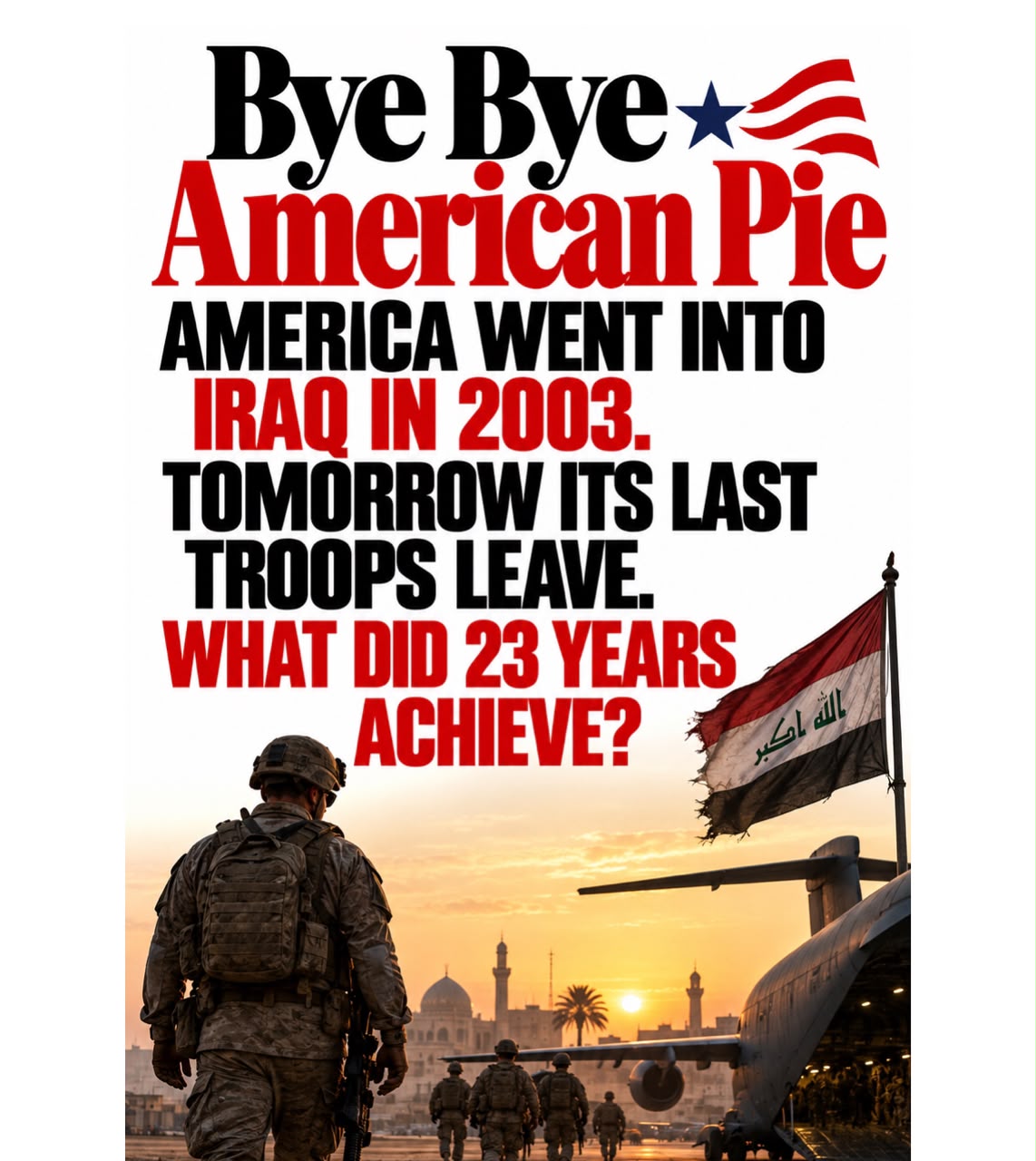
The last American forces are scheduled to leave Iraq tomorrow, September 30, closing a military presence that began with the invasion that overthrew Saddam Hussein. America is leaving. The argument over what it accomplished is going nowhere.
Twenty-three years is long enough for a child born when American tanks entered Baghdad to have grown into an adult with no personal memory of Iraq before the invasion.
Tomorrow, the last American troops are scheduled to leave.
Submit Your Press Release
Get your company news, announcements, launches, appointments and events in front of a wider audience.


The withdrawal completes an agreement reached between Washington and Baghdad in 2024 to end the US-led coalition’s military mission in Iraq. Most American forces had already departed from bases elsewhere in the country, leaving the final contingent principally in the Kurdish north.
It closes one of the most consequential chapters in modern Middle Eastern history.
The United States invaded Iraq in March 2003 with Britain and other coalition partners. Saddam Hussein’s government collapsed with extraordinary speed. The war that followed did not.
The central justification advanced for the invasion was Iraq’s alleged possession of weapons of mass destruction. The stockpiles that featured so prominently in the case for war were never found.
What was found was a country whose political order had been shattered.
Saddam was captured, tried by an Iraqi court and executed. A new political system emerged, elections were held and Iraq developed institutions very different from the dictatorship Washington had removed.
But the price was enormous.
About 4,500 American military personnel died during more than two decades of US involvement. Iraqi losses were vastly greater, although estimates vary substantially depending upon whether they count only directly documented violent deaths or attempt to measure the broader human consequences of war.
Then came another consequence that Washington certainly had not advertised in 2003.
Iran became more influential.
Saddam Hussein’s Iraq had been one of Iran’s principal regional enemies. Removing his regime dismantled a major counterweight to Tehran, while Iraq’s post-invasion political order empowered Shia political movements, some with longstanding relationships with Iran.
Iran-backed armed groups subsequently became deeply embedded within Iraq’s political and security landscape. Tehran and its allies now regard the final American departure as a strategic victory.
There was another American departure before this one.
US forces formally ended their earlier combat mission and withdrew in 2011. Three years later, Islamic State swept across enormous areas of Iraq and Syria, capturing Mosul and declaring a caliphate.
America returned.
Operation Inherent Resolve began in 2014, with US and coalition forces supporting Iraqi forces against ISIS. The territorial caliphate was eventually destroyed, but Islamic State did not disappear completely.
That is one of the questions hanging over tomorrow’s withdrawal.
Iraqi security forces are considerably stronger than they were when ISIS captured Mosul in 2014. Baghdad insists that it can secure the country and says the relationship with the international coalition will now move towards a different form of bilateral cooperation.
But the departure of American forces coincides with another unresolved issue: armed groups operating outside the ordinary structures of the State.
The Iraqi Government has linked the American withdrawal to demands that non-state militias disarm. Several have shown little enthusiasm for doing so.
So tomorrow will produce two very different pictures depending upon where one stands.
For many Iraqis, the departure of foreign troops is an assertion of sovereignty after more than two decades of foreign military presence. For Iran and its allies, it represents the removal of their principal military rival from Iraqi soil.
For Washington, it ends a commitment that consumed lives, money and political capital across four American presidencies after George W. Bush launched the invasion.
And for historians, the argument is only beginning.
America removed Saddam Hussein. Iraq has elections. ISIS lost the territory it once controlled. Those are facts.
So are the failed weapons claims, the sectarian violence that followed the invasion, the rise of ISIS, thousands of American deaths, enormous Iraqi suffering and the remarkable expansion of Iranian influence.
Tomorrow the soldiers can leave. The consequences cannot.