
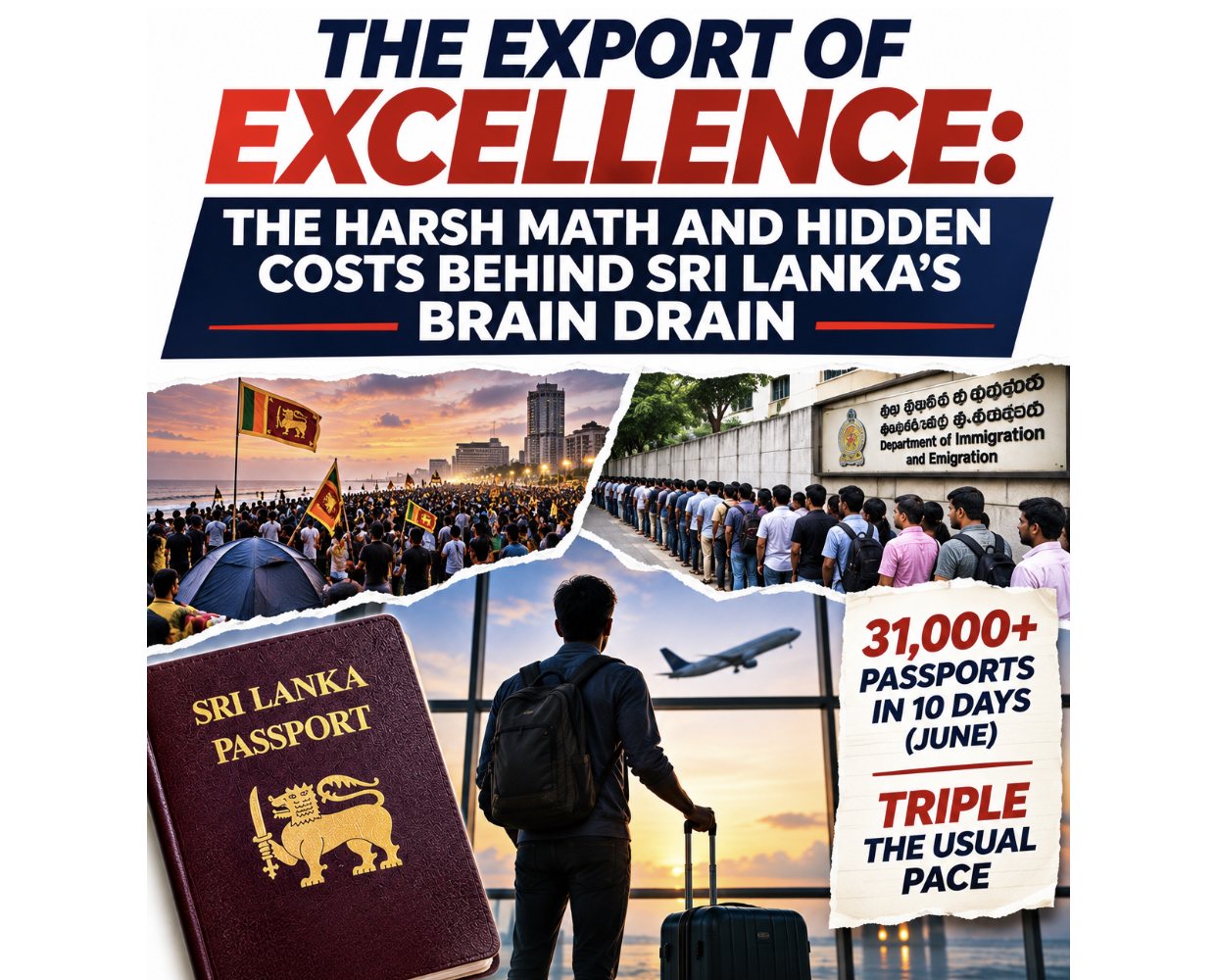
If you cast your mind back to the summer of 2022, two distinct queues defined the national psyche. The first gathered by the sea at Galle Face where thousands camped out to demand a change of government, eventually sending national leadership fleeing into exile. The second snake wrapped for over a kilometer around the Department of Immigration in Battaramulla where citizens stood for days in the searing heat not to alter the political landscape but to escape it entirely. In the first ten days of June alone, authorities issued more than 31,000 passports at triple the usual pace, driven by a shared conviction that local prospects had reached a permanent dead end.
What began as an emergency exodus during the height of the economic collapse has since evolved into a quiet, enduring structural reality. Between 2020 and 2025, roughly 1.4 million departures for foreign employment took place across a population of just under 22 million. Every family in the country now shares the same dinner table conversation about cousins in Dubai, aunts in London, or graduates packing their bags for Australia. Yet this mass movement represents far more than personal career pivots. It has turned human capital into Sri Lanka’s largest and most reliable export commodity.
By 2025, overseas remittances surged to a record 8.1 billion dollars through official banking channels. To put that figure in perspective, our premier apparel export sector generated about 5 billion dollars while tourism brought in roughly 3.2 billion during its peak arrival year. Citizens laboring abroad pumped almost as much foreign exchange into the national treasury as apparel and tourism combined. For a debt-ridden island struggling to stabilize its foreign reserves, remittances became the invisible cushion preventing total fiscal collapse.
Submit Your Press Release
Get your company news, announcements, launches, appointments and events in front of a wider audience.


This reliance on human exports is not an accidental byproduct of globalization. It is officially codified in state policy. The 1985 legislation that established the Sri Lanka Bureau of Foreign Employment explicitly lists promoting and developing employment opportunities outside the country as one of its primary statutory goals. For decades, successive administrations viewed labor migration as a convenient pressure valve for domestic unemployment.
However, the nature of this migration has shifted dramatically. While blue-collar workers in the Middle East have long powered the remittance economy under strict sponsorship rules, the contemporary wave has hollowed out our professional and technical ranks.
The math behind this professional drain reveals a profound and unsustainable paradox, particularly when examining the healthcare sector. A young doctor working in a regional hospital in Sri Lanka might earn roughly 400 pounds sterling equivalent a month, while an equivalent practitioner in the United Kingdom commands upwards of 3,000 pounds. At the same time, domestic inflation has pushed local living costs to punishing heights, effectively erasing any traditional financial buffer of staying home. Researchers from our premier universities calculate that training a single medical specialist from undergraduate admission through post-graduate qualification costs taxpayers approximately 13.3 million rupees. Funded by free education policies established in 1945, this taxpayer-backed training effectively functions as one of the most generous scholarship programs in the world, with one critical flaw. When that specialist boards a flight to Manchester or Belfast, the destination country acquires a fully formed medical expert without contributing a single rupee toward their foundational education.
The domestic fallout from this professional hemorrhage is neither abstract nor distant. When two anesthetists packed their bags and left Embilipitiya, emergency surgeries ground to a complete halt for weeks. When all three pediatricians at the Anuradhapura Teaching Hospital migrated within a short window, children’s wards had to temporarily shut down. Treating public health as a bottomless reservoir of free talent relies entirely on the professional goodwill of doctors and nurses who eventually reach a breaking point when compensation fails to match basic economic survival. Surveys conducted at teaching hospitals in Jaffna confirm that early-career clinicians planning to leave cite economic instability, political interference, and institutional corruption far more frequently than low pay alone.
State policy toward this exodus has resembled a rudderless ship caught in a storm. Over the span of a single year, government directives shifted wildly from encouraging departures to panicking over domestic shortages. Authorities introduced five-year unpaid leave schemes for public servants to work abroad on the condition they remitted funds home, only to abruptly cancel those programs in late 2025 when municipal departments realized key senior personnel had vanished. Cabinets tinkered with retirement ages for medical professionals, batted around contradictory circulars, and treated professional migration as an administrative toggle switch rather than a systemic crisis.
Compounding this policy confusion is the state’s uneasy relationship with its diaspora. While politicians happily pocket remittance dollars, overseas citizens have historically faced bureaucratic hurdles, shifting voting rights, and structural disenfranchisement that prevent them from participating meaningfully in civic life. Roughly 1.5 million Sri Lankans working abroad were unable to cast a ballot in recent national elections because no legal mechanism permitted remote voting from their host countries. Treating the diaspora as an invisible ATM rather than an integral part of the national community breeds deep resentment.
While raw labor migration remains a fixture of our economy, high-value brain drain poses an existential threat to local innovation. Entrepreneurs attempting to build technology firms in Colombo face an uphill battle against severe infrastructure deficits, unreliable energy costs, and a massive funding chasm. While early-stage angel investors occasionally write modest seed checks, scaling capital is virtually nonexistent locally.
Consider the trajectory of WSO2, co-founded by Sanjeewa Wickramanayake in Colombo with initial funding from angel investors. For years, investors pressured him to move headquarters to the United States. He resisted, keeping eighty percent of his engineering team in Sri Lanka. In 2024, an international private equity firm acquired the company in a deal valued at approximately 600 million dollars, delivering massive returns to early backers. Yet that monumental success story highlights a glaring structural weakness. The ultimate valuation check came from foreign private equity rather than domestic capital markets. Ambitious founders today find themselves forced to build their enterprises abroad because local financial ecosystems cannot support high-growth ambitions.
Economists studying this phenomenon often apply Albert Hirschman’s classic framework of exit, voice, and loyalty. When citizens feel deeply dissatisfied with economic management and institutional decay, they can either stay and fight for reform through political voice or vote with their feet and exit the system entirely. In Sri Lanka, the sheer volume of departures demonstrates that exit has become the default rational choice for ambitious youth.
Yet history shows that exit and voice are not always mutually exclusive. In late 1989 East Germany, tens of thousands fled across the border while those who stayed filled the streets in massive protests that ultimately dismantled the regime. In Sri Lanka, the 2022 protests at Galle Face unfolded alongside the endless queues at Battaramulla.
Fixing this dynamic requires moving beyond empty ministerial appeals asking professionals to return out of pure patriotism while offering the exact same broken salary scales and stagnant working conditions that drove them away in the first place. A country cannot tax its way to prosperity while exporting the very minds needed to build it. Until the state treats its human capital as its most valuable asset rather than a disposable commodity, the queue at the immigration office will remain the truest barometer of our national future.



