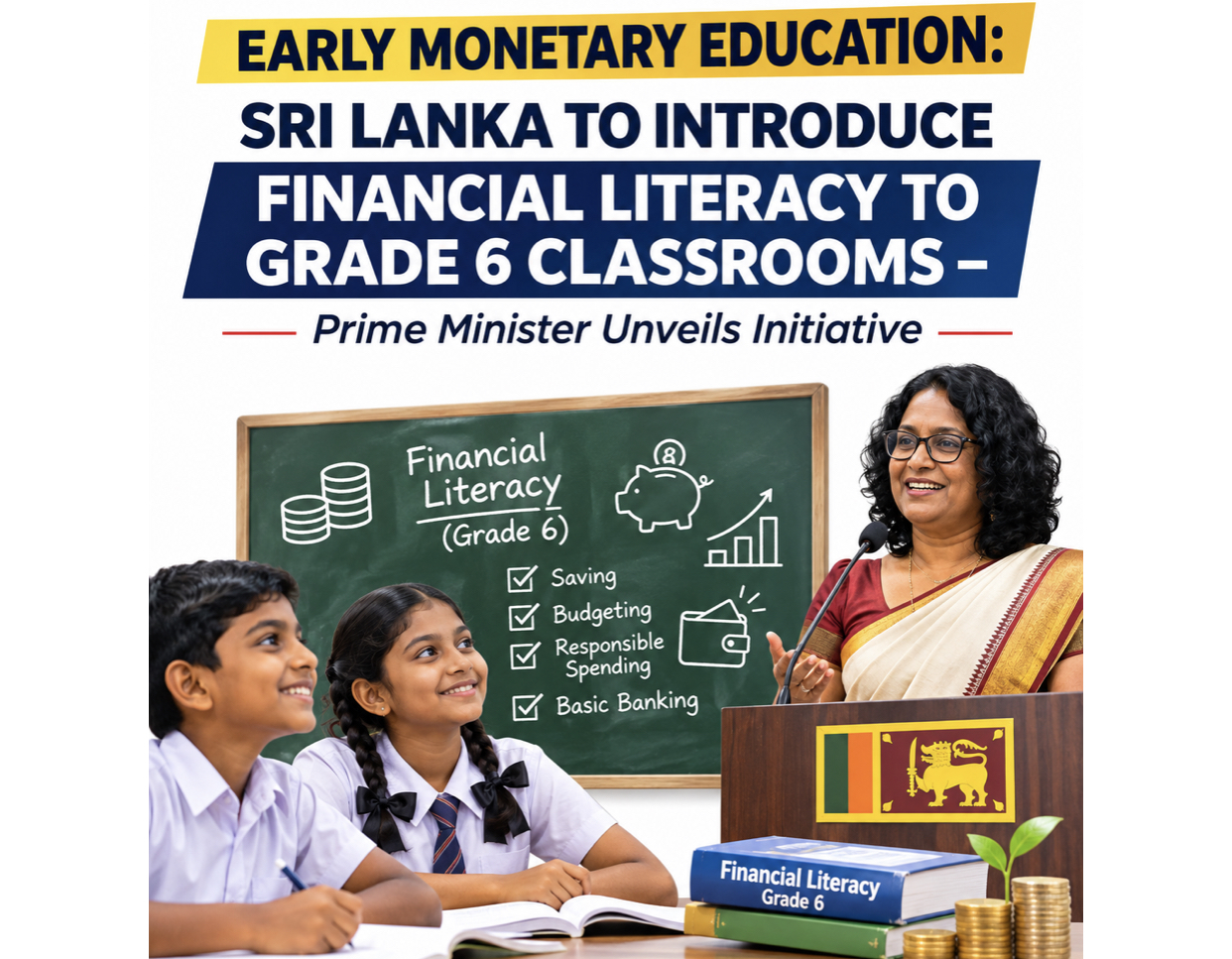
In an educational landscape long dominated by rote learning and exam-heavy academic tracks, the government has announced a major curriculum shift aimed at turning basic financial awareness into an essential life skill. Starting in 2027, entrepreneurship and financial literacy will become mandatory components of the Grade 6 syllabus across all state schools.
Prime Minister and Minister of Education Dr. Harini Amarasuriya unveiled the initiative at Isurupaya during an awards ceremony recognizing national commerce quiz winners. The policy marks a clear departure from traditional educational structures, where commerce and economic principles remained strictly confined to senior secondary Ordinary Level and Advanced Level streams. By bringing foundational monetary concepts down to the lower secondary level, the ministry seeks to equip students with practical skills in budgeting, ethical business management, and digital financial safety long before they enter the workforce.
The broader educational framework includes establishing 100 activity-based commerce learning centers nationwide between 2026 and 2028. The initial phase deploys 25 specialized centers across all 25 districts to replace purely theoretical lectures with interactive financial simulations and enterprise modules. Official guidance stresses that the goal is not to turn every child into a corporate executive, but to foster economic participation rooted in environmental sustainability, social accountability, and consumer awareness.
Submit Your Press Release
Get your company news, announcements, launches, appointments and events in front of a wider audience.


Integrating early financial education aligns Sri Lanka with international benchmarks that have yielded measurable social and economic returns. Countries like Singapore and Finland embedded financial literacy and practical problem-solving into middle-school curricula years ago, linking early exposure directly to higher national savings rates, reduced personal debt loads, and greater resilience against modern financial scams. In emerging economies across East Asia, early exposure to micro-enterprise concepts helped demystify commercial banking systems, allowing young adults to navigate formal credit channels rather than falling victim to unregulated predatory lenders.
For Sri Lanka, where rapid digitalization has coincided with a troubling rise in online banking fraud, unregulated pyramid schemes, and youth debt traps, teaching monetary literacy early is a crucial defensive measure. Understanding risk evaluation, compounding interest, and contractual obligations in the classroom gives the next generation the tools needed to identify fraudulent financial schemes before losing their savings.
Beyond individual consumer protection, the policy addresses a deep structural bottleneck in Sri Lanka’s domestic economy. For decades, the national education system produced millions of humanities and white-collar job seekers while suffering acute shortages of skilled trade operators, creative entrepreneurs, and independent business founders. Teaching twelve-year-olds how capital flows, how markets function, and how small businesses generate value helps dismantle the cultural stigma surrounding vocational enterprise.
If properly executed with updated teacher training and modern learning tools, embedding financial literacy into the secondary school baseline could fundamentally reshape the country’s economic culture. Shifting youth mindsets from passive state employment reliance toward self-directed enterprise may prove to be one of the most consequential long-term investments in national resilience.