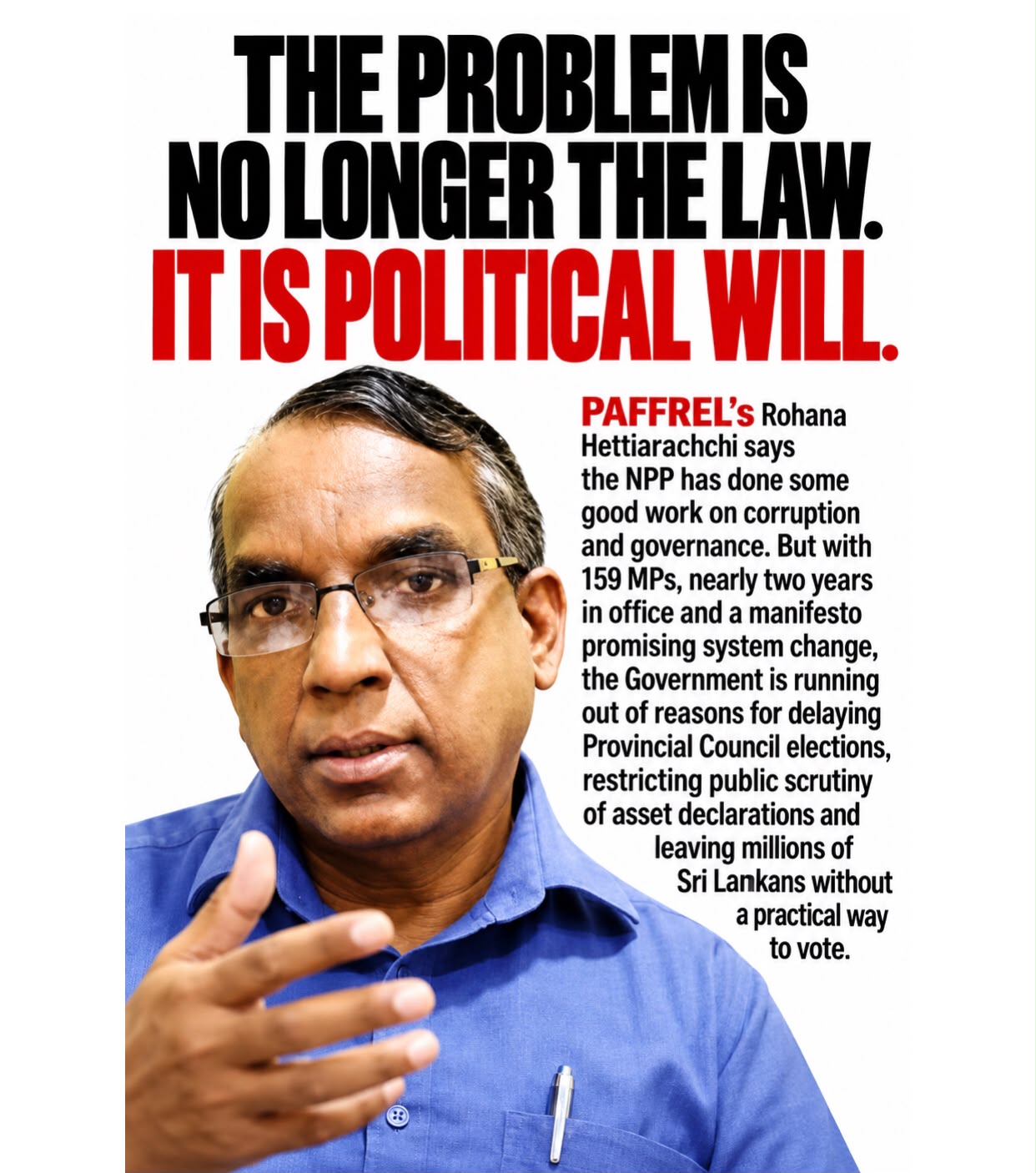
PAFFREL’s Rohana Hettiarachchi says the NPP has done some good work on corruption and governance. But with 159 MPs, nearly two years in office and a manifesto promising system change, the Government is running out of reasons for delaying Provincial Council elections, restricting public scrutiny of asset declarations and leaving millions of Sri Lankans without a practical way to vote.
Sri Lanka voted for change. First Anura Kumara Dissanayake won the presidency and then the NPP was handed 159 seats in Parliament. It was an extraordinary mandate, built not simply on replacing one collection of politicians with another, but on changing the system itself.
Nearly two years later, the question is becoming unavoidable. How much of the system has actually changed?
Submit Your Press Release
Get your company news, announcements, launches, appointments and events in front of a wider audience.


PAFFREL Executive Director Rohana Hettiarachchi, speaking to Faraz Shauketaly on Newsline: The Turning Point, says his organisation and the March 12 Movement are now doing something rather important. They are tracking what the NPP promised against what the Government actually delivers.
That distinction matters.
Governments are very good at promises. They are also very good at committees, Cabinet papers, consultations and announcements. Delivery is rather more difficult.
One area where Hettiarachchi sees little excuse for further delay is Provincial Council elections.
The NPP manifesto, he says, promised Local Government and Provincial Council elections within its first year. Local Government elections have been held. Provincial Council elections have not.
The familiar explanation is that the electoral system remains tangled in legislation and delimitation. Hettiarachchi does not accept that this remains an insurmountable obstacle.
PAFFREL brought together representatives of 44 political parties around two months ago. According to Hettiarachchi, every party agreed that the immediate Provincial Council election could be conducted by reverting to the previous electoral system.
There was one important complication. The newer system provided for a 25 percent quota for women while the old system did not. Hettiarachchi says the parties agreed voluntarily to maintain 25 percent female representation among candidates.
If that account is correct, something rather important has happened. The technical argument is disappearing.
“My reading is that the Government simply lacks the political will,” Hettiarachchi said.
That deserves attention because elections are not supposed to be held when governments believe the timing is convenient.
Hettiarachchi suspects the Government would prefer to show greater progress on the ground before facing another election. Previous governments have done much the same thing, waiting for public frustration to subside or political conditions to improve.
The NPP, however, came to power promising to behave differently. Then there is corruption.
This is perhaps the more serious test because the battle against corruption was not a footnote in the NPP campaign. It was one of the principal reasons people voted for it.
Hettiarachchi says the Government is doing many good things in this area. But he is deeply concerned about provisions in the proposed changes to the anti-corruption framework, particularly those affecting what citizens can do with information contained in asset declarations.
At present, he says, publicly available information can be accessed, analysed and published.
That matters.
If a politician enters public life with one level of wealth and several years later possesses substantially more, citizens and journalists ought to be able to ask a perfectly reasonable question.
Where did the money come from? In a twist from the NDB Bank fraud, this time, the money wasn’t there until it was!
Hettiarachchi says the proposed framework would still permit information to be accessed and possible wrongdoing to be reported to the Bribery Commission or pursued legally. The problem is what happens in between. His concern is that the public’s ability to analyse that information and bring those findings into public discussion would be restricted.
PAFFREL has challenged the proposed legislation and appealed to President Dissanayake to reconsider it.
There is an entirely legitimate argument on the other side. Asset declarations should not become weapons with which politicians and public officials are maliciously smeared using distorted or deliberately misinterpreted information.
Hettiarachchi accepts that.
Punish deliberate abuse if necessary. But that is not the same thing as restricting legitimate scrutiny.
After all, what is the point of declaring assets if the public is prevented from asking meaningful questions about them?
PAFFREL is also concerned about concentrating substantial authority in the Director-General of CIABOC rather than the Commission collectively.
Hettiarachchi’s argument is not about whether the present Director-General is good or bad. It is about something Sri Lanka has repeatedly failed to understand when designing institutions.
Never write a law on the assumption that a good person will always occupy the chair.
A powerful office may function perfectly well when occupied by someone independent, competent and restrained. The problem begins when someone politically compromised or less restrained inherits exactly the same powers.
Hettiarachchi therefore argues that authority should rest with the Commission rather than becoming excessively concentrated in one individual.
Checks and balances are not designed because we distrust everyone. They exist because eventually someone will come along whom we should have distrusted.
There is another democratic deficit that receives considerably less attention.
Hettiarachchi estimates that around one million people within Sri Lanka can effectively lose their opportunity to vote because they cannot physically reach their designated polling station on election day. They include some journalists working away from their polling areas, election observers, medical personnel, private security employees and remand prisoners.
Sri Lanka has postal voting, but not for everybody who happens to be working on election day. It is principally available to eligible public officials performing election-related duties.
There is no general advance-voting mechanism and no convenient alternative polling arrangement for many of these people.
Then there are Sri Lankans overseas. Hettiarachchi puts that population at roughly 2.5 million. Successive governments have promised to find a mechanism through which overseas Sri Lankans can vote. The problem is considerably more complicated than simply putting a ballot box inside an embassy. Hundreds of thousands of Sri Lankans can be working in a single Middle Eastern country, some enormous distances from the embassy.
But difficulty is not an argument for doing nothing.
The present Government has appointed a committee to examine international systems and possible alternatives. That is welcome. Eventually, however, another committee must produce something more useful than another report.
These people send billions of dollars home. They support families, strengthen Sri Lanka’s foreign-exchange position and remain Sri Lankan citizens.
Surely citizenship should mean something on election day too.
Hettiarachchi believes President Dissanayake remains personally popular and estimates his support at around 60 percent, although he makes clear that this is an assessment rather than the result of formal polling. He also believes the Opposition remains divided and weak.
He describes many NPP politicians positively and gives the Government credit for aspects of its work on corruption and governance. But there is a gap between being clean and delivering change.
The NPP made enormous promises. A new Constitution. Reform of the Executive Presidency. Lower household burdens. Electoral reform. Provincial Council elections. A different political culture.
People may be willing to wait. After everything Sri Lanka has endured, many clearly are.
They will not wait forever. Hettiarachchi put the danger in remarkably ordinary terms.
The kitchen.
Electricity bills remain painful. Household expenses remain difficult. Families do not experience economic policy through spreadsheets, GDP projections or ten-year plans. They experience it when they open the refrigerator, pay the electricity bill and decide what they can afford for dinner.
“If a government fails to feel the heartbeat of the public, they will run into serious trouble,” he warned.
That is probably the most important political observation of all.
AKD has something most Sri Lankan leaders who promised reform would have loved to possess. He has the presidency. He has 159 MPs. He has a mandate for change.
He inherited an electorate willing to tolerate difficult decisions because it believed something fundamentally different was being attempted.
The Government therefore has political capital.
The danger is believing political capital cannot run out.
On Provincial Council elections, PAFFREL says the remaining obstacle is political will. On electoral reform, millions of Sri Lankans remain effectively excluded from voting. On overseas voting, another generation of migrant workers is waiting. On anti-corruption legislation, PAFFREL is asking why a Government elected on transparency should contemplate restricting legitimate public scrutiny of asset declarations.
These are not attacks on system change. They are tests of it. Sri Lanka did not give the NPP 159 seats merely to explain why things cannot be done.
It gave them 159 seats because voters believed they could be.
Be that as it may.