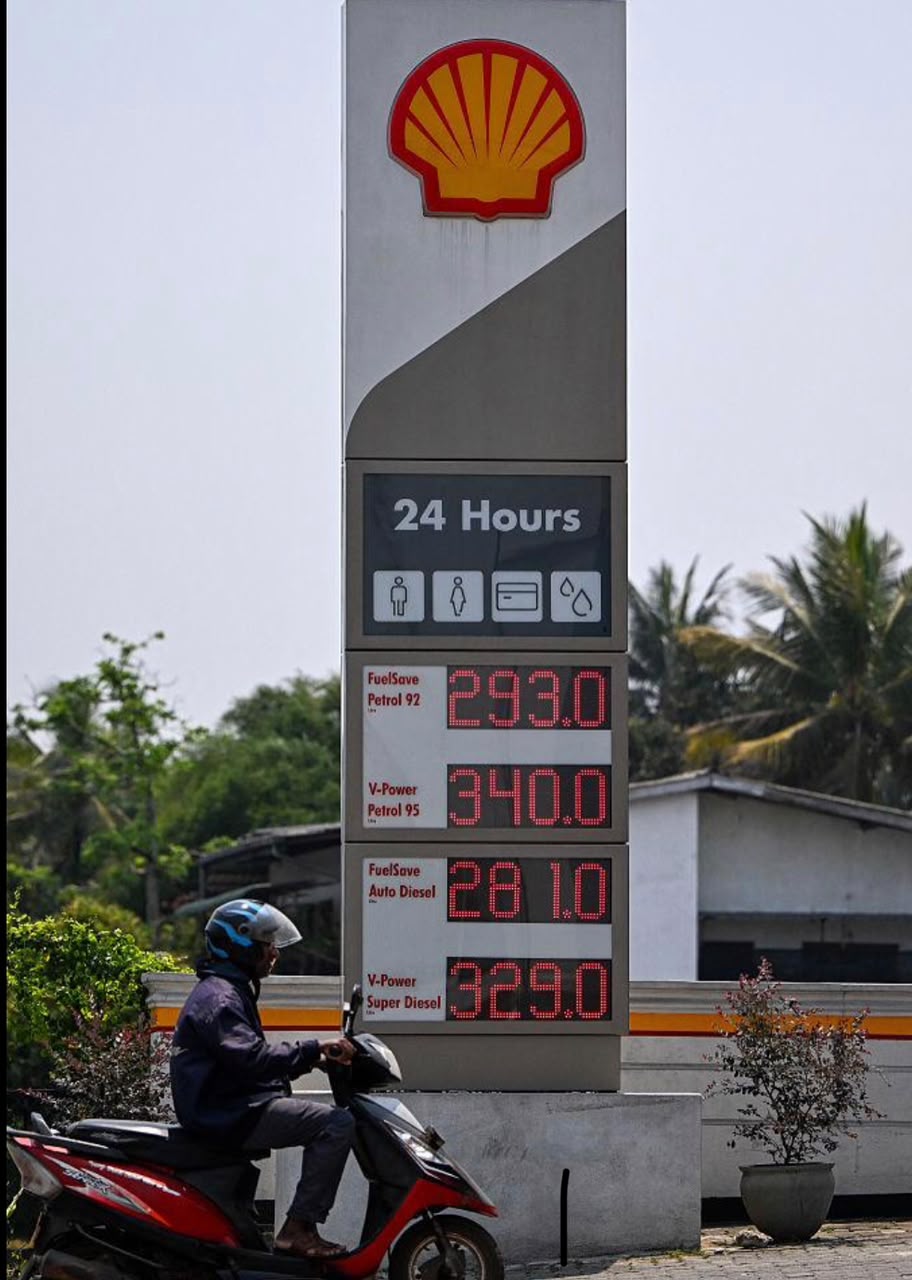
Sri Lanka has spent years trying to ensure that fuel prices reflect their real cost rather than becoming another political subsidy. The IMF wants that discipline maintained. That sounds perfectly reasonable until international oil prices move sharply upwards and the real cost arrives at the petrol pump, the bus fare and eventually almost everywhere else.
Sri Lanka knows rather more about expensive fuel than it would probably like to remember. The queues of 2022 may have disappeared, but the underlying vulnerability that helped create them has not. This remains a country heavily dependent upon imported energy and therefore exposed to events over which neither the President, the Treasury nor the Ceylon Petroleum Corporation has much control.
That vulnerability matters again as uncertainty in the Middle East places renewed attention on international oil prices and the security of supply routes. For Sri Lanka, an increase in the world price of crude is not something happening thousands of kilometres away. It eventually becomes a domestic economic event.
Submit Your Press Release
Get your company news, announcements, launches, appointments and events in front of a wider audience.


The IMF’s position is straightforward. Energy pricing should remain cost-reflective and fuel prices should respond to movements in international markets. The logic is equally straightforward. If the Government sells fuel below its true cost, somebody eventually has to pay the difference, usually the Treasury, a state enterprise or the taxpayer.
Sri Lanka has already discovered where that road can lead. Artificially cheap energy may be politically attractive, but accumulated losses do not disappear simply because they are hidden from the consumer. They eventually appear as debt, taxation, money creation or another demand upon public finances.
The difficulty is what happens at the other end of the argument.
Allow every external price increase to flow rapidly through the domestic pricing formula and the burden moves directly towards households and businesses. Petrol and diesel become more expensive, transport costs rise, distribution becomes more costly and the price effect works its way through the economy.
A fuel price is therefore never merely a fuel price.
The Government’s problem is particularly interesting because the NPP came to office promising economic relief as well as fiscal reform. It must now reconcile the political expectations of voters with an IMF programme built around cost recovery, revenue discipline and the avoidance of broad subsidies.
There is no particularly painless answer.
The Government could absorb part of a major external shock, but that costs money and raises the question of where that money comes from. It could allow the pricing formula to operate without interference, protecting public finances but exposing consumers to the full increase. Or it could provide targeted assistance to those most affected, which is broadly consistent with the IMF approach but depends upon Sri Lanka having an effective mechanism for identifying and reaching the people who genuinely need help.
That last point deserves attention. A subsidy applied to every litre of fuel benefits the wealthy owner of a large vehicle as well as the struggling worker travelling to work. Targeted relief makes greater economic sense, but only if the targeting actually works.
There is also the question of public transport. If diesel rises substantially, bus operators will inevitably argue that fares must follow. Goods transported by road become more expensive and businesses facing higher electricity, transport and input costs will attempt to pass those increases to consumers.
That is how an international oil shock can eventually arrive at a Sri Lankan kitchen table.
The Government cannot control the price of crude oil or events in the Middle East. What it can control is whether Sri Lanka has a clearly explained policy for dealing with the consequences.
That policy should be understood before the next shock arrives, not invented after it.
Be that as it may, cost-reflective pricing is easy to defend when prices are falling. The real test begins when the market decides to send them the other way.