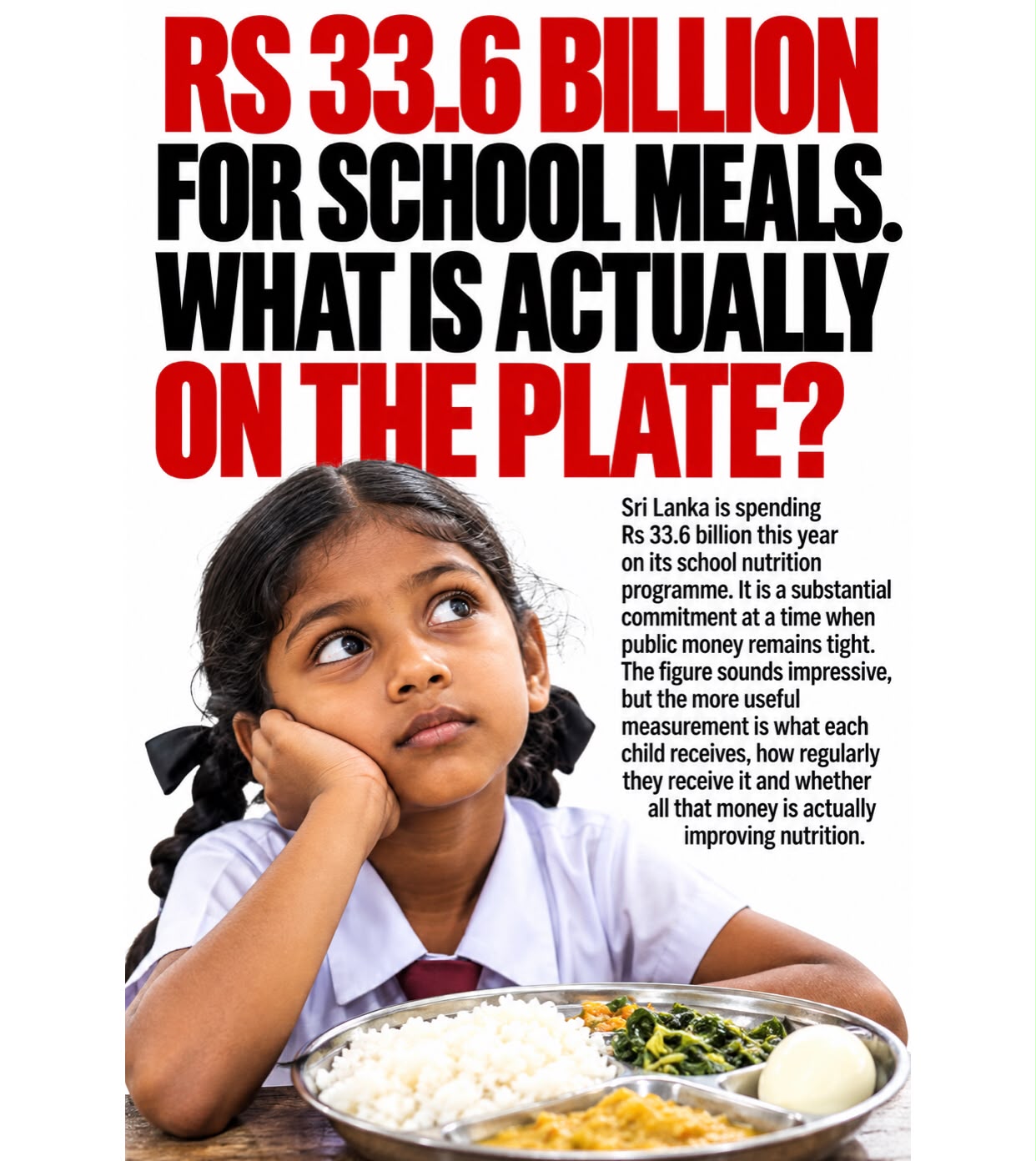
Sri Lanka is spending Rs 33.6 billion this year on its school nutrition programme. It is a substantial commitment at a time when public money remains tight. The figure sounds impressive, but the more useful measurement is what each child receives, how regularly they receive it and whether all that money is actually improving nutrition.
Sri Lanka’s school nutrition programme is one of those government expenditures with which it is difficult to quarrel. Feed a child properly and there is a reasonable chance that child will concentrate better, attend school more regularly and learn more effectively. For families struggling with the cost of living, a dependable meal at school can also remove one small but important pressure from the household budget.
The Government has allocated Rs 33.6 billion for the programme in 2026. That is serious money, particularly for a country still operating within tight fiscal constraints and being repeatedly reminded that every rupee of public expenditure must be justified.
Submit Your Press Release
Get your company news, announcements, launches, appointments and events in front of a wider audience.


The question, therefore, should not be whether Sri Lanka ought to feed schoolchildren. It should. The question is whether Rs 33.6 billion is buying the nutritional outcome taxpayers and children have been promised.
That requires looking beyond the size of the allocation. How many children are receiving meals under the programme, how many school days are actually covered and what does the expenditure amount to per child per day? More importantly, what can that amount realistically purchase at today’s prices?
Rice, vegetables, eggs, fish, dhal, fruit and other basic foods have all been affected by the movement of prices over recent years. A nutritional programme designed several years ago cannot simply continue on the assumption that the purchasing power of the allocation remains unchanged. If the cost of providing a genuinely nutritious meal rises while the amount available for each child fails to keep pace, something eventually has to give.
There is also the question of what reaches the plate. A national allocation of Rs 33.6 billion tells us very little about the meal eaten by a child in Monaragala, Mullaitivu, Hambantota or Colombo. The quality, quantity and nutritional value of that meal are the measurements that matter.
Sri Lanka should therefore be able to answer some fairly straightforward questions. What nutritional standards are prescribed for each meal? How often are schools inspected for compliance? Who purchases the food, who selects the suppliers and how are prices checked? How much of the total allocation pays directly for food and how much is absorbed elsewhere in administering and delivering the programme?
None of these questions implies that the programme is failing. They are precisely the questions that should be asked when Rs 33.6 billion of public money is being spent on something as important as the health and development of children.
There is another measurement that matters even more. If Sri Lanka spends tens of billions of rupees feeding schoolchildren every year, there should eventually be evidence showing whether childhood nutrition is improving. Attendance, weight, growth, anaemia and other appropriate indicators can tell policymakers whether the programme is achieving what the expenditure is intended to achieve.
Otherwise there is a danger that success becomes measured by the amount allocated rather than the result produced.
Governments understandably like large numbers. Rs 33.6 billion sounds substantial in a Budget speech, a press release or a political argument about commitment to education. For the child sitting down to eat at school, however, the national allocation means very little.
What matters is what is on the plate.
Sri Lanka has made the decision to spend heavily on feeding its schoolchildren, and that is a policy worth supporting. It should now be equally determined to establish whether every rupee is delivering the nutrition those children deserve.
Be that as it may, Rs 33.6 billion is the cost. A healthier generation should be the return.