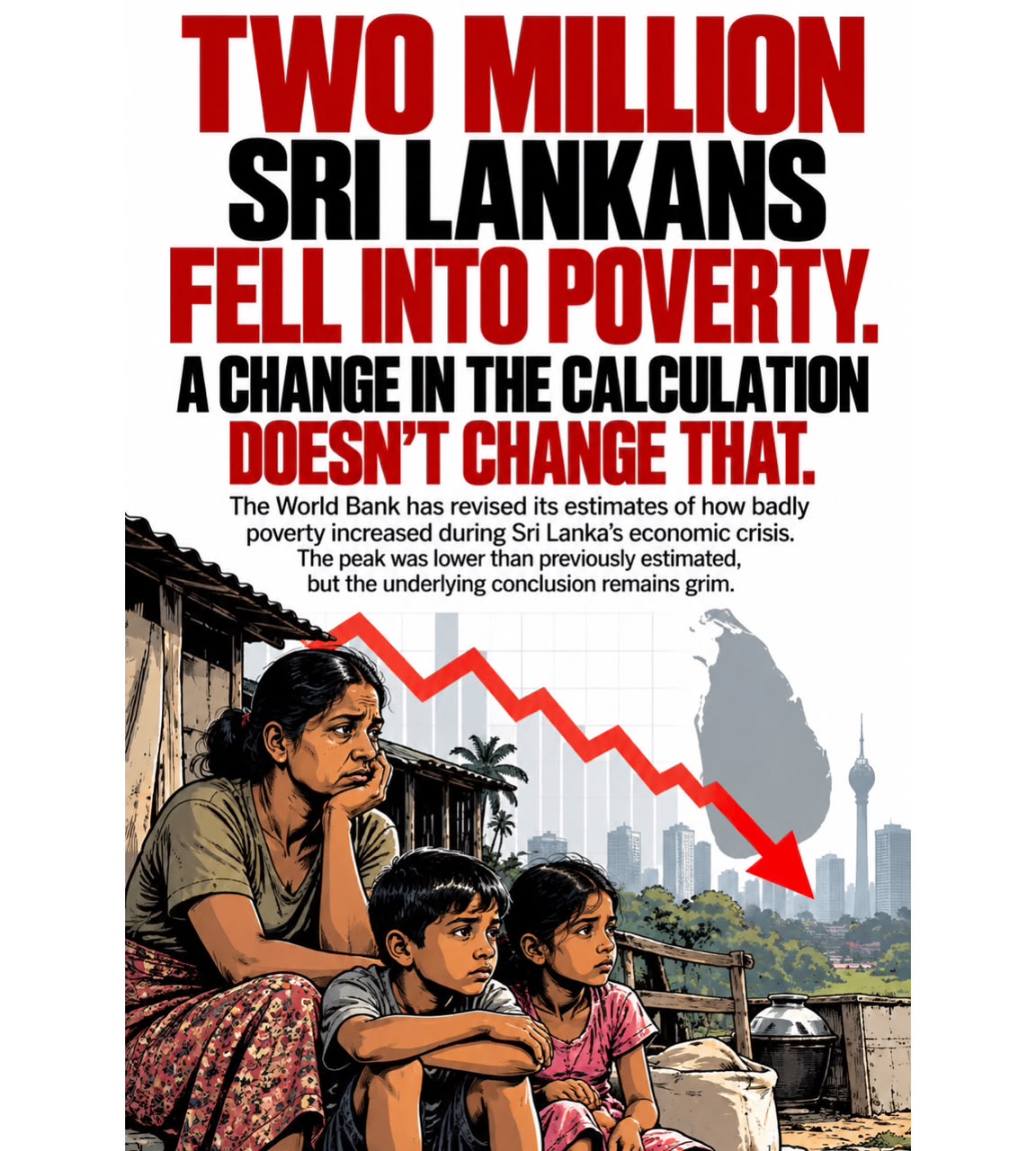
The World Bank has revised its estimates of how badly poverty increased during Sri Lanka’s economic crisis. The peak was lower than previously estimated, but the underlying conclusion remains grim. About two million people were pushed below the poverty line and the country is still years away from returning to its pre-crisis position.
Statistics can occasionally create the impression that reality has changed when only the method of measuring it has.
Sri Lanka has just received a useful example.
Submit Your Press Release
Get your company news, announcements, launches, appointments and events in front of a wider audience.


The World Bank has revised its poverty estimates for the years surrounding the economic crisis after adopting more detailed household-level information from the Labour Force Survey.
Under the revised methodology, poverty is estimated to have risen from 11.5 percent in 2019 to a peak of 20.7 percent in 2023.
The previous estimate for 2023 had been considerably higher at 27.6 percent.
At first sight that appears to be very good news. Poverty at the worst point of the crisis was almost seven percentage points lower than previously believed.
Except that nobody suddenly became richer because an economist changed the methodology.
The World Bank itself makes that distinction clear. The revision does not mean poverty suddenly disappeared. It means the institution believes it can now measure what happened more accurately.
And what happened remains serious.
Poverty approximately doubled during the crisis and an estimated two million people were pushed below the World Bank poverty line between 2019 and the 2023 peak.
The revised estimate places poverty at 18.4 percent in 2024 and 16.9 percent in 2025. It is projected to fall to 15.8 percent this year, 14.8 percent in 2027 and 14 percent in 2028.
Even then Sri Lanka would remain above its 2019 level.
There is another caution required here. These are World Bank estimates and projections rather than Sri Lanka’s official poverty statistics. The country’s official benchmark remains the Household Income and Expenditure Survey conducted by the Department of Census and Statistics.
New data will therefore matter.
But the broad direction is already difficult to dispute.
Sri Lanka suffered an economic crisis that did considerably more than empty foreign reserves and force the Government into sovereign default. It damaged household finances on a scale that will take considerably longer to repair than the country’s headline economic indicators.
That should influence the way recovery is discussed.
The Government is entitled to point to growth, improved revenue, debt restructuring and restored economic stability. Those are real achievements of the country’s recovery process.
But poverty statistics provide the necessary counterweight.
An economy can stabilise before a household does.
A government balance sheet can improve while a family remains indebted. Foreign reserves can rise while somebody’s savings remain exhausted. Inflation can fall without reversing the increase in prices that occurred while inflation was high.
Sri Lanka should welcome every indication that poverty is declining.
But, be that as it may, changing the estimate of how many Sri Lankans became poor does not alter the central fact.
The crisis made approximately two million people poor who were not poor before it. The real measure of recovery will be how many of them can build their way back out.
The World Bank’s new release supports the key figures here: 4.7% first-half growth, 4.4% projected 2026 growth, 16.9% estimated 2025 poverty, and a recovery to 2018 real-output levels. The separate reconstruction finding is also current as of October 6.