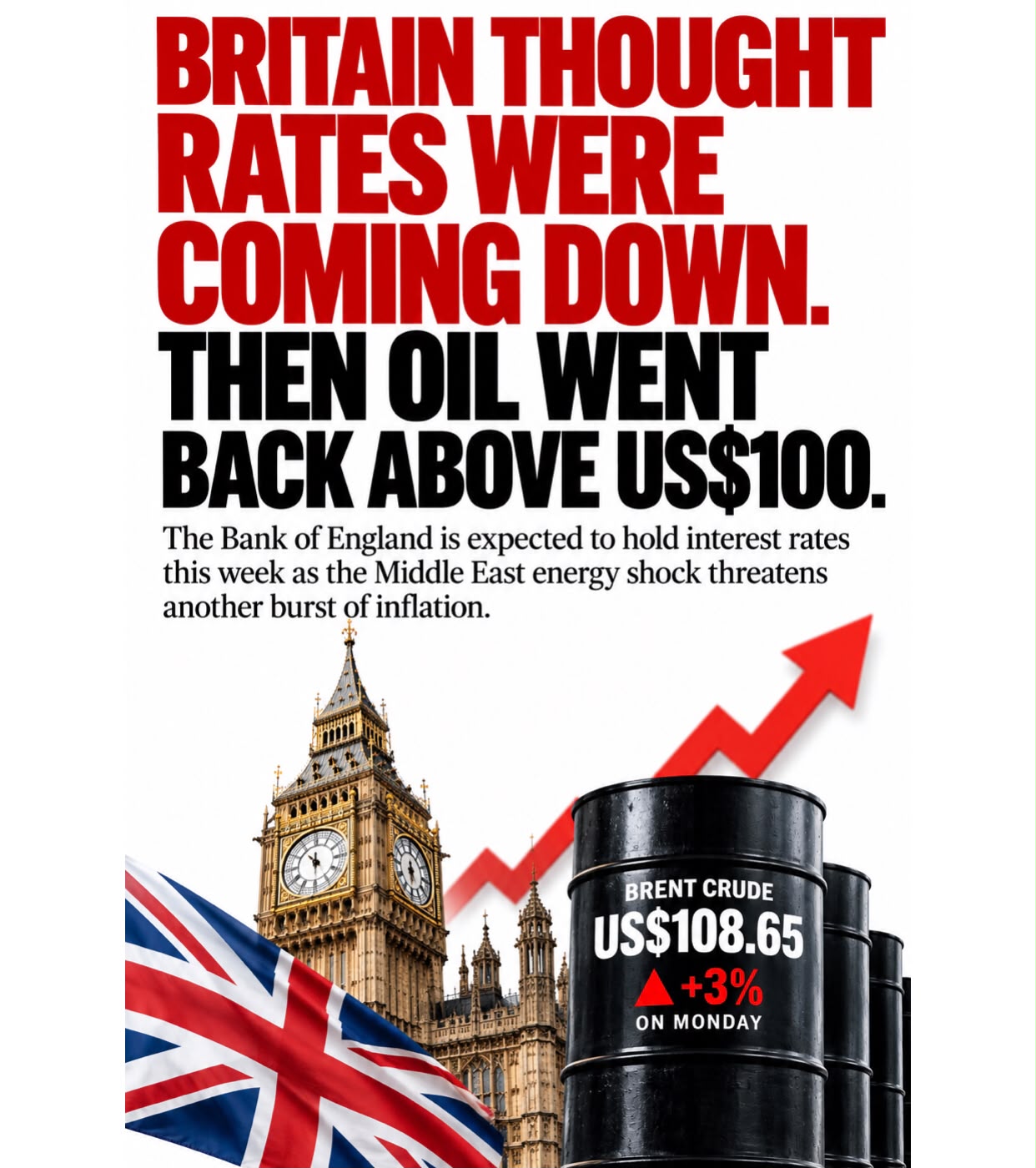
The Bank of England is expected to hold interest rates this week as the Middle East energy shock threatens another burst of inflation. British households who thought the long battle against rising prices was finally being won are discovering an old economic truth: a war thousands of miles away can arrive remarkably quickly in the monthly bills.
Britain’s battle against inflation has acquired an unwelcome new enemy.
Oil.
Submit Your Press Release
Get your company news, announcements, launches, appointments and events in front of a wider audience.


The Bank of England is expected to keep interest rates unchanged at its meeting this week as policymakers attempt to determine whether the latest surge in global energy prices will produce another sustained bout of inflation.
Until recently, the direction of travel appeared considerably more comfortable.
Inflation had been brought down from the extraordinary levels reached during the earlier cost-of-living crisis, and attention had increasingly shifted towards when monetary policy could be loosened further.
The Middle East has complicated that calculation.
Brent crude has returned to above US$100 a barrel as attacks on energy infrastructure, disruption around the Strait of Hormuz and renewed fighting in Yemen threaten global supplies. British wholesale energy costs have risen with it.
Financial markets are consequently beginning to consider something that would have appeared unlikely only months ago: whether the Bank of England might eventually have to raise rates again rather than continue reducing them.
Markets now attach a meaningful probability to another increase later this year, although economists generally expect the Bank to leave rates unchanged at the immediate meeting while it assesses whether the energy shock feeds more broadly into domestic prices.
That distinction is important.
Central banks cannot manufacture oil and they cannot reopen shipping lanes. Raising interest rates does nothing to repair a Saudi pipeline or persuade a tanker to enter Hormuz.
What monetary policy can attempt to prevent is an external price shock becoming embedded across the economy through wages, services and expectations.
The difficulty is that British households have already endured years of expensive mortgages, high rents, increased food costs and squeezed disposable incomes.
Another prolonged period of high interest rates would therefore arrive just as many families expected financial conditions finally to begin easing.
There is also a substantial problem for the British Government.
Higher interest rates increase the cost of servicing public debt, restricting the Chancellor’s room to spend or cut taxes. Rising oil and gas prices simultaneously squeeze households and businesses, creating precisely the circumstances in which political pressure for government assistance tends to increase.
Britain is therefore confronting the same uncomfortable arithmetic facing many energy-importing countries.
Government cannot control the Strait of Hormuz.
But the Strait of Hormuz may increasingly control what government can afford to do.