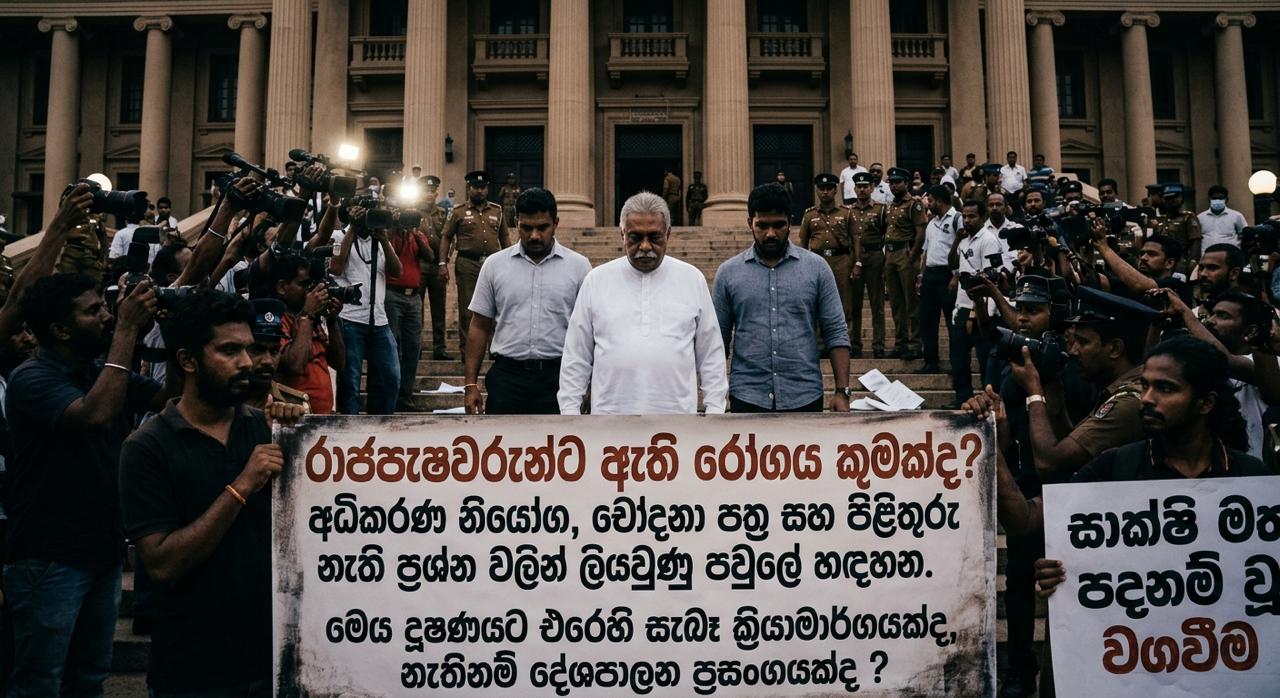
The political family that once appeared almost untouchable now faces a succession of criminal investigations, remand orders and court proceedings. Namal Rajapaksa is reported to be in remand, Yoshitha Rajapaksa faces legal proceedings, Shasheendra Rajapaksa has been indicted, Basil Rajapaksa is reportedly being sought in connection with an investigation, and former First Lady Shiranthi Rajapaksa has been granted bail. But are these developments evidence of a serious reckoning with alleged corruption, or are they part of a political spectacle whose ultimate credibility will depend on what prosecutors can actually prove?
If the Rajapaksa family consulted an astrologer this weekend, the advice might reasonably be to avoid making any important decisions until the planets have moved into considerably more favourable positions. The family’s political fortunes, once sustained by electoral victories, extensive patronage networks and an extraordinary concentration of State authority, are now being examined in magistrates’ courts, investigative offices and prosecutorial chambers. The stars, it would appear, have been replaced by case files.
For former President Mahinda Rajapaksa, the spectacle must be particularly uncomfortable. His political career was built around the projection of authority, loyalty and family unity, with relatives occupying prominent positions throughout the State. Today, several members of that same family face separate legal difficulties, raising questions not only about their individual conduct but also about the political culture that permitted such an extensive concentration of influence.
Submit Your Press Release
Get your company news, announcements, launches, appointments and events in front of a wider audience.


Namal Rajapaksa, the former President’s eldest son and a serving parliamentarian, has reportedly been remanded in connection with an ongoing investigation. He has also faced scrutiny over financial transactions and other allegations arising from earlier periods of political influence. The allegations require careful examination, but the legal distinction is equally serious: remand is not conviction, and prosecutors must establish alleged offences through admissible evidence.
Yoshitha Rajapaksa has also faced investigations and legal proceedings concerning financial matters, while Shasheendra Rajapaksa, a member of the extended family, has been indicted over allegations involving compensation claimed for damage to a political office. Basil Rajapaksa, who previously served as Finance Minister and played a central role in the family’s political organisation, is reportedly being sought in connection with an investigation. Any claim that an Interpol notice has been issued must be distinguished from a request for such assistance, and neither establishes guilt.
Then there is Shiranthi Rajapaksa, the former First Lady, whose legal difficulties concern allegations involving the Siriliya Saviya account. Having reportedly been granted bail, she has also been reported to be receiving hospital treatment. Her circumstances raise a particularly sensitive question about the relationship between criminal proceedings, medical necessity and the treatment of politically influential individuals.
There can be no reasonable objection to an accused person receiving appropriate medical care. The Constitution’s promise of equality before the law cannot mean that prominent individuals must be denied treatment simply because they are unpopular or facing criminal allegations. Equally, medical treatment must never become a convenient mechanism through which influential suspects obtain privileges unavailable to ordinary citizens in comparable circumstances.
The question is therefore not whether Shiranthi Rajapaksa is genuinely unwell, something that cannot responsibly be determined through political speculation. It is whether medical assessments are independent, whether the relevant clinical findings justify the treatment arrangements and whether equivalent standards would apply to a less prominent accused person. The same principles must govern every politically sensitive case, irrespective of the identity of the individual concerned.
Sri Lanka has a troubling history of politically influential suspects experiencing medical difficulties at moments when the criminal justice system begins to exercise its authority. That history understandably generates public suspicion, but suspicion cannot substitute for evidence. The appropriate response is not to ridicule illness or presume deception, but to insist upon transparent medical procedures, independent clinical judgment and consistent judicial oversight. The larger question concerns the origins of the allegations now surrounding members of the Rajapaksa family. Did these alleged offences arise from individual decisions, or were they facilitated by a political environment in which family relationships became intertwined with State authority, public finance and institutional appointments? If investigators can establish that public resources were improperly diverted, the consequences must extend beyond individual punishment to an examination of the systems that permitted the transactions.
The roots of this problem reach considerably further back than the Rajapaksa administration. Sri Lanka’s post-independence political history contains repeated examples of powerful families exercising disproportionate influence over public institutions. Patronage, political appointments, access to State contracts and the use of public resources to strengthen electoral organisations have been persistent features of governance under different administrations.
The executive presidency intensified many of these tendencies by concentrating enormous authority in a single political office. When the President controls significant appointments, influences public institutions and commands a parliamentary majority, the distinction between State authority and personal political influence can become dangerously blurred. The problem is not necessarily that every decision is corrupt, but that the institutional safeguards intended to detect and prevent wrongdoing may become less effective.
Political power can also produce a particular form of psychological insulation. Leaders surrounded by loyal advisers, dependent officials and enthusiastic supporters may gradually lose the ability to distinguish between legitimate authority and personal entitlement. Decisions that would appear extraordinary to an ordinary citizen can become routine within a political environment where few individuals are willing to challenge those at the top.
The Rajapaksas were not the inventors of this political culture, although the scale of their family’s participation in government made them an especially prominent example. Other political families and administrations must therefore be subjected to the same standards of scrutiny. Accountability loses its legitimacy when it becomes a selective instrument directed exclusively against those who have recently lost power.
That brings the present government into the equation. President Anura Kumara Dissanayake and the National People’s Power administration were elected on promises that included ending corruption and restoring public confidence in State institutions. Their responsibility is not merely to ensure that investigations proceed, but to protect the independence of investigators, prosecutors and courts from political interference.
A government that pursues opponents through fabricated allegations would be guilty of precisely the abuse of authority it claims to oppose. Conversely, a government that declines to investigate credible allegations because the suspects are politically influential would betray the public mandate for accountability. The distinction between these outcomes lies in evidence, due process and the independence of the judicial system.
There is also a warning for those currently occupying the highest offices. Political power is temporary, even when parliamentary arithmetic suggests otherwise. The officials who approve transactions, the ministers who exercise discretion and the advisers who recommend questionable decisions must understand that their conduct may eventually be examined by institutions operating under a different administration.
For the Rajapaksa family, the present difficulties may represent the beginning of a genuine legal reckoning, or they may eventually produce a mixture of convictions, acquittals and discontinued proceedings. The public should resist the temptation to regard every arrest as proof of corruption, just as it should reject the suggestion that politically sensitive prosecutions are automatically acts of revenge.
What matters is whether investigators can follow the money, establish the decisions taken, identify those responsible and present evidence capable of surviving judicial scrutiny. If the allegations are proved, appropriate consequences must follow. If they are not proved, the accused are entitled to the protection of the law and the restoration of their legal standing.
Be that as it may, the Rajapaksa horoscope contains one prediction that requires no assistance from an astrologer. The future of this family, like that of every other political family, must ultimately depend not upon the alignment of the planets but upon the evidence before the courts.
And the same horoscope should be required reading for those presently enjoying the privileges of office. The law is supposed to stand above the government of the day, not change its position according to which political family happens to be in power.