
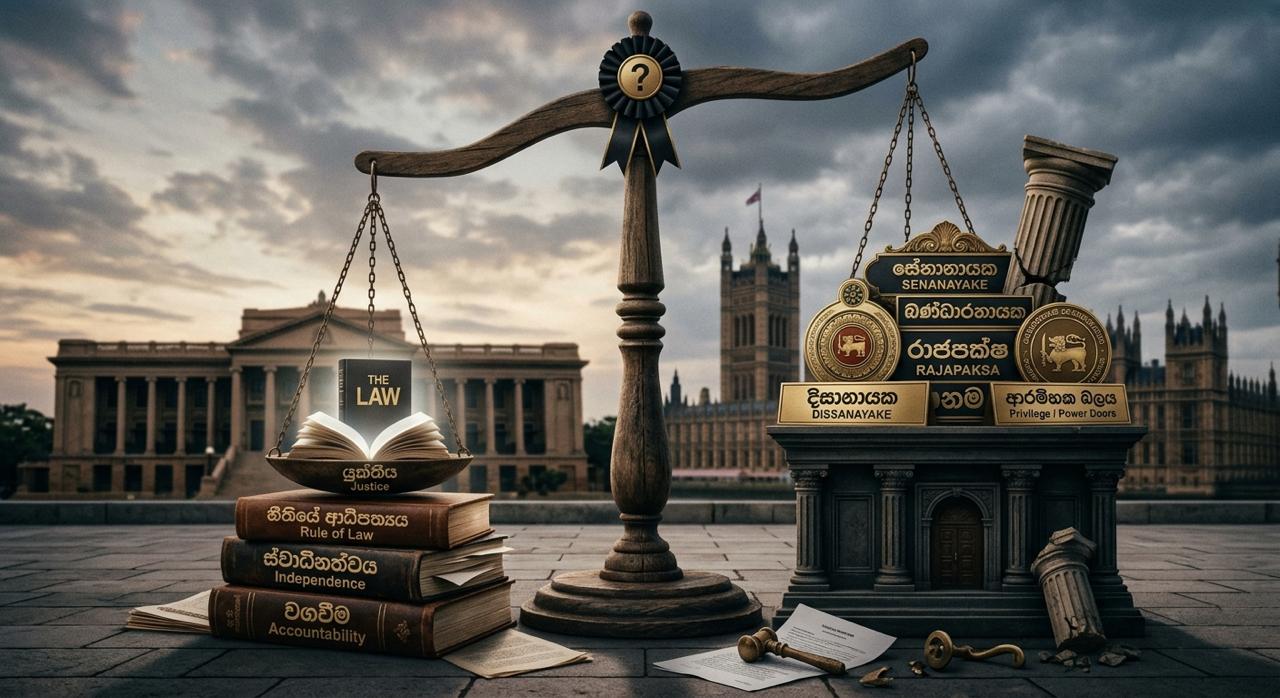
In Britain, a Famous Surname May Open Doors. In Sri Lanka, It Has Sometimes Appeared to Open the Entire Government.
Britain and Sri Lanka share an island identity, a parliamentary inheritance and a legal tradition that promises equality before the law. Neither country is free of privilege, patronage or political scandal. But there is a fundamental difference between announcing reforms and producing justice that ordinary citizens can recognise. President Anura Kumara Dissanayake speaks frequently about the rule of law. The question is whether Sri Lankans are experiencing its benefits in the here and now.
William Shakespeare wondered what was in a name and concluded that a rose would smell as sweet by any other. He was not contemplating the political arrangements of modern Sri Lanka, where the right surname has sometimes carried considerably greater practical advantages than the fragrance of a flower. Nor was he thinking of Britain, where aristocratic titles, inherited privilege and distinguished family connections have influenced public life for centuries.
Submit Your Press Release
Get your company news, announcements, launches, appointments and events in front of a wider audience.


Britain has its Churchills, Cecils and Benns. Sri Lanka has its Senanayakes, Bandaranaikes and Rajapaksas. Both countries have produced political dynasties, and both have experienced the consequences of allowing wealth, influence and family connections to shape access to public office.
Britain’s House of Lords remains an especially curious institution in a modern democracy. Its history is rooted in hereditary privilege, and the conduct of some members has attracted legitimate criticism involving expenses, lobbying, financial interests and standards of public behaviour. The British have ample reason to question aspects of their own parliamentary arrangements, particularly when membership of an unelected chamber confers substantial influence over legislation.
Yet the more instructive comparison concerns what happens when the conduct of powerful individuals is challenged. Britain has developed an extensive framework of parliamentary scrutiny, judicial independence, public-sector standards and mechanisms for investigating misconduct. Those arrangements are imperfect, and their application is not invariably equitable, but they provide visible avenues through which decisions can be questioned and officials held accountable.
Sri Lanka possesses many of the same legal traditions. Its Constitution promises equality before the law, its judiciary exercises independent constitutional functions, and its public institutions are subject to statutory obligations. The country has also enacted legislation intended to strengthen anti-corruption enforcement, public accountability and the administration of justice.
President Anura Kumara Dissanayake frequently speaks about the rule of law and the importance of ensuring that political influence no longer determines how citizens are treated. His government points to legislative changes, institutional reforms, new investigative arrangements and administrative procedures intended to eliminate the abuses associated with previous administrations.
Those commitments deserve to be examined seriously rather than dismissed because they come from a political party. Sri Lanka urgently requires stronger institutions, and reforms capable of improving their independence should be welcomed irrespective of which government introduces them.
But there is a fundamental difference between reforming the machinery of justice and delivering justice itself. A government may establish commissions, introduce legislation, amend procedures and appoint officials while ordinary citizens continue to encounter the same delays, inconsistencies and inequalities that characterised the previous system.
The rule of law cannot exist indefinitely as a promise of improvements yet to come. It must be demonstrated in the daily conduct of police officers, investigators, prosecutors, public administrators and courts. Citizens should be able to recognise its presence without requiring a presidential speech explaining that it is being introduced.
This is where Britain offers a useful, if imperfect, comparison. Its political establishment has experienced serious scandals, and members of the House of Lords have not always behaved in ways consistent with the dignity of their positions. But the country’s institutions provide established procedures through which misconduct can be exposed, challenged and subjected to consequences.
The British system is certainly not free of inequality. Wealthy defendants may obtain advantages through superior legal representation, public services experience serious pressures, and delays in the criminal courts have become a significant concern. Nevertheless, the principles governing official conduct are publicly articulated, and citizens possess meaningful opportunities to challenge the exercise of State authority.
Sri Lanka’s problem has frequently been the distance between constitutional principle and administrative reality. Equality before the law is proclaimed with considerable enthusiasm, but its application has too often appeared dependent upon wealth, influence, political connections or the identity of the individual concerned.
The recent legal difficulties confronting members of the Rajapaksa family illustrate why this distinction matters. Arrests, remand orders and indictments may demonstrate that investigators are pursuing allegations involving previously powerful individuals. They do not, by themselves, establish that the country has achieved a more equitable system of justice.
That conclusion requires evidence of fair investigations, independent prosecutions, reasonable judicial processes and outcomes determined by law rather than political convenience. The same standards must apply to members of the present administration, opposition politicians, business leaders and ordinary citizens.
There is no objection to a former minister receiving appropriate medical treatment while facing criminal proceedings. There is, however, every reason to question a system in which a politically influential individual appears capable of obtaining arrangements unavailable to an ordinary detainee with comparable medical needs.
The issue is not whether prominent individuals should receive less favourable treatment. It is whether everyone else receives the treatment to which they are legally entitled.
The present government has an unusual opportunity to establish that distinction. Its parliamentary majority gives it the capacity to undertake substantial institutional reform, while its electoral mandate provides a clear basis for confronting corruption and political privilege.
But the government must recognise that public confidence cannot be sustained indefinitely through announcements about new laws, additional offices or changes in administrative procedure. Citizens are entitled to ask what has improved in their daily experience of the State.
Are police complaints handled more fairly? Are investigations completed more efficiently? Can citizens obtain public services without political intervention? Are allegations against government supporters pursued with the same determination as allegations against political opponents? Can an ordinary person challenge a powerful official without fearing retaliation?
These are not unreasonable demands upon a government that has placed the rule of law at the centre of its political identity. They are the practical measurements by which its promises should ultimately be judged.
The comparison with Britain is particularly relevant because Sri Lanka did not inherit an entirely unfamiliar legal tradition. Many of the principles underpinning its courts, parliamentary institutions and public administration emerged from the same constitutional heritage. The challenge has been to preserve their independence while preventing political authority from overwhelming the safeguards intended to restrain it.
Britain’s institutions have evolved over centuries, frequently through confrontation, scandal and public pressure. Their relative durability does not mean that the British are inherently more committed to justice or that their political leaders are less susceptible to temptation. It means that institutional safeguards, however imperfect, have acquired a degree of continuity that does not depend entirely upon the goodwill of the government of the day.
Sri Lanka must develop that same institutional confidence. The law should not become more energetic when a government changes, nor should investigations lose momentum when political relationships become inconvenient. An independent justice system must be capable of disappointing those in power without placing its own survival at risk.
President Dissanayake has repeatedly spoken of transforming Sri Lanka’s political culture. If that ambition is genuine, the most persuasive evidence will not be found in the number of reforms announced or the number of former politicians brought before the courts. It will be found in the consistency with which the State treats everyone subject to its authority.
Be that as it may, there is no harm in Sri Lanka taking a cue from its island peers in Britain. The British may have good reason to be embarrassed by the behaviour of some members of their political establishment, including those occupying seats in the House of Lords. Their institutions are far from perfect, and justice is not always as swift or equitable as it should be. But there remains much to learn from a system in which public accountability is expected to operate through established procedures rather than depend primarily upon the declarations of political leaders.
If the NPP government genuinely wishes to be taken seriously as an administration committed to justice without fear or favour, it must demonstrate that the rule of law is not simply something being prepared for future generations. It must become something citizens can experience today, regardless of their surname, political allegiance, social standing or financial circumstances.
Sri Lanka does not require another government to explain why the rule of law is important. Its people have understood that lesson through decades of political favouritism, institutional failure and unequal treatment.
What they require now is evidence that the rules have changed, that those changes are being applied consistently and that no individual or family can place themselves beyond the reach of justice.
The President has spoken often enough about what his government intends to achieve. The next stage must be judged by what the people can see, experience and verify.
For ultimately, the question is not what is in a name, whether Rajapaksa, Bandaranaike, Senanayake or Dissanayake. The question is whether the name matters when the law is applied.
In a democracy worthy of the description, it should not.



