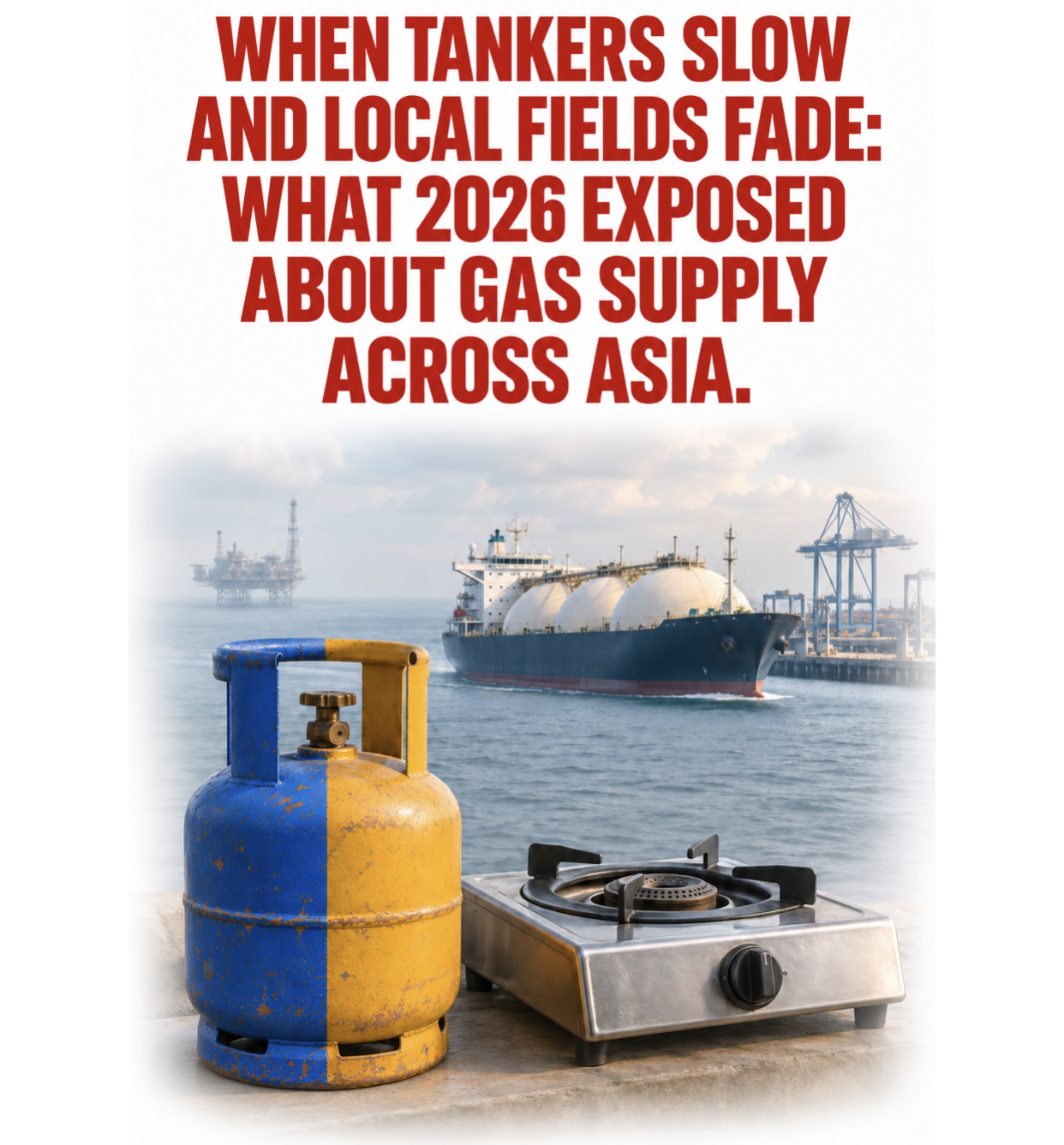
Here at home, cooking gas shortages and steep prices have already turned an everyday household chore into a daily test of patience. Across South and Southeast Asia in 2026, however, that same stress has played out on a massive scale. Shrinking local gas fields, thin storage tanks, and shipping trouble around the Strait of Hormuz have exposed how easily a disruption thousands of kilometers away can stall power plants, factories, and stoves across the region.
Start with Pakistan, where leaning almost entirely on one supplier turned into one of Asia’s harshest liquefied natural gas shocks of 2026. Having bought 98% of its imported LNG from Qatar in 2025, and 99% combined from Qatar and the UAE, Pakistan had almost no backup when Middle East shipping ran into trouble during the conflict that broke out in February and March. Shipments dropped from as many as 12 cargoes in January to just 2 in March. Over the first 10 months of the year, LNG imports fell by 56%, or about 4.5 billion cubic meters, while deliveries between March and September dropped by more than 70% compared with the same period a year earlier. Because imported gas normally generates over 21% of Pakistan’s electricity, gas’s share of power production fell by roughly 25% between March and September. Power plants had to burn about 35% more coal to keep the lights on, while fertilizer factories between March and August struggled with scarce, expensive gas. When a country keeps virtually no spare gas stored for emergencies, global shipping hiccups quickly turn into power cuts and higher farming costs.
Bangladesh has been hit from two directions at once: older local gas fields are pumping less, while demand for expensive imported gas keeps climbing. Local gas production dropped by 28% between FY2018–19 and FY2024–25. At the same time, imported LNG jumped 143% to make up nearly 29% of supply, leaving Bangladesh short by roughly 1,200 to 1,400 million cubic feet of gas on a typical day against total demand of 3,800 to 4,000 million cubic feet. Then on July 21, 2026, a fire aboard the floating gas terminal ship at Moheshkhaliknocked out roughly 450 million cubic feet of daily imported gas, cutting national pipeline supply by more than 17%. Along with lower Qatari deliveries and global spot gas prices climbing into the $15.88 to $16.98 per million British thermal unit range, state utility Petrobangla’s subsidy bill to cover high import costs surged to BDT 16,600 crore. Electricity shortages passed 3,000 megawatts on peak days, gas pressure for vehicles dropped close to zero at 0 to 1 psi, ceramic kilns struggled with 0 to 3 psi instead of the 15 psi they need, and garment output ran near 40% of normal in late August as over 900 of roughly 1,800 textile mills shut at the peak.
Submit Your Press Release
Get your company news, announcements, launches, appointments and events in front of a wider audience.


India has a far bigger economy and refining system, yet its numbers show why sheer size does not make a country immune to gas shocks. India buys roughly half of its natural gas from abroad, with import dependence at 52.8% in October, and relies on the Strait of Hormuz for half of its household cooking LPG cylinders. When shipping disruptions hit during the 2026 Middle East conflict, LPG imports fell by more than half over the first 2 months of the crisis. To protect kitchens, New Delhi ordered refineries to push out more LPG and prioritize household cylinders. By October, India’s monthly oil and gas import bill jumped 60% to $16 billion, while LPG imports and domestic usage both saw steep drops. Even with busy refineries and reserve stocks, the squeeze showed how fast trouble at sea can tighten everyday cooking fuel.
For the Maldives, keeping gas on hand is a delicate island-shipping challenge with almost no margin for error. Depending on imported LPG for homes and resorts, the country felt the squeeze repeatedly in 2026. In mid-March, Maldives Gas cut LPG sales in half for a week to 5 kilograms per 10-kilogram cylinder amid Middle East supply disruptions. In June, it raised refill prices for commercial and resort 45-kilogram cylinders by 25%. In early November, refill limits returned briefly, capping 10-kilogram cylinders at 7 kilograms, 22-kilogram cylinders at 14 kilograms, and 45-kilogram cylinders at 31 kilograms. By November 13, those limits were lifted as deliveries steadied, while work continues to add 1,500 tonnes of gas storage in Male’ to eventually hold a 3-month supply cushion.
Across Southeast Asia, the picture shifts from immediate rationing toward long-term transition pains. Thailand, long reliant on gas from the Gulf of Thailand and pipeline imports from Myanmar, has seen those traditional supplies fall by more than 20% since 2010, with Myanmar pipeline flows down an estimated 9.6% in 2025. Thailand now leans more heavily on pricier imported LNG to run power stations and factories, adding pressure to electricity bills while raising debates over expanding gas terminals in Rayong and moving faster on cleaner energy.
The Philippines faces a similar slowdown as output from its Malampaya gas field declines. Natural gas supplies about 22% of the country’s electricity, and LNG import terminals are expanding toward 10.72 million tonnes per year. Even so, the Philippines remains heavily exposed to global price swings and depends on the Middle East for roughly 91% of its imported LPG. Occasional shipments, such as a 21,000-metric-ton LPG delivery in May, help steady local supply, yet shifts in global gas and coal markets still ripple through power and fertilizer costs.
Vietnam, meanwhile, is trying to balance fast-growing power demand with shifting energy choices. Fossil fuels still provide about 80% of its primary energy, with coal generating around 52% of electricity in the first quarter of 2026 and natural gas around 6%, even as electricity use rose 9.5% in the first half of the year and hit a record 57,189 megawatts in May. As older local gas fields slow down, Vietnam has brought in LNG cargoes through terminals such as Thi Vai while pushing ahead with projects like Block B-O Mon and Son My. Still, slow approvals, funding hurdles for uncontracted LNG power plants, and growing attention to renewable and nuclear power mean its gas expansion is moving unevenly.
Whe pulling back from all those numbers, it leaves you wondering how much margin for error any of these countries really have. Putting so much faith in a single shipping lane or one main supplier is a risky bet when politics in the Gulf can turn overnight, yet that seems to be how many grids got built. And with storage tanks holding so little compared with what is now imported, you have to ask: what happens next time a tanker gets delayed or a terminal catches fire? Maybe spreading out suppliers, building bigger reserves, and leaning faster into cleaner power are part of the answer, or maybe the trade-offs are harder than they look on paper. Either way, when trouble flares up half a world away, how long can Asian kitchens, factories, and power plants keep absorbing the shock?