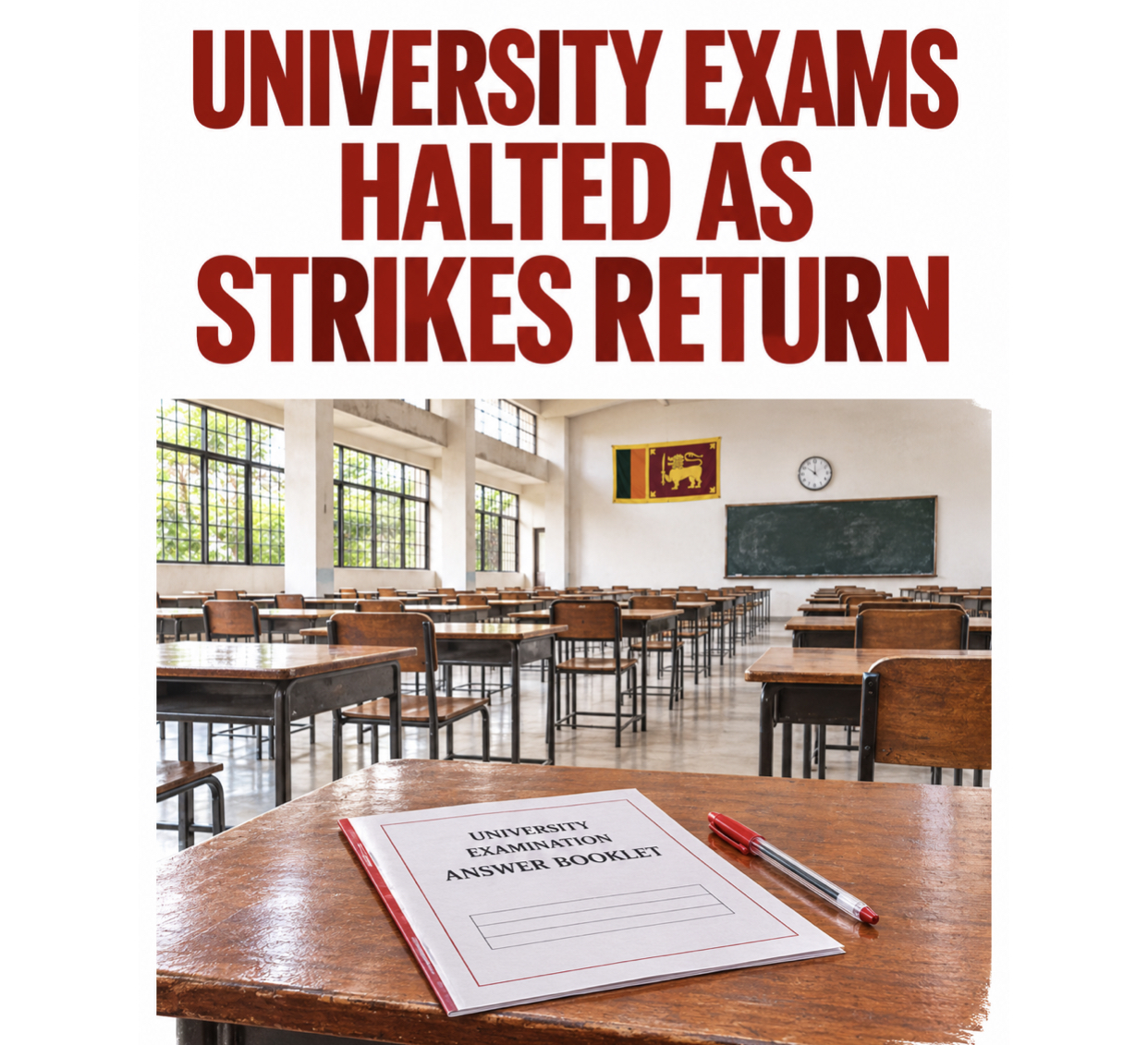
Sri Lanka’s brief season of industrial peace ended at the gates of its state universities yesterday, November 25, as non-academic staff walked off the job for the second time in 7 days and forced the postponement of scheduled exams and lectures. Organized by the University Trade Union Joint Committee, the one-day token strike directly challenges the government’s 2027 Budget and signals a wider return to coordinated public-sector unrest.
At the centre of the dispute is a demand to restore basic salaries, overtime rates, and allowances that union leaders say were reduced under the 2025 Budget. Co-Chairman Dhammika S. Priyantha confirmed that protests took place outside state universities nationwide while representatives of 9 major unions convened in Colombo. Co-Chairman Mangala Dabarera stressed that employees are seeking the reinstatement of earnings they received prior to the 2025 reductions, accusing the administration of failing to honour earlier agreements or hold substantive talks since presenting its maiden fiscal plan.
For much of the past year, Sri Lanka’s public sector experienced a rare stretch of industrial calm after the government took office on promises of economic stabilization and administrative reform. That truce has fractured sharply since the 2027 Budget reached Parliament.
Submit Your Press Release
Get your company news, announcements, launches, appointments and events in front of a wider audience.


Over the past week, labour unrest has spread well beyond university gates into hospitals, schools, and local government offices. On Monday, November 23, a coalition of education, health, and development sector unions staged a “National Day of Protest” against the fiscal proposals. The Government Medical Officers’ Association launched a two-hour islandwide trade union action on Monday morning over unaddressed grievances in the health sector, while nursing unions warned of escalating steps.
Now, an even wider confrontation is set for Monday, November 30, just 24 hours before Parliament takes up the Education Ministry’s budgetary vote on December 1. The Teachers’ and Principals’ Trade Union Alliance, led by figures including Ceylon Teachers’ Union General Secretary Joseph Stalin, has announced a coordinated one-day sick leave campaign expected to involve nearly 250,000 teachers and principals across 10,110 state schools. Their demands include the release of unpaid salary increments, a Rs. 25,000 monthly bridging allowance, updated difficult-service allowances, and an allocation of 6 percent of GDP for education. Workers’ Struggle Centre collectives across public institutions have also pledged sector-wide stoppages for the same day.
The government faces a narrow fiscal corridor as the International Monetary Fund prepares to consider Sri Lanka’s seventh programme review on December 2. Ministers maintain that fiscal discipline remains essential to sustain recovery and keep inflation contained, leaving little room for unbudgeted wage concessions.
Yet for university undergraduates facing delayed graduation timelines, parents bracing for school closures next Monday, and patients waiting outside state clinics, the return of familiar picket lines signals that Sri Lanka’s brief period of labour peace has come to an end.