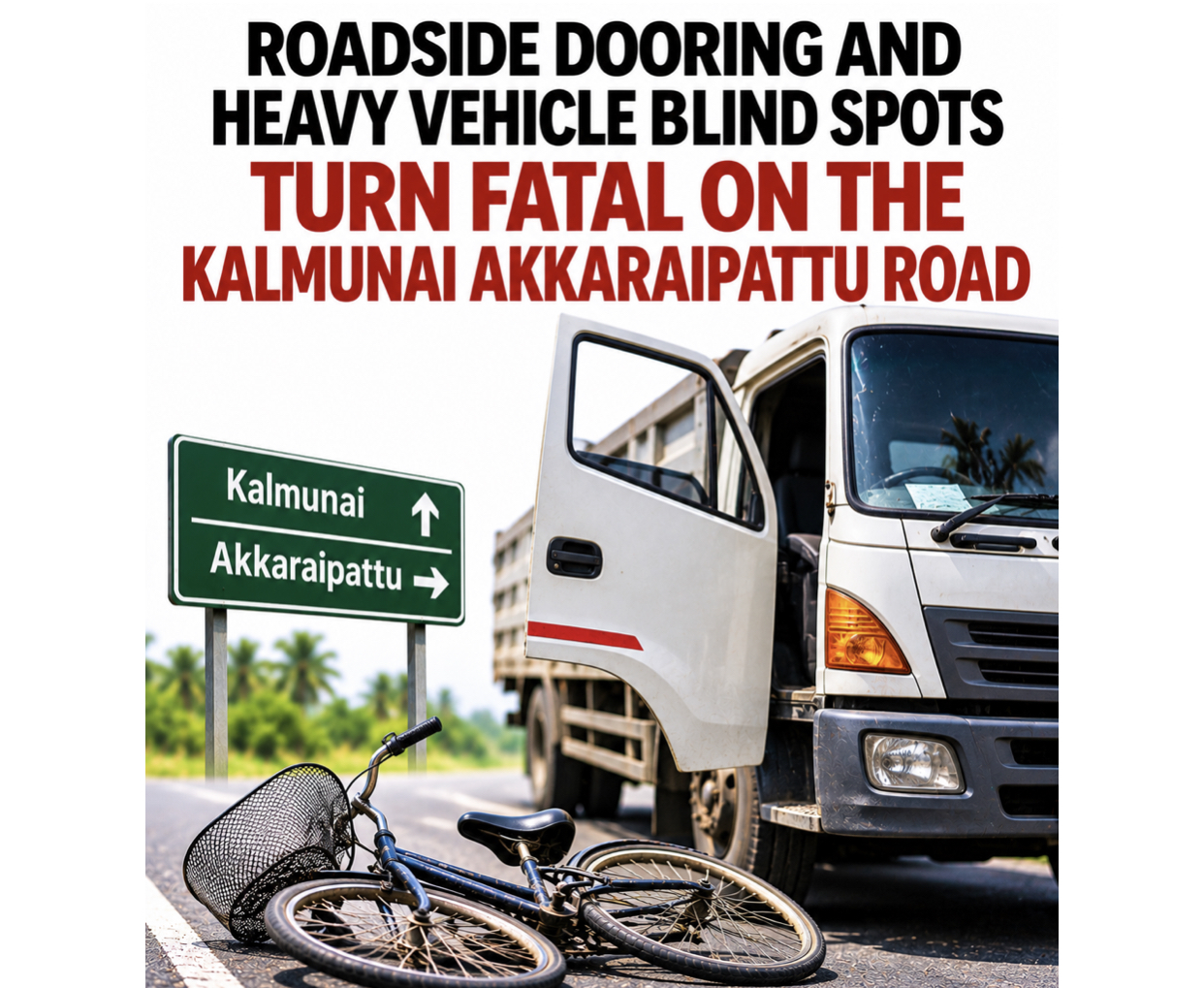
A 23-year-old resident of Kalmunai died on Tuesday, November 24, after a parked lorry driver opened his cab door directly into the path of a passing bicycle on the Kalmunai Akkaraipattu Main Road. According to Kalmunai Police, the impact threw the bicycle off balance into the carriageway, where an oncoming bus travelling towards Kalmunai struck the riders. Both the cyclist and the 23-year-old pillion passenger suffered critical injuries and were rushed to the Kalmunai Base Hospital, where the passenger succumbed to his injuries.
This fatal chain reaction highlights a recurring hazard on Sri Lankan highways where heavy vehicles, narrow road shoulders, and vulnerable road users share the same unmarked tarmac. Across the island, police traffic divisions regularly record fatal “dooring” collisions alongside crashes caused by lorries parked without warning triangles, buses overtaking in tight corridors, and commercial trucks operating with worn tyres or defective mirrors. In recent years, similar tragedies along the A4 highway, the Kandy Colombo road, and the Southern Expressway access routes have repeatedly exposed how a single careless movement by a heavy vehicle operator leaves cyclists and motorcyclists with zero margin for survival.
Under Sri Lanka’s Motor Traffic Act, opening a vehicle door so as to endanger any person on a road is already a punishable offence, while parking regulations restrict heavy vehicles from obstructing active lanes. Yet enforcement remains largely reactive, arriving only after an ambulance leaves the scene. Heavy commercial vehicles routinely park along busy main roads to load goods or rest, forcing cyclists to swerve blindly into fast-moving bus lanes.
Submit Your Press Release
Get your company news, announcements, launches, appointments and events in front of a wider audience.


Other jurisdictions have tackled this exact sequence of failure through both driver habits and vehicle design. In the Netherlands, learner drivers are tested on the “Dutch Reach,” requiring them to open the car or cab door with their far hand so their torso naturally turns toward approaching traffic before the door swings out. Across the United Kingdom, the updated Highway Code formally codified the Dutch Reach alongside a strict hierarchy of road users that places greater legal responsibility on heavy vehicle drivers to protect cyclists and pedestrians. Meanwhile, European Union safety regulations mandate blind-spot detection sensors, side underrun protection bars, and wide-angle proximity mirrors on lorries and buses so drivers cannot miss two-wheelers riding alongside their cabs.
Sri Lanka does not need to reinvent road engineering to prevent deaths like Tuesday’s tragedy in Kalmunai. Authorities should have enforced dedicated loading bays off main arterial roads, mandatory reflective side-underrun guards on all registered lorries, and strict roadside parking bans along narrow stretches of the A4 highway years ago. Introducing basic blind-spot mirror standards during annual vehicle fitness inspections, embedding the far-hand door check into heavy vehicle licensing tests, and equipping traffic police with clear authority to impound improperly parked commercial vehicles would immediately cut preventable fatalities. Until heavy vehicle safety is treated as a frontline licensing and enforcement priority rather than an afterthought, ordinary cyclists will continue paying the price on Sri Lanka’s main roads.