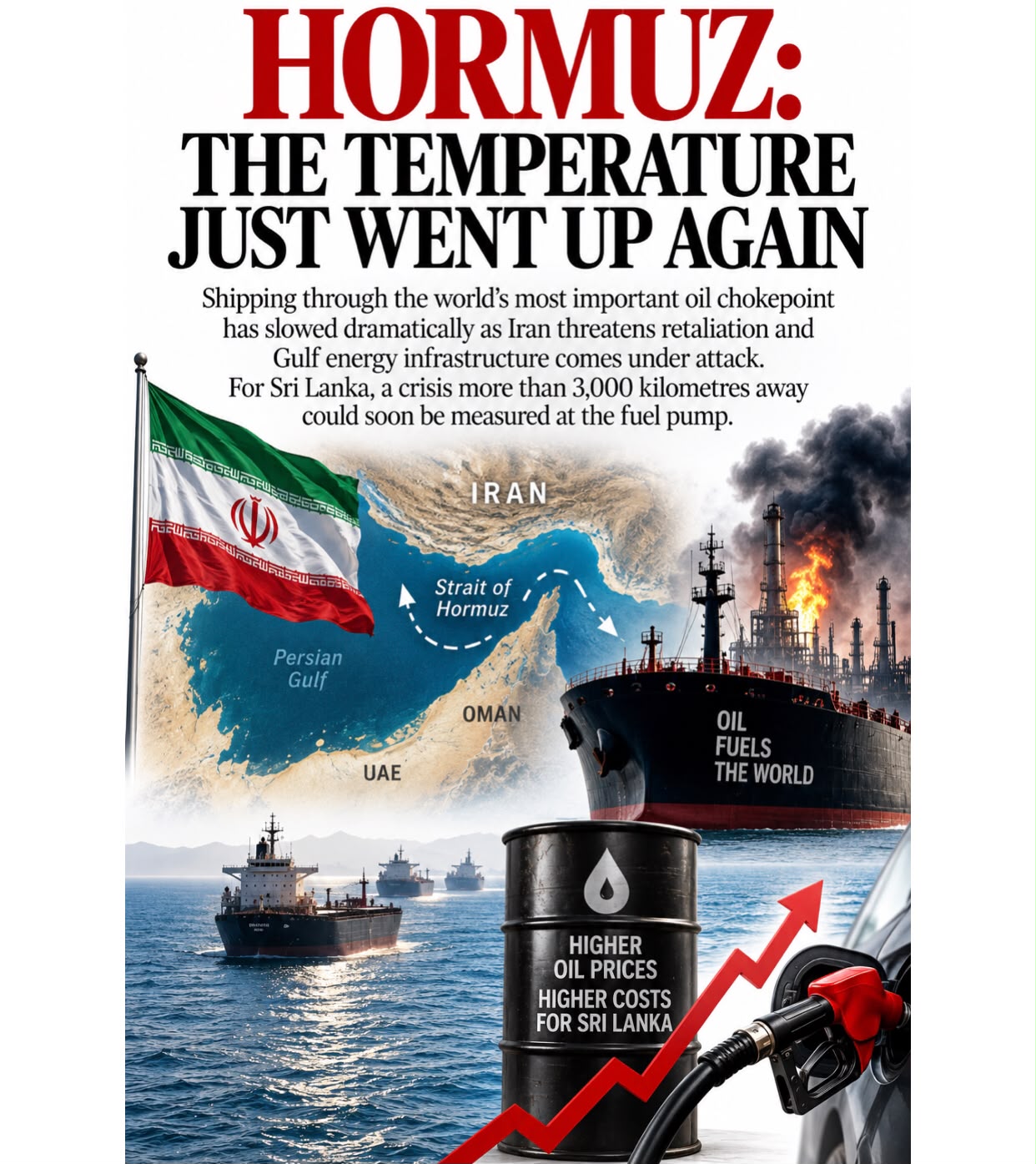
Shipping through the world’s most important oil chokepoint has slowed dramatically as Iran threatens retaliation and Gulf energy infrastructure comes under attack. For Sri Lanka, a crisis more than 3,000 kilometres away could soon be measured at the fuel pump.
Shipping through the Strait of Hormuz has slowed sharply as the confrontation involving Iran and the United States intensifies, raising fears of a prolonged disruption to one of the world’s most important energy corridors. Commodity-vessel traffic through the Strait fell to just seven vessels on Monday, following only eight the previous day, as shipowners increasingly weigh the risks of entering the Gulf.
The numbers matter because Hormuz is no ordinary shipping lane. Roughly a fifth of global petroleum liquids consumption normally passes through the narrow waterway connecting the Gulf’s major oil and gas producers with markets across Asia and the rest of the world, meaning that even a partial disruption can affect oil prices, freight rates and marine insurance.

Iran has warned that further American attacks could provoke retaliation against US-linked energy interests in the Gulf and has spoken of establishing a new restricted maritime zone and controlled shipping corridor around Hormuz. The confrontation has meanwhile widened, with Iran-aligned Houthi forces attacking targets in Saudi Arabia, including energy infrastructure, and dozens of people reported injured in attacks on southern Saudi cities.
The danger for energy markets is therefore no longer confined to whether Iran physically closes the Strait. A broader conflict threatening oil production, processing facilities, tankers and export infrastructure across the Gulf could make ordinary commercial shipping increasingly expensive and unpredictable even while Hormuz technically remains open.
Oil prices have responded, with Brent crude again moving towards the psychologically important US$100-a-barrel level. Alternative pipelines, export routes and available global inventories have so far helped prevent a still more dramatic price surge, but those alternatives cannot completely replace the enormous volume of energy normally carried through Hormuz.
For Sri Lanka, this is where a distant geopolitical confrontation becomes a domestic economic issue. The country imports most of the petroleum it consumes, leaving fuel prices, electricity generation and transport costs exposed to movements in international energy markets.
A tanker does not have to be sunk for its cargo to become more expensive. Higher war-risk insurance, freight charges, delayed deliveries and shipowners unwilling to enter dangerous waters can eventually be reflected in the price paid by an importing country thousands of kilometres away.
There is also the foreign-exchange consequence. Sri Lanka has spent several difficult years rebuilding reserves and stabilising an economy that experienced first-hand what happens when dollars become scarce and fuel becomes difficult to obtain, and a substantially higher petroleum import bill would inevitably place additional pressure on that recovery.
The country’s exposure goes beyond oil. The Middle East remains an important destination for Sri Lankan workers and source of remittances, while Gulf aviation routes, tourism, shipping and trade connect Sri Lanka closely to a region in which instability can rapidly produce economic consequences elsewhere.
There is now an additional Sri Lankan dimension. The Government says 47 vessels are being monitored in international waters around the island after the United States alerted Colombo regarding Iranian vessels operating in the region. The 47 are not all Iranian and include vessels associated with several countries, while the Government maintains that they remain outside Sri Lankan territorial waters and have made no request to enter.
Their presence nevertheless demonstrates how the maritime consequences of the Gulf confrontation are spreading into the wider Indian Ocean. The shipping routes emerging from Hormuz eventually cross the Arabian Sea and Indian Ocean, placing Sri Lanka close to one of the principal arteries connecting Gulf energy with Asian markets.
Colombo’s sensible position is to remain outside somebody else’s military confrontation while protecting Sri Lankan territory, shipping interests and economic security. That requires considerably more than watching television pictures of events in the Gulf and hoping the crisis passes.
The Government should already know how much petroleum Sri Lanka physically holds, what quantities are contracted and in transit, how exposed the country would be to a prolonged price increase and what alternative supply arrangements exist if normal Gulf shipping becomes seriously disrupted. Those are questions of contingency planning, not reasons for consumers to panic or begin forming another national collection of plastic fuel cans.
Sri Lanka learnt in 2022 how quickly an energy problem can become an economic and social crisis when foreign exchange, fuel supplies and public confidence collapse together. The country’s economic position today is considerably stronger than it was then, but its geography and dependence on imported energy have not changed.
Be that as it may, Hormuz does not have to close for Sri Lanka to feel the consequences. If ships become more expensive to insure, cargoes more difficult to move and oil more expensive to buy, the distance between the Strait of Hormuz and a Sri Lankan petrol pump can become remarkably short.