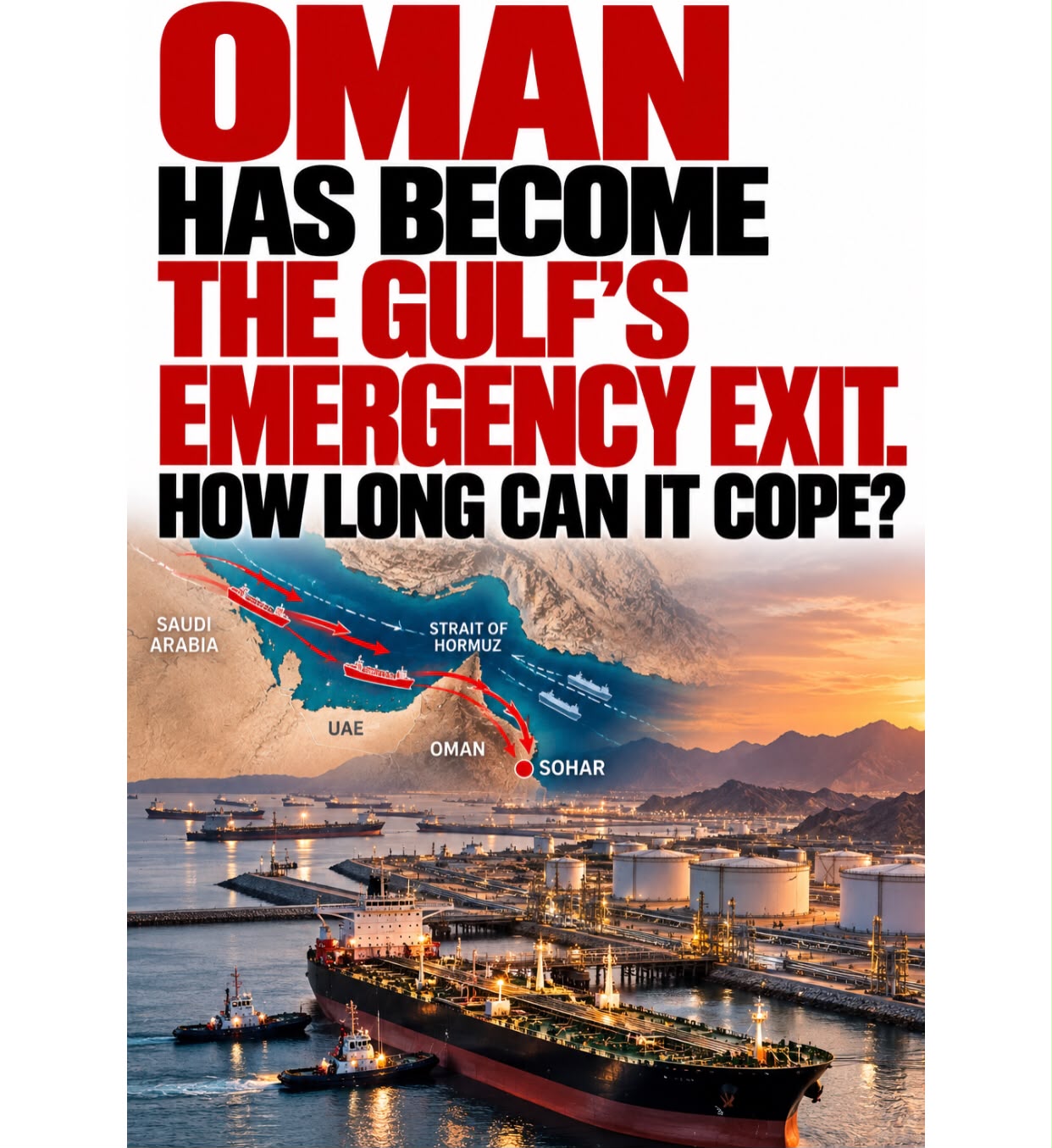
Oman has spent years positioning itself as the Gulf state that talks to almost everyone and quarrels with almost no one. The Hormuz crisis has now given that diplomatic geography an extraordinary commercial value. Sohar is becoming a pressure-release valve for Saudi oil, but the volume of emergency traffic is beginning to test how much pressure that valve can take.
Look at a map of the Gulf and Oman’s strategic importance becomes immediately obvious.
Part of the country sits beside the Strait of Hormuz. Much of the rest of Oman faces the Arabian Sea and Indian Ocean outside it. Sohar, Duqm and Salalah therefore offer something that has become extremely valuable during the present crisis: access to international waters without first having to negotiate the Strait.
Submit Your Press Release
Get your company news, announcements, launches, appointments and events in front of a wider audience.


Saudi Arabia has been making extensive use of that advantage.
Saudi Aramco has sold around 60 million barrels of crude from Ras Tanura for loading through ship-to-ship transfers around the Omani port of Sohar during September and October. The arrangement allows crude originating inside the Gulf to be moved onto tankers positioned outside the Strait, providing buyers with an alternative to the kingdom’s disrupted Red Sea export route.
The process sounds deceptively simple.
A tanker carrying oil approaches another tanker at sea. The vessels are carefully positioned alongside each other, hoses are connected and enormous quantities of crude are transferred between them. The receiving vessel can then continue towards the buyer.
Doing this safely with very large crude carriers requires specialist crews, suitable weather, tug and support services, sufficient anchorage space and extensive coordination. Multiply the exercise across millions of barrels and Oman suddenly finds itself hosting one of the world’s largest emergency oil-transfer operations.
The system is now approaching its limits.
Trade sources told Reuters last week that ship-to-ship transfer capacity in the Gulf of Oman had effectively reached saturation as Saudi Arabia added its cargoes to oil already being moved by other Gulf producers. Buyers and traders have consequently begun examining alternative transfer locations farther away, including India and Malaysia.
That tells us something important about how Oman is coping day by day.
It is coping because the infrastructure exists, because its ports remained outside the principal conflict zone and because Oman’s long-standing diplomatic position gives commercial operators a degree of confidence that is increasingly scarce elsewhere in the region.
But coping does not mean unaffected.
Every additional tanker requires anchorage, marine services, bunkering, pilots, provisions and logistical support. Congestion increases. Transfer windows become harder to secure. Freight rates rise as vessels spend longer waiting rather than carrying cargo. An operation originally designed as a workaround can eventually develop its own bottlenecks.
There is also a physical risk. Ship-to-ship oil transfers are established maritime operations, but conducting them at exceptional scale inevitably raises the consequences of collision, mechanical failure or a spill. Oman is therefore carrying not only an economic opportunity but an environmental and logistical responsibility.
The crisis may ultimately strengthen Oman’s strategic position.
Duqm was already being developed as a major industrial and logistics centre. Sohar already possessed substantial port and refinery infrastructure. Salalah sits beside one of the world’s great east-west shipping routes. The present emergency has demonstrated why access to the Arabian Sea without dependence upon Hormuz has value far beyond Oman itself.
There is a diplomatic dimension too. Muscat has repeatedly acted as an intermediary between Iran and Western powers. While larger neighbours have sometimes chosen confrontation, Oman has built influence through communication. In a crisis centred on a waterway that partly runs through Omani territorial waters, that quiet diplomacy suddenly becomes an economic asset.
Sri Lanka should watch Oman closely.
Both countries sit beside major Indian Ocean shipping routes. Both possess ports whose value depends partly upon geography. Oman has spent decades converting location into logistics, diplomacy and commercial leverage.
Be that as it may, geography gave Oman the opportunity. Policy made the opportunity usable.
Sohar is now helping keep part of the world’s oil system functioning. The more interesting question is whether what began as an emergency workaround will permanently change the way Gulf energy reaches the world.