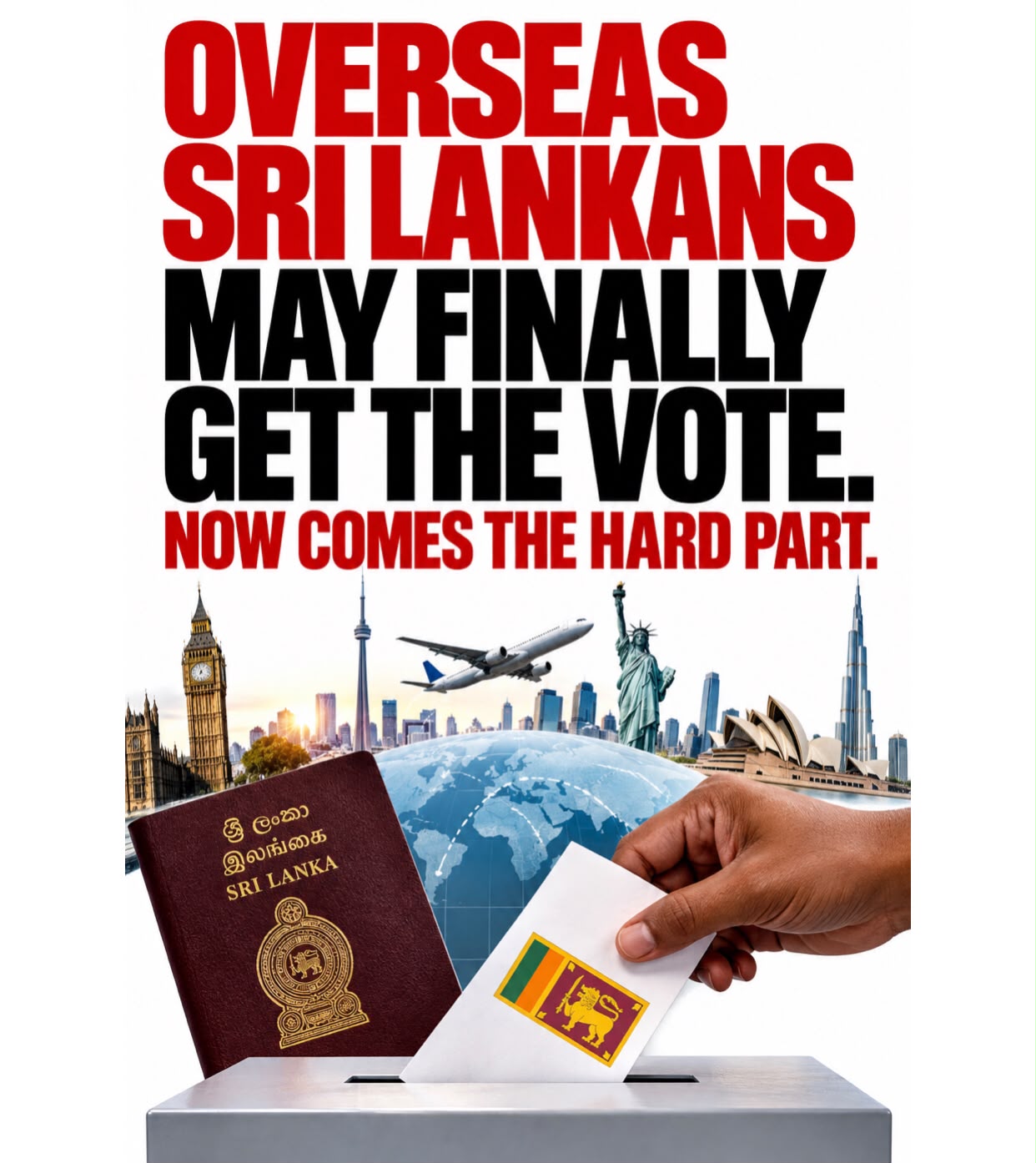
Sri Lanka is moving towards allowing its citizens overseas to vote without flying home. The principle sounds straightforward. Making it secure, credible and genuinely accessible to a diaspora scattered across the world will be considerably more difficult.
For generations, Sri Lanka has been remarkably happy to receive the money of its citizens overseas while making the exercise of one of their most fundamental democratic rights considerably more complicated. A Sri Lankan working in Dubai, London, Toronto or Melbourne may remain a citizen, contribute to the country’s foreign exchange earnings and retain an intense interest in what happens at home. But if an election arrives while that citizen is abroad, there is presently no general mechanism enabling that vote to be cast overseas.
The Government says it intends to change that.
Submit Your Press Release
Get your company news, announcements, launches, appointments and events in front of a wider audience.


Acting Minister of Foreign Affairs, Foreign Employment and Tourism Arun Hemachandra said on Monday that work is underway to establish a mechanism through which Sri Lankans living overseas can exercise their voting rights. The announcement came alongside plans for new foreign employment legislation and other measures aimed at strengthening protection for migrant workers.
This is not an idea invented yesterday. Cabinet approved the establishment of an official committee in September 2025 to examine the legal changes necessary for overseas voting. That committee subsequently began consultations, seeking views on voter registration, campaigning, voting procedures, counting and the declaration of results.
The problem is that agreeing Sri Lankans overseas should be able to vote is the easy part. Designing a system everybody trusts is something else.
Sri Lanka’s present electoral framework ties voters closely to the domestic electoral register and constituency system. International IDEA notes that the country’s existing postal voting arrangements are limited to specified categories such as members of the armed forces, police, certain public services and election officials. They do not presently provide a general overseas voting facility for migrant workers or other citizens abroad.
There are several possible models. Voting could take place at embassies and consulates. Postal voting could be extended. Some countries use electronic arrangements, while others require citizens overseas to register separately and vote at designated locations.
Every option brings questions.
How does a worker living hundreds of kilometres from the nearest Sri Lankan mission cast a ballot? Who transports and safeguards the votes? How is secrecy protected? What happens to a voter registered in a particular Sri Lankan electorate? How are election campaigns overseas regulated, particularly in jurisdictions whose own laws may restrict foreign political activity?
Then comes the largest question of all: trust.
Sri Lanka’s elections have traditionally depended heavily upon physical safeguards, party representatives, counting centres and processes that competing political parties can observe. An overseas voting system will succeed only if government, opposition, Election Commission, candidates and voters can accept that ballots cast thousands of kilometres away are as secure as those cast in Colombo, Jaffna or Hambantota.
That should not become an excuse for endless delay.
Sri Lanka’s overseas workforce is an important economic constituency. Remittances have repeatedly helped the country through its foreign exchange difficulties. But the democratic argument is stronger than the economic one. Voting is not something citizens should have to earn by sending dollars home.
The Government has therefore opened an important door. The task now is to demonstrate exactly what lies behind it.
Be that as it may, overseas voting should not become another reform that remains permanently “under consideration”. The Government has accepted the principle. The committee has consulted. The problem has been identified.
Now Sri Lankans overseas need to know when they will actually be able to vote.