
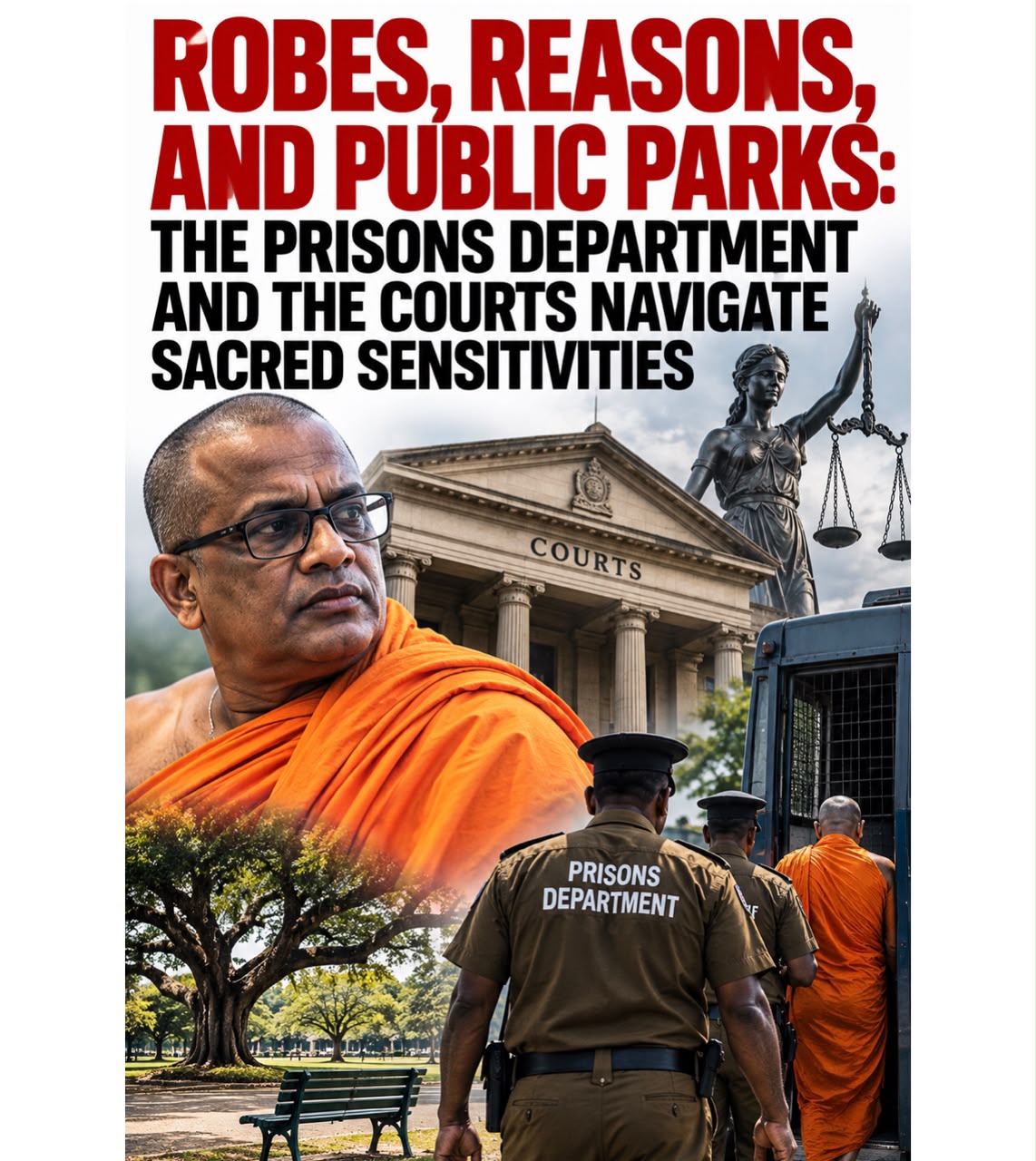
Navigating the intersection where state authority meets ecclesiastical tradition is rarely straightforward in Sri Lanka, but recent developments involving the imprisonment of Galagoda Aththe Gnanasara have brought that delicate friction into sharp focus. What began as a standard enforcement of penal procedures quickly escalated into a multi-front administrative balancing act, encompassing extraordinary gazette notifications from the Ministry of Justice, firm municipal enforcement at Viharamahadevi Park, and clear judicial boundaries drawn by the courts. Together, these unfolding events highlight the immense difficulty the state faces when trying to maintain procedural equality without igniting deep-seated social and religious sensibilities.
The initial political flashpoint emerged when prison authorities removed Gnanasara’s monastic robes upon his remand under long-standing departmental regulations that mandate standard prison attire for all inmates.
The action prompted immediate objections from monastic councils, who argued that decisions regarding a monk’s robes belong strictly to the Mahanayake Theras and the respective Nikayas rather than prison officials.
Submit Your Press Release
Get your company news, announcements, launches, appointments and events in front of a wider audience.


In response, the government issued an extraordinary gazette updating Department of Prisons Standing Orders. Under the new framework, the Commissioner General of Prisons must consult the Department of Buddhist Affairs and the relevant Nikaya within specified timeframes before altering a monk’s attire, while extending similar procedural considerations to clergy of other faiths. By formalizing this ten-day consultation window, the administration sought to establish a predictable, codified compromise that respects religious custom without surrendering state custody. The government made it quite clear that there was no special class of people within prison. If convicted they were all one.
Simultaneously, the controversy spilled beyond prison walls and directly into the public spaces of the capital. A group of Buddhist monks and supporters initiated a multi-day satyagraha at Viharamahadevi Park, demanding his immediate release and erecting display boards and temporary structures near the park’s Buddha statue. The situation escalated when the Colombo Municipal Council attempted to dismantle the unsanctioned installations, leading to tense confrontations on the ground. Municipal officials maintained that while peaceful expression is protected, allowing unauthorized physical structures on public parkland undermines urban governance and sets a hazardous precedent for public land management.
The judiciary stepped in decisively to restore order, issuing a clear court order prohibiting protesters from obstructing access to the park or maintaining illegal setups. The court made it clear that while citizens possess the right to assembly, public parks cannot be transformed into permanent, unregulated protest encampments that infringe upon the rights of the wider citizenry.
By enforcing penal provisions against those defying the order, the magistrate reinforced the principle that municipal bylaws apply universally, regardless of the cause or the robes worn by those assembled.
These twin episodes illustrate the delicate walk required of a modern democratic state. On one hand, updating outdated prison standing orders demonstrates an administrative willingness to accommodate genuine cultural sensitivities through formal legal channels rather than arbitrary executive favors.
On the other hand, the firm judicial and municipal stance at Viharamahadevi Park confirms that public spaces and the rule of law cannot be compromised by emotional pressure campaigns.
Ultimately, upholding institutional integrity requires the state to remain entirely blind to titles and status, ensuring that whether inside a prison cell or across a public park, written code and equal protection remain the final authority.



