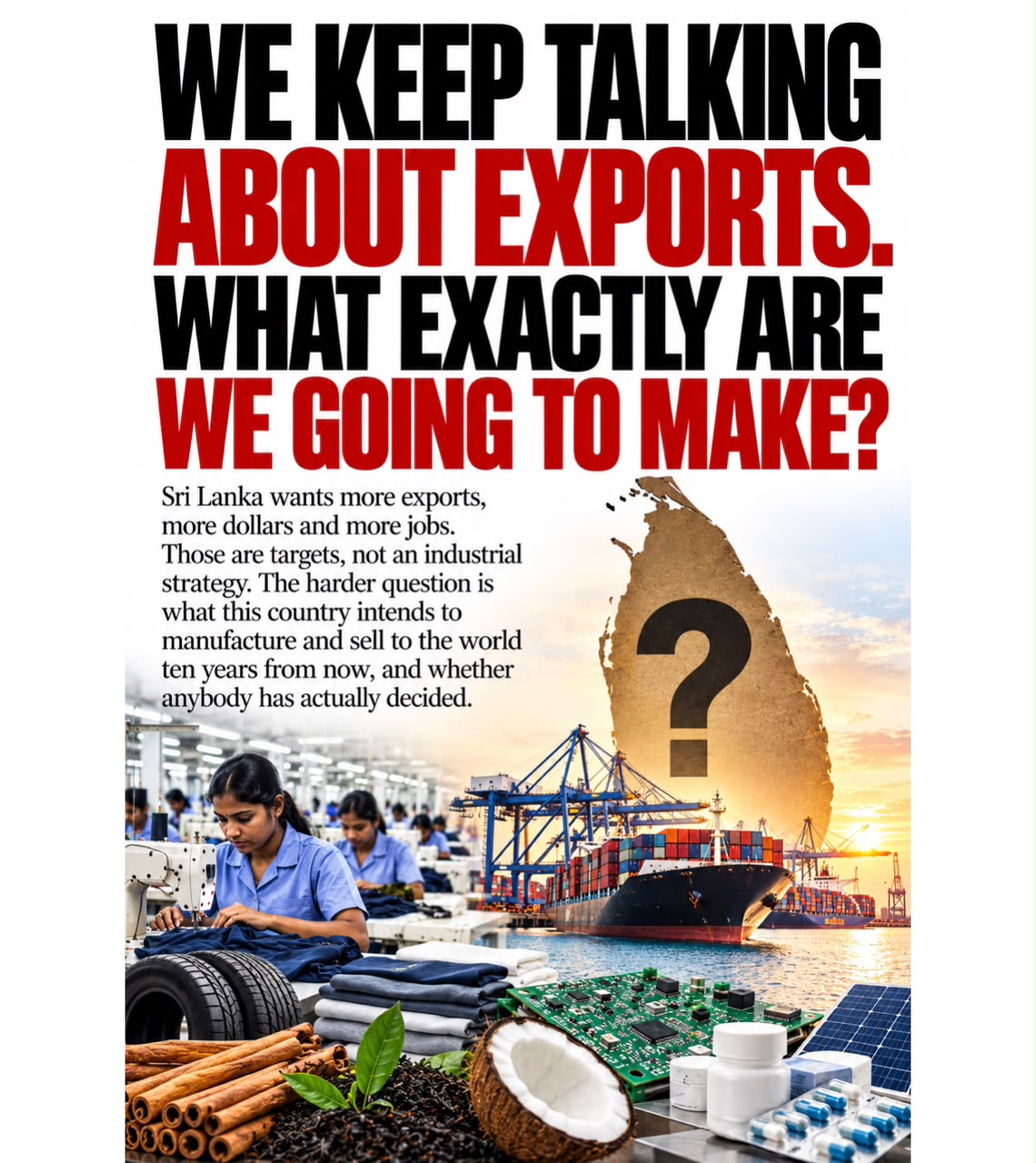
Sri Lanka wants more exports, more dollars and more jobs. Those are targets, not an industrial strategy. The harder question is what this country intends to manufacture and sell to the world ten years from now, and whether anybody has actually decided.
Sri Lanka has become very good at discussing exports in numbers. We celebrate when merchandise exports rise, worry when they fall and repeatedly announce ambitious targets for the years ahead, but the conversation rarely spends enough time examining what will actually be inside the containers leaving our ports.
Apparel remains one of Sri Lanka’s greatest industrial achievements. Companies built here have demonstrated that Sri Lankan management, engineering, design and manufacturing can compete at the highest international level, while tea, rubber products, coconut-based industries, gems and other established sectors continue to bring valuable foreign exchange into the country.
Submit Your Press Release
Get your company news, announcements, launches, appointments and events in front of a wider audience.


But an industrial economy cannot indefinitely depend upon yesterday’s success.
Across Asia, governments are deliberately choosing industries around which they intend to build the next generation of economic growth. Semiconductors, electronics, batteries, electric vehicles, aerospace components, medical devices, renewable-energy technology and advanced materials are not appearing accidentally. Governments are building infrastructure, developing skills, offering incentives and assembling supply chains around them.
Tamil Nadu is particularly relevant because this transformation is occurring almost within sight of Sri Lanka. A state traditionally associated with textiles and automobiles is now pursuing electronics, aerospace, defence manufacturing, advanced engineering and space technology while continuing to strengthen the industries it already possesses.
Sri Lanka should not imagine that it can replicate India. The difference in population, domestic market, capital and industrial scale makes that unrealistic, and attempting to manufacture everything would merely produce another collection of government strategies with impressive titles and very little commercial consequence.
A small country has to be more selective.
That means deciding which industries Sri Lanka has a realistic chance of becoming unusually good at and then concentrating national resources behind them. Instead of announcing that we want “high-tech manufacturing”, identify the particular components, materials or services in which Sri Lankan companies could enter an existing international supply chain.
There are already clues.
Sri Lanka possesses a sophisticated apparel industry capable of moving further into technical textiles, wearable technology and advanced materials. Its rubber industry has manufacturing knowledge that can be pushed further into specialised industrial and medical products, while companies involved in activated carbon demonstrate that something as ordinary as a coconut shell can become a sophisticated material used in industries far removed from traditional agriculture.
Our location creates another opportunity. Southern India is rapidly industrialising, which should make Sri Lanka think less about competing with the entirety of India and more about becoming useful to the enormous manufacturing ecosystem developing next door.
A factory in Tamil Nadu does not necessarily have to be a factory Sri Lanka lost. It could also become a customer.
What can we manufacture here that those factories need? Which components can move efficiently through Colombo or Hambantota? Which engineering, testing, design or technology services can Sri Lankan companies provide? Where can a smaller country insert itself into a supply chain without needing to own the entire industry?
Those are considerably more useful questions than simply declaring another export target.
There is also an uncomfortable human-capital issue. Sri Lanka regularly celebrates having an educated workforce, but an industrial strategy requires more than general education. If we decide that electronics, medical devices, advanced materials or precision engineering are future industries, universities and technical colleges need to know because the people those industries require must be trained before the factories arrive.
Energy policy must know too. So must the ports, Customs, the tax authorities and the agencies responsible for industrial land.
That is what an industrial strategy actually means. It is not a document belonging to one ministry but an agreement across Government about what the country is trying to become.
The private sector has an equally important responsibility. Businesses cannot demand protection indefinitely while producing goods the world increasingly buys elsewhere. Government should create the environment, but companies must invest in technology, research, productivity and the difficult transition from making what we have always made to making what international markets increasingly want.
Artificial intelligence adds urgency to the question. Sri Lanka has sensibly promoted IT and business-process services as an important export sector, but AI is beginning to automate precisely some of the routine work on which lower-cost service economies have depended. That does not mean IT/BPM disappears; it means the country has to keep climbing towards work requiring greater expertise and value.
Sri Lanka therefore needs something more specific than another promise to become an export economy.
Choose perhaps five or six industrial areas where we possess a genuine competitive possibility. Publish why they were chosen, what infrastructure each requires, what skills must be created, which international companies we intend to attract and what Sri Lankan businesses can participate.
Then measure the results every year. The world does not need another country that wants to export more.
It needs products.
By 2035, Sri Lanka should already know which ones it intends to be exceptionally good at making.
Be that as it may.