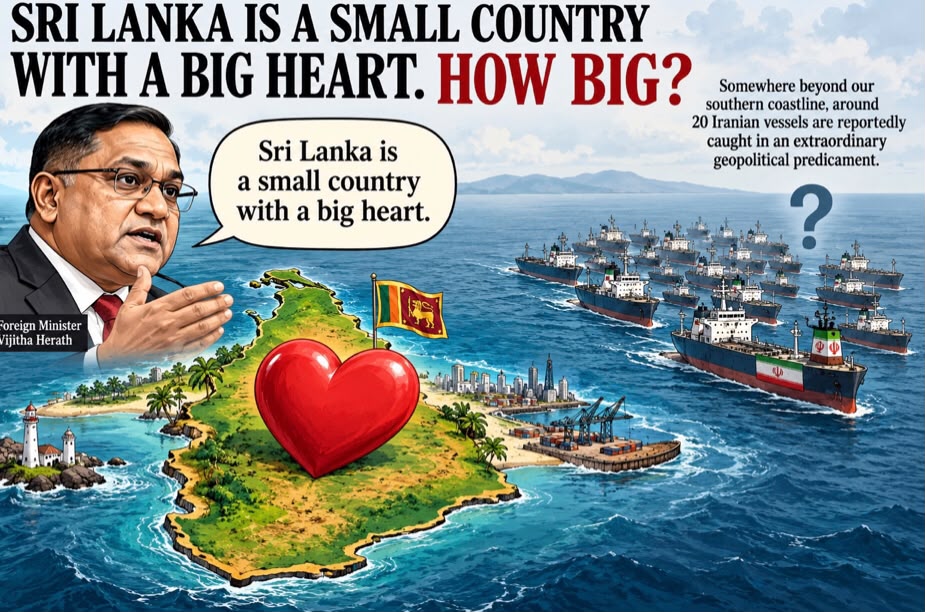
Foreign Minister Vijitha Herath says Sri Lanka is a small country with a big heart. Somewhere beyond our southern coastline, around 20 Iranian vessels are reportedly caught in an extraordinary geopolitical predicament. If their crews genuinely need food, drinking water and medicine, Sri Lanka may soon have an opportunity to discover whether that big heart is strong enough to act.
There was something rather appealing about Foreign Minister Vijitha Herath’s description of Sri Lanka as a small country with a big heart. We like to think of ourselves that way and, throughout our history, ordinary Sri Lankans have frequently demonstrated a generosity towards strangers that bears little relationship to the amount of money in their pockets.
But a big heart is easiest to display when there is no price attached to compassion. The more difficult test comes when doing the decent thing might irritate somebody considerably bigger and more powerful than ourselves.
Submit Your Press Release
Get your company news, announcements, launches, appointments and events in front of a wider audience.


That may now be the question presented by the Iranian vessels reported to be lying in international waters off Sri Lanka’s southern coastline. Before anything else happens, the circumstances aboard those ships must be independently established because humanitarian action cannot be based upon rumour. If reports that crews are running short of drinking water, food, medicines and sufficient fuel to maintain essential shipboard systems are correct, however, this ceases to be merely a question about Iran and American sanctions.
It becomes a question about people. Sri Lanka has no reason to involve itself in the political confrontation between Washington and Tehran. We have important relationships with both countries and preserving those relationships is sensible foreign policy. Neither should humanitarian assistance become a convenient disguise for sanctions-busting, supplying commercial cargo or providing sanctioned vessels with what they need to resume ordinary commercial operations.
There is, however, an enormous moral difference between helping a government evade sanctions and giving a sailor drinking water.
That distinction is where Sri Lanka should be prepared to stand its ground. If international sanctions permit genuinely humanitarian assistance, and appropriate legal advice establishes that Sri Lankan citizens and companies can provide it without violating applicable restrictions, why should we look away?
The United States should be asked the same question. Sanctions are intended to exert pressure upon governments and economies in pursuit of foreign-policy objectives. Are they also intended to prevent an ordinary crew member aboard a vessel from receiving medicine, food or drinking water? If the answer is no, there should be no dispute. If the answer is yes, then Washington should be prepared to defend that position openly.
This need not become Sri Lanka standing up to “The Donald”, much as that might provide an irresistible headline. Trump is entitled to pursue the foreign policy he believes serves American interests. Sri Lanka is equally entitled to determine what serves ours, provided we remain within international law. And importantly we are not, unlike Israel, a defacto American state like Israel is often likened to.
Friendship with powerful countries should never require smaller countries to abandon independent judgement. Neither should opposition to American policy automatically make somebody a supporter of Iran. That increasingly fashionable demand that every international issue requires us to choose a camp is precisely how small countries surrender their foreign-policy independence.
Perhaps this is also an opportunity for Sri Lanka’s private sector and ordinary citizens.
If the humanitarian need is verified and the legal position permits it, could Sri Lankan companies, charities, religious organisations and citizens assemble supplies of food, bottled water and essential medicines? Could a properly authorised humanitarian flotilla carry those supplies from Sri Lanka to vessels whose crews genuinely require them, with every box declared, every donor identified and every transaction transparent?
There should be nothing clandestine about it. Invite the authorities to inspect everything. Invite international observers if necessary. Publish what was supplied and to which vessel it went. Humanitarian assistance conducted openly is rather different from sanctions evasion conducted secretly.
It would also answer an uncomfortable question about the world in which smaller countries increasingly find themselves. International order cannot mean that powerful countries establish the rules and everybody else quietly looks askance when those rules produce consequences that offend basic humanity. America has been enormously important to Sri Lanka. Iran has been a longstanding friend too. Neither relationship requires us to surrender the elementary proposition that hungry people should be fed, thirsty people should receive water and sick people should have access to medicine.
The Government should therefore establish the facts first. If there is no humanitarian emergency aboard these vessels, there is nothing further to discuss. If there is, Sri Lanka should establish precisely what assistance can legally be provided and then have the confidence to provide it.
Foreign Minister Vijitha Herath has already given us the measure by which that decision can be judged. Sri Lanka, he says, is a small country with a big heart.
We agree.
Now we would like to know how strong that heart is.
NEWSLINE would also like to hear from its readers. If the humanitarian need aboard these vessels is independently confirmed and assistance can lawfully be provided, should Sri Lanka’s Government, private sector and ordinary citizens help provide food, water and essential medicines?
Send us just one word: YES or NO.
Be that as it may.