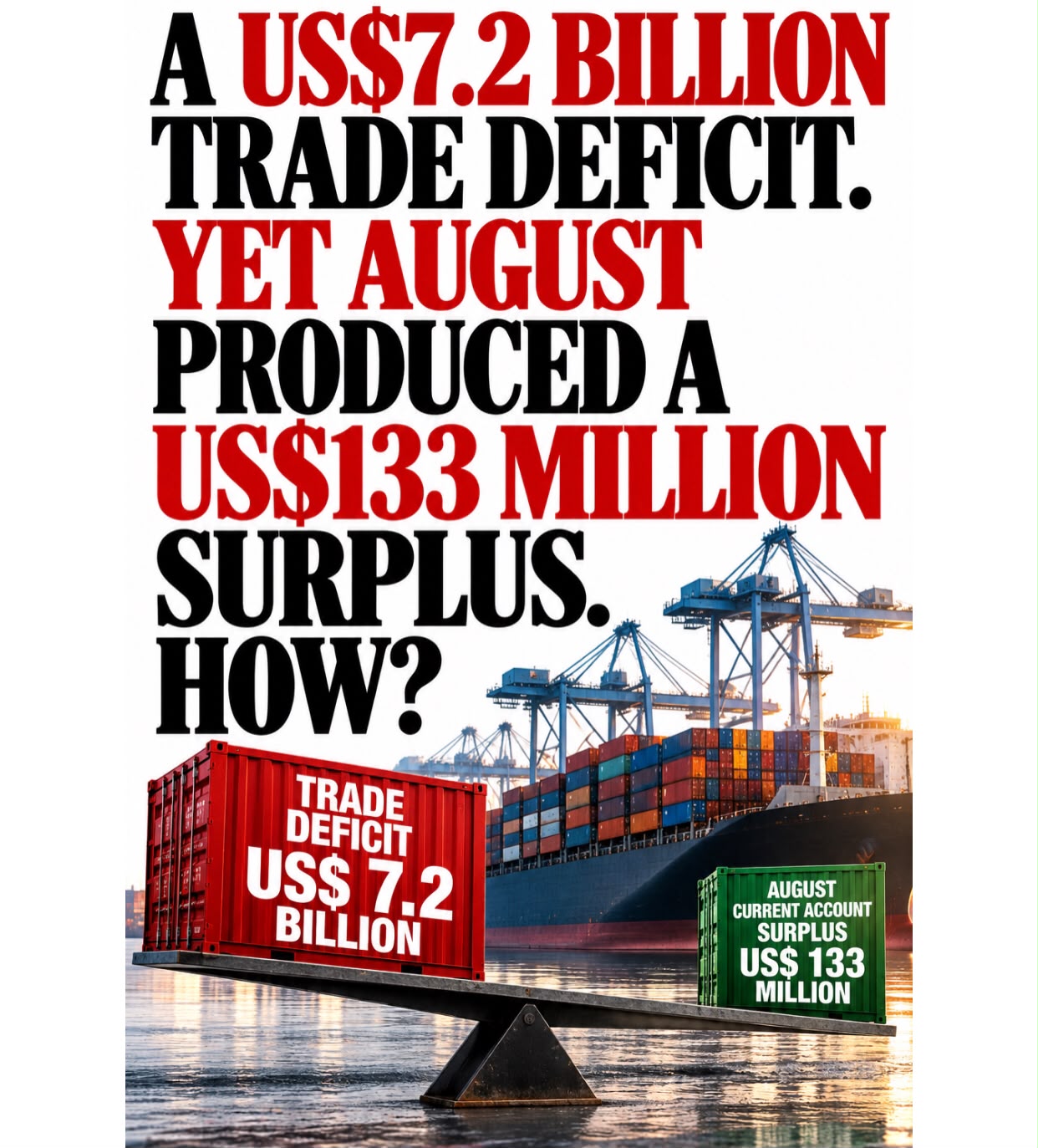
Sri Lanka bought considerably more goods from overseas than it sold during the first eight months of 2026. Yet in August the country’s current account returned to a US$133 million surplus after four consecutive monthly deficits. There is no contradiction. The explanation lies in tourism, services and, above all, Sri Lankans working overseas.
Sri Lanka’s merchandise trade numbers look uncomfortable. During January to August the country accumulated a trade deficit of approximately US$7.2 billion, substantially wider than the US$4.3 billion recorded during the corresponding period of 2025.
Then comes another number.
Submit Your Press Release
Get your company news, announcements, launches, appointments and events in front of a wider audience.


Sri Lanka recorded a current-account surplus of US$133 million in August.
At first sight the two appear difficult to reconcile. If Sri Lanka is buying substantially more goods from the world than the world is buying from Sri Lanka, how can the country’s external current account possibly move into surplus?
The answer is that merchandise is only part of Sri Lanka’s economic relationship with the outside world.
A container of garments leaving Colombo counts towards merchandise exports. A tanker arriving with petroleum counts towards merchandise imports. But foreign currency also enters and leaves Sri Lanka through tourism, transport, financial and other services, investment income and transfers including workers’ remittances.
Put those flows together and we reach the current account.
August is therefore particularly instructive.
The monthly trade deficit narrowed compared with preceding months as import expenditure moderated. The services account simultaneously recorded a surplus of approximately US$220 million, while workers’ remittances reached US$749 million during the month, 10 percent higher than a year earlier.
Those remittances are doing an extraordinary amount of work.
During the first eight months of 2026, Sri Lankans working overseas sent home approximately US$6.1 billion, an increase of 19.8 percent compared with the same period last year. That is foreign currency entering the country without a container leaving the port in exchange.
Tourism provided another important inflow. Earnings were estimated at approximately US$264 million during August and US$2.1 billion for the first eight months, although cumulative tourism earnings were 10 percent lower than during the same period last year.
Put these different flows together and August ended with a US$133 million current-account surplus, the first monthly surplus after deficits from April through July.
There is nevertheless an important qualification. One good month does not erase the previous four. For January to August as a whole, Sri Lanka’s current account remained in deficit by approximately US$291 million. Tthe substantial pressure created by higher imports, particularly following the Middle East energy shock.
The August number therefore represents improvement rather than resolution.
It also exposes something fundamental about the structure of Sri Lanka’s economy.
The country’s merchandise trade account can sustain a very large deficit because other Sri Lankans are earning foreign currency elsewhere. Migrant workers send money home, tourists bring money in and service industries earn foreign exchange without necessarily shipping a physical product overseas.
There is nothing inherently wrong with that. Modern economies do not have to balance merchandise imports and exports independently, and services can be every bit as economically valuable as manufacturing.
The danger lies in becoming dependent upon inflows over which Sri Lanka has limited control.
A recession in countries employing Sri Lankan workers can affect remittances. A war or global downturn can reduce tourism. Changes in migration policies can alter labour flows. International competition can affect services just as easily as it affects manufactured exports.
Sri Lanka therefore needs to understand the difference between having enough foreign currency today and possessing a resilient mechanism for earning it tomorrow.
There is also a human dimension hidden inside the remittance number. US$6.1 billion did not appear because Sri Lanka discovered an unusually productive natural resource. Much of it exists because Sri Lankans left their families and went abroad to work.
That money is invaluable to households and to the national balance of payments. But an economy should perhaps hesitate before treating the export of its people as an indefinitely expandable solution to the weakness of its export industries.
August’s US$133 million surplus is consequently good news. It demonstrates that Sri Lanka’s external economy has enough different sources of foreign currency to compensate, at least temporarily, for an enormous merchandise deficit.
The question is whether that is resilience or dependence.
The answer probably contains a little of both.