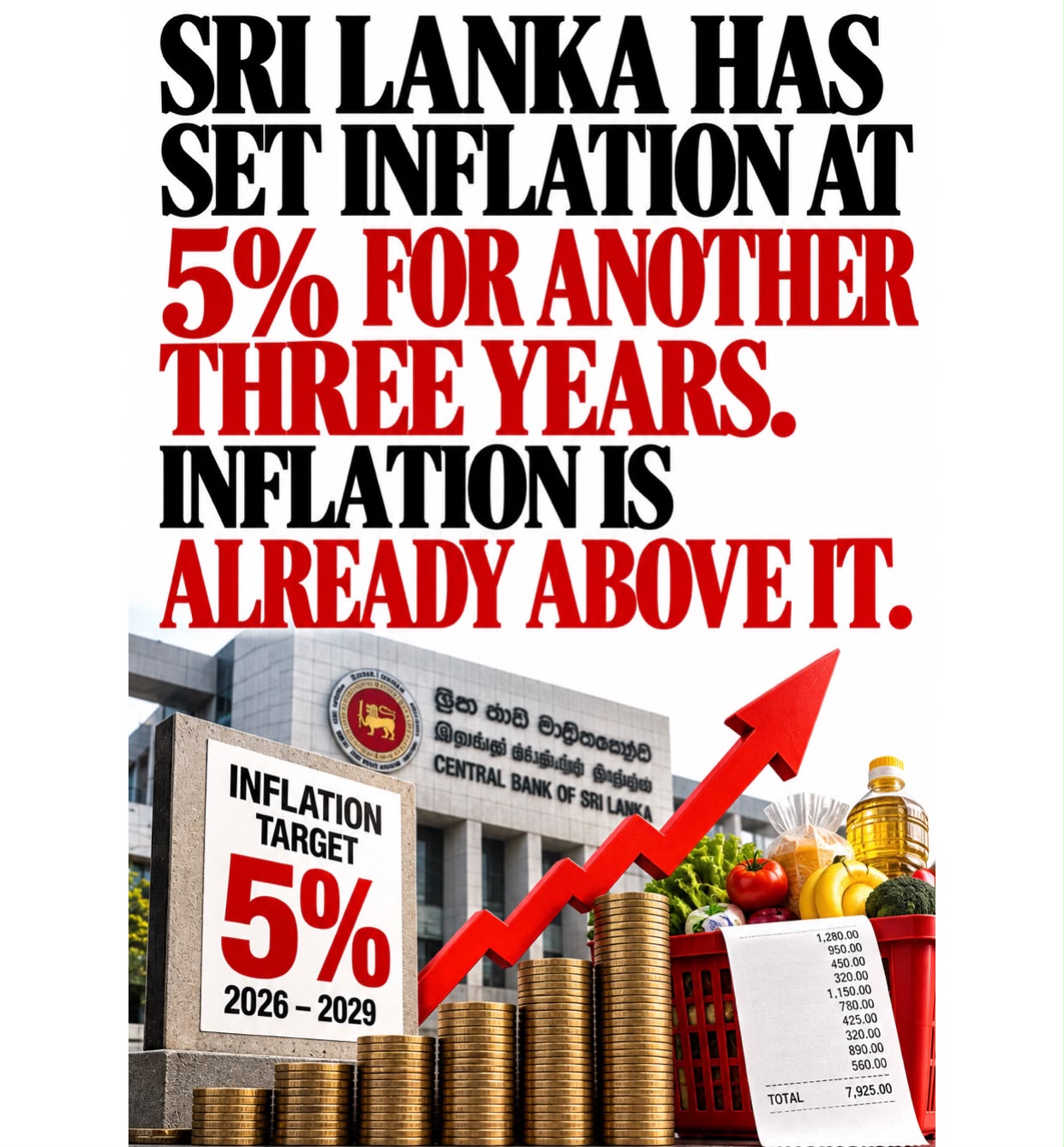
Sri Lanka has formally retained its 5 percent inflation target for the next three years, with a tolerance band of two percentage points either side. It provides the Central Bank with a clear destination. The awkward part is that inflation has already moved beyond the upper boundary and the Bank has just decided not to increase interest rates again.
Central banks like targets because monetary policy works partly through expectations. If households, businesses, investors and workers believe inflation will remain reasonably stable, they make decisions on prices, wages, borrowing and investment accordingly.
Sri Lanka’s target remains 5 percent.
Submit Your Press Release
Get your company news, announcements, launches, appointments and events in front of a wider audience.


The new agreement between the Government and the Central Bank retains that figure for another three years under the country’s flexible inflation-targeting framework. Inflation is permitted to fluctuate within a band of two percentage points either side, effectively creating a normal operating range between 3 and 7 percent.
That gives us an immediate problem.
Headline inflation is already 8 percent.
The Central Bank therefore begins the new three-year target period with inflation above the upper edge of its tolerance band. At the same time, it has decided to keep the Overnight Policy Rate at 8.75 percent rather than tighten monetary policy further.
Those two decisions are not necessarily contradictory.
The Central Bank does not attempt to force every temporary movement in inflation immediately back to 5 percent. Monetary policy operates with a lag, and attempting to crush a short-lived external price shock with dramatically higher interest rates could inflict unnecessary damage upon businesses, borrowers and economic growth.
The source of the inflation matters too.
Sri Lanka has been hit by substantially higher international energy prices because of the Middle East crisis. Increasing interest rates in Colombo cannot reduce the cost of crude oil produced thousands of kilometres away, nor can it eliminate higher freight and insurance costs caused by geopolitical disruption.
The Government has also intervened through fuel subsidies, preventing the full increase in international petroleum prices from immediately reaching consumers. That has helped suppress some of the inflation that would otherwise have appeared in the headline number.
The Central Bank is therefore looking beyond today’s 8 percent and asking where inflation is likely to be months from now.
That is exactly what it should do.
But an inflation target becomes credible only if businesses and households believe the Central Bank will eventually act when inflation persistently refuses to return towards it.
This is where core inflation becomes important. A temporary increase in fuel or food prices can push headline inflation higher without necessarily indicating that the entire economy has developed an inflation problem. If underlying price pressures begin spreading across goods and services, however, the Central Bank has a considerably more difficult decision.
Sri Lanka knows what happens when inflation expectations become detached from reality.
During the economic crisis, inflation accelerated to levels at which ordinary household budgeting became almost meaningless. Prices changed rapidly, savings lost purchasing power and businesses struggled to predict what inputs would cost even several months ahead.
The return to single-digit inflation was therefore not merely a statistical achievement. It restored a degree of predictability to economic life.
The 5 percent target is intended to preserve that predictability.
There is nevertheless another point worth understanding. Five percent inflation does not mean prices remain unchanged. It means the general price level can increase approximately 5 percent each year.
At 5 percent annual inflation, something costing Rs 10,000 today would cost roughly Rs 12,760 five years later if its price moved exactly with the overall index. That is why wage and income growth matter alongside the inflation number.
Stable inflation is not the same as cheap living.
The Central Bank’s task is therefore not to return Sri Lanka to the prices that existed before the crisis. That is neither its target nor a realistic objective. Its job is to prevent the purchasing power of money being eroded unpredictably and to keep inflation sufficiently low and stable for the economy to function.
For the next three years, the destination remains 5 percent.
The first challenge is getting back inside 7.