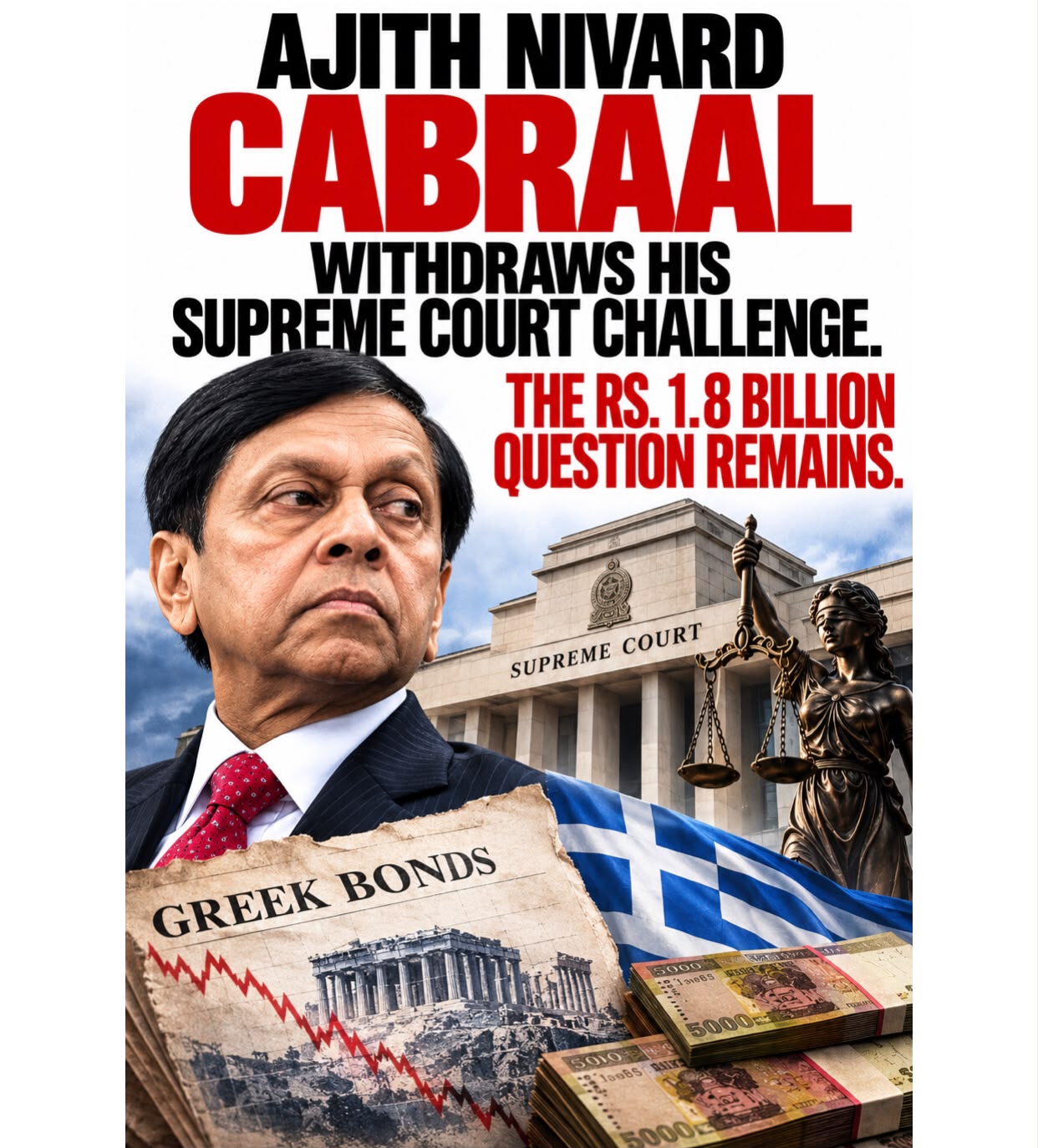
Former Central Bank Governor Ajith Nivard Cabraal has withdrawn his Supreme Court petition challenging proceedings arising from Sri Lanka’s controversial investment in Greek sovereign bonds. The withdrawal comes as a three-judge High Court bench considers his application for acquittal. Fourteen years after the transactions, the case continues to raise important questions about investment decisions, criminal responsibility and the management of public money.
Former Central Bank Governor Ajith Nivard Cabraal withdrew his Supreme Court petition on Friday, 9 October, bringing to an end his latest attempt to challenge the legal basis of proceedings concerning the Central Bank’s investments in Greek sovereign bonds.
The Supreme Court, headed by Chief Justice Preethi Padman Surasena, permitted the withdrawal following submissions by President’s Counsel Dilan Ratnayake, appearing for Cabraal.
Submit Your Press Release
Get your company news, announcements, launches, appointments and events in front of a wider audience.


The decision does not constitute an acquittal, nor does it establish the allegations against him. It leaves the substantive proceedings before the Colombo High Court Trial-at-Bar to be determined according to law.
The case concerns investments made during the period when Greece was experiencing a severe sovereign debt crisis. The Commission to Investigate Allegations of Bribery or Corruption alleges that the transactions caused the Sri Lankan State losses exceeding Rs. 1.8 billion.
Cabraal has consistently disputed criminal liability.
His defence maintains that the transactions represented legitimate investment decisions and that the prosecution has failed to establish the elements necessary to sustain the charges.
The distinction between an investment that loses money and a criminally improper investment is fundamental.
Financial markets involve risk. Government securities, including sovereign bonds, may experience substantial changes in value following economic or political developments. A loss does not automatically establish corruption, dishonesty or criminal negligence.
Equally, the fact that a transaction involves a recognised financial instrument does not place it beyond scrutiny.
The relevant questions concern what information was available when the investment decisions were taken, whether applicable procedures were followed, whether risks were properly assessed and whether the conduct alleged satisfies the legal requirements of the offences charged.
Those are matters for the court.
The procedural history of this case has been unusually complicated.
The Bribery Commission previously withdrew an indictment before filing fresh charges under different provisions of the Anti-Corruption Act. Cabraal challenged the legality of that course, arguing that the subsequent proceedings were improper.
The High Court Trial-at-Bar rejected his preliminary objections in July.
Cabraal subsequently approached the Supreme Court seeking to overturn that decision and obtain relief from the proceedings.
Friday’s withdrawal followed an indication that the Trial-at-Bar was expected to deliver an order concerning a separate application made on his behalf.
In that application, the defence has sought an acquittal without further evidence being recorded, maintaining that the prosecution has failed to establish its case.
The three-judge bench comprises Manoj Thalgodapitiya, Udesh Ranatunga and Buddhika Sri Ragala.
The continuing proceedings illustrate the difficulties involved in determining criminal responsibility for financial decisions made many years earlier.
Documents must be examined in their proper historical context. Investment conditions prevailing at the time must be distinguished from developments that became apparent only afterwards.
It would be inappropriate to judge an investment exclusively by the eventual outcome if the relevant risks could not reasonably have been anticipated.
But it would be equally inappropriate to disregard evidence of foreseeable risks merely because the transaction was undertaken by a public financial institution.
The court must determine whether the prosecution has established criminal conduct, not simply whether the investment proved unsuccessful.
There is also a wider question concerning accountability within the Central Bank.
Sri Lanka’s monetary authority is entrusted with responsibilities extending far beyond ordinary commercial investment. Decisions involving public financial resources require professional judgment, institutional safeguards and appropriate supervision.
Where losses occur, the public is entitled to understand how the decisions were made and what lessons were subsequently learned.
That expectation does not diminish the presumption of innocence enjoyed by Cabraal or any other defendant.
Indeed, the integrity of the process depends upon maintaining that distinction.
Sri Lanka has experienced repeated controversies involving financial decisions taken by public officials. Some have resulted in criminal investigations, while others have produced political accusations without corresponding judicial findings.
The country must resist the temptation to treat every financial loss as evidence of corruption.
It must also resist the opposite temptation of assuming that technical complexity makes financial decisions immune from examination.
The Greek bonds case provides an opportunity for the courts to apply the law to a disputed investment decision without political interference.
Cabraal’s withdrawal of his Supreme Court petition is a procedural development.
The central questions remain unresolved.
Whether the prosecution has established the alleged offences, whether the defence is entitled to an acquittal at this stage and what responsibility, if any, attaches to the decisions concerned must be determined through the judicial process.
Fourteen years after the transactions, Sri Lanka is still waiting for those answers. As for the infamous Bond Scam, well that’s been going on since February 2015. Why is that investigation languishing as part of the laws delays?