
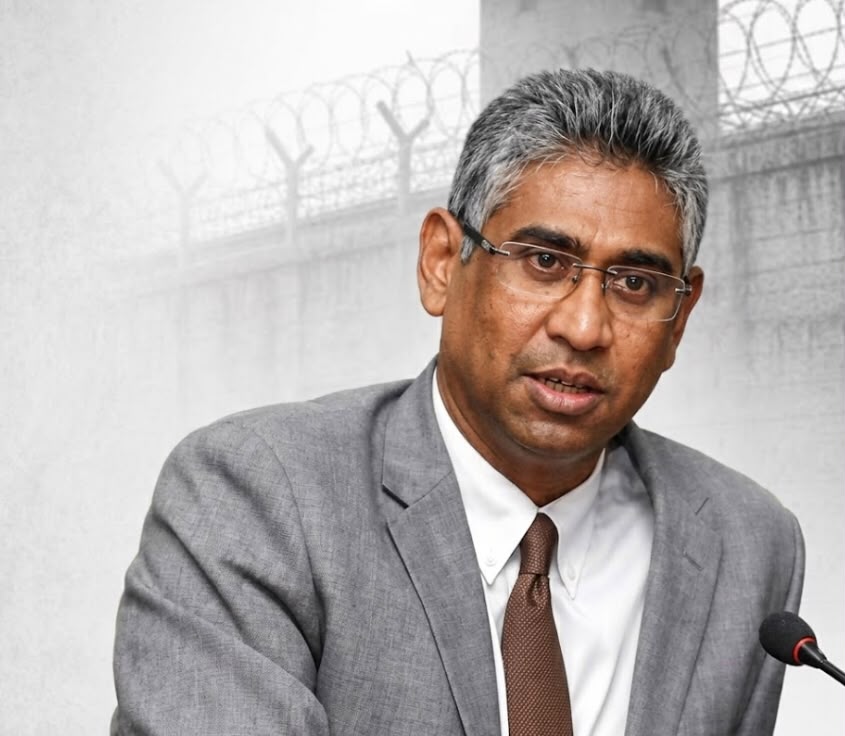
Reacting to the violence, Mr Musthapha said that while accountability must always follow any serious incident, immediate political point-scoring does little to address the deeper structural challenges facing the country’s correctional system.
Mr Musthapha recalled that President Anura Kumara Dissanayake, while serving in the Opposition, had observed that “those held in correctional institutions also have rights” and that persons in State custody are entitled to the protection of the State.
“Those observations reflected an important constitutional principle,” Mr Musthapha said.
“Now that the Government has assumed responsibility for the administration of the country, it has an opportunity to translate those principles into reality. The measure of a democracy is not only how it protects the freedoms of its citizens, but also how it safeguards those whose liberty has been lawfully restricted.
Ensuring secure, humane and professionally managed correctional institutions is therefore not merely a prison policy objective – it is a national obligation.”
“That was an important statement then, and it remains an important principle today,” Mr Musthapha said. “Now that the Government holds the reins of power, there is an opportunity to translate that principle into practical reality by strengthening conditions within our correctional institutions while ensuring the safety of prison officers, inmates and the wider public.”
“What Sri Lanka needs now is not another political contest, but a united national response.”
Mr Musthapha observed that the Government’s intensified campaign against illegal narcotics may have inevitably increased pressure within the prison system, with correctional institutions becoming an increasingly important front in the wider battle against organised criminal networks.
“If that is indeed the case, it reminds us that this is not simply a prison administration issue. It is part of a much broader national security challenge. The illegal drug trade destroys lives, devastates families, exploits our young people and ultimately undermines the future progress of our country.”
He said the country’s response should therefore extend beyond managing individual incidents and instead focus on strengthening institutions.
“Our prison officers carry enormous responsibility under exceptionally difficult conditions. At the same time, every individual held in State custody is entitled to safety, dignity and treatment consistent with the rule of law. These are not competing principles. They are the hallmarks of a mature democracy.”
He called for a comprehensive programme to strengthen the prison system through greater investment in infrastructure, modern technology, intelligence capabilities, staff training, rehabilitation programmes and the operational resources necessary to address evolving security threats.
“Providing our correctional institutions with the resources they require is not merely expenditure.
It is an investment in national security, public confidence and the proper administration of justice.”
Mr Musthapha said meaningful and lasting reform would require cooperation across political parties, the judiciary, law enforcement agencies, prison authorities and civil society.
“The fight against organised crime and illegal narcotics cannot be won by any single institution acting alone. It demands coordination, professionalism and a shared commitment to the national interest.”
Concluding his remarks, Mr Musthapha urged Sri Lankans to move beyond political division.
“When incidents such as these occur, our first instinct should be to ask how we strengthen our institutions and prevent a recurrence – not simply who should be blamed. If we genuinely place the national interest above politics, we will build a correctional system that is more secure, more humane and better equipped to protect our society.”
“The national interest must always come before politics.”


