Sri Lanka’s digital information landscape is changing. For decades, important information has been available, but often scattered across government websites, legal publications, regulatory notices, company filings, stock-market disclosures, tax documents and institutional databases. Finding the right information has therefore frequently been as much of a challenge as understanding it.
Lanka Data is attempting to solve that problem at the infrastructure level.
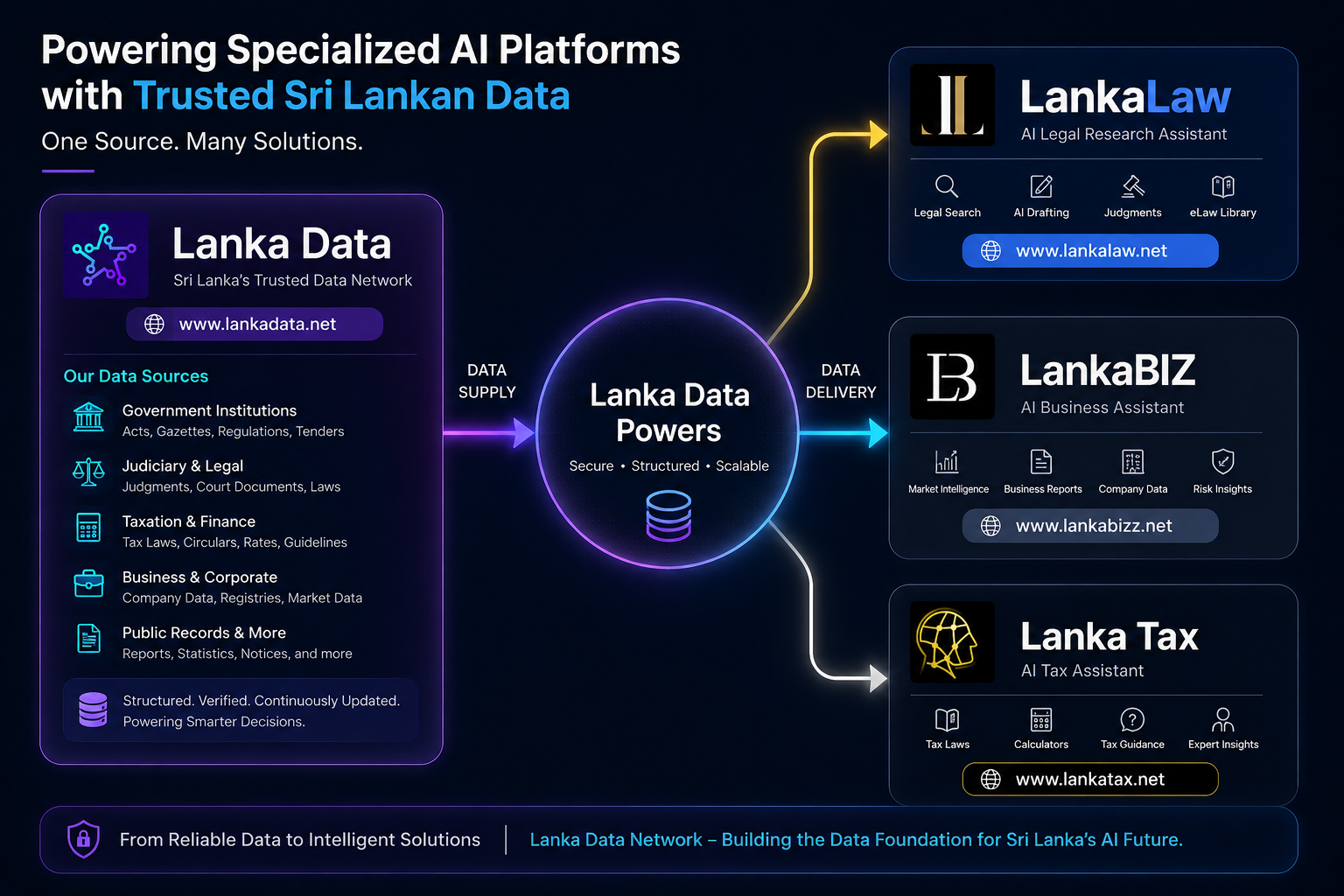
At Lanka Data, the focus is on collecting, structuring, indexing and continuously updating Sri Lankan public information and making it available through intelligent search, APIs and specialised AI systems. The same data foundation can then serve different professional applications. Today, that model is particularly visible through LankaLAW, LankaBIZ and LankaTAX.
Submit Your Press Release
Get your company news, announcements, launches, appointments and events in front of a wider audience.


The significance of the ecosystem is therefore not simply that it offers three AI websites. It is that the three platforms are being built around a common Sri Lankan data infrastructure.
From scattered information to an intelligence infrastructure
Lanka Data says its repositories draw information from institutions including the Colombo Stock Exchange, Central Bank of Sri Lanka, Registrar of Companies, National Medicines Regulatory Authority, Sri Lanka Customs, Inland Revenue Department and other official public authorities. It states that information is processed, indexed and standardised while preserving the integrity of the original public records.
That distinction is important.
A conventional website might simply reproduce documents. A general-purpose AI model might know something about Sri Lanka from its training data. Lanka Data is taking a different route: build a structured information layer first and then allow AI systems to retrieve the relevant information when it is needed.
Its Intelligent Layer describes this architecture explicitly. Curated datasets are standardised and indexed, with Retrieval-Augmented Generation (RAG) systems retrieving relevant information at the time of a query. The platform says its archive contains more than 90,000 Sri Lankan public documents and that its broader data infrastructure spans legal, taxation, business, news, pricing and education domains.
This creates an important separation between data and application.
The data can be maintained centrally, while different AI applications can use that information for completely different purposes.
That is where LankaLAW, LankaBIZ and LankaTAX come in.
LankaLAW: Making Sri Lankan Law Searchable and Intelligent
LankaLAW is the legal application built around this approach.
LankaLAW began as an AI-powered legal research assistant and has developed into a broader legal technology platform. It brings together Sri Lankan legislation, case law and legal publications with AI-assisted research, judicial analysis and drafting. The platform says it was launched in March 2024 as Sri Lanka’s first publicly launched AI platform for legal research and analysis.
The legal information available through LankaLAW includes Supreme Court and Court of Appeal judgments, Acts and amendments, legislative enactments, Gazettes, Bills, New Law Reports, Sri Lanka Law Reports and consolidated legislation.
This is where the underlying Lanka Data concept becomes particularly valuable.
Legal research is not simply a matter of finding a document. A lawyer may need to determine which legislation applies, identify relevant judicial decisions, understand the reasoning of a court and establish how different authorities relate to one another.
LankaLAW’s AI Legal Research system is designed around that problem. Users can search legal material using natural-language questions rather than relying exclusively on conventional keyword searches. Its Judicial Analysis capability is intended to help analyse judgments, identify legal principles and extract important findings.
The platform has also moved into AI-assisted legal drafting. Its current services include the generation of agreements, pleadings, motions, affidavits, letters and other legal documents, supported by its underlying legal information environment.
More recently, LankaLAW has been extending the model beyond technology alone. Its relationship with LankaLaw Chamber brings professional legal expertise into the same ecosystem, connecting legal information and AI-assisted research with access to lawyers.
That is an important direction for professional AI: the objective is not necessarily to replace lawyers, but to allow lawyers and clients to work with information much more efficiently.
LankaBIZ: Turning Corporate and Economic Data into Business Intelligence
LankaBIZ applies the same philosophy to business and investment.
LankaBIZ describes itself as a business intelligence platform covering Sri Lanka’s economy, businesses, stock market, regulations, corporate intelligence and predictive analytics. Its platform brings together an AI assistant, market information, economic indicators, business regulations, company research and financial-market research.
This is particularly relevant in Sri Lanka because information about a company is rarely contained in one place.
An investor may need a company’s financial statements, CSE announcements, industry information, economic conditions, regulatory developments and market performance before reaching a conclusion.
LankaBIZ brings these areas together.
Its dashboard covers the Colombo Stock Exchange, including ASPI, S&P SL20, turnover, gainers, losers and sector performance. Its economic section covers indicators such as GDP, inflation, exchange rates, reserves and tourism, while its regulatory section brings together business laws, tax updates, Gazettes, compliance and licensing information.
The platform also has a substantial research component. Its Research Hub covers economic outlooks, stock-market outlooks, sector analysis, company research, quarterly updates and annual reviews.
This is more than an AI chatbot.
The objective is to create a working environment in which an investor, entrepreneur or corporate executive can move from information to analysis without having to manually assemble the entire information set.
LankaBIZ has also experimented with new formats for research. Its research podcast series provides analysis of listed companies and market developments, with AI used to accelerate production while research is curated by investment analysts.
The business-intelligence platform therefore combines three elements: structured information, AI-assisted analysis and professional research.
That combination is potentially much more powerful than any one of those components on its own.
LankaTAX: Bringing Tax Information, Calculation and Assistance Together
LankaTAX applies the same data-and-AI concept to taxation.
Tax information is particularly difficult to navigate because it changes frequently and is spread across legislation, amendments, circulars, rulings, Gazettes, forms, schedules and administrative guidance.
LankaTAX brings these materials together with an AI Tax Assistant, tax calculators, forms, guides and access to professional assistance.
Its tax-information environment covers Tax Acts and amendments, tax circulars, public rulings, IRD Gazettes, Customs tariffs, Treasury publications, tax forms and tax schedules.
The platform’s approach is particularly practical. Instead of stopping at the question, “What does the tax law say?”, LankaTAX attempts to take the user through the next stages: understanding the applicable rule, calculating the potential liability, identifying the necessary forms and obtaining assistance where required.
Its current platform includes calculators for areas such as individual income tax, employment tax, company tax, withholding and advance income tax, VAT, stamp duty and other tax categories.
The AI Assistant provides a natural-language interface for questions concerning Sri Lankan tax laws, IRD circulars, rulings and tariffs.
The human component is also significant. LankaTAX maintains a directory connecting users with tax consultants, accountants and professional advisory firms.
The result is a model that combines tax data, AI, calculations and professional assistance rather than treating tax AI simply as a question-and-answer service.
One Data Layer, Three Professional Applications
The relationship between the platforms becomes clearer when viewed as an architecture.
Lanka Data sits underneath.
It collects and structures information from Sri Lankan public and official sources. That information is indexed and made accessible through search, APIs and AI retrieval systems.
LankaLAW applies that infrastructure to law.
LankaBIZ applies it to business, companies, markets and economics.
LankaTAX applies it to taxation and compliance.
The underlying principle remains the same.
Data is collected once, structured properly and then used intelligently across specialised applications.
This is potentially one of the most important aspects of the model.
A legal AI does not need to independently build an entirely separate national legal-data infrastructure if it can draw from a common data layer. Similarly, business intelligence and tax intelligence can build on specialised repositories maintained within the same wider ecosystem.
The API Changes the Proposition
Lanka Data’s developer platform takes this idea one step further.
The platform currently advertises more than 100 API endpoints and access to structured information covering areas such as companies, judgments, stock information, pharmaceutical registrations and intellectual property. It describes the APIs as secure REST services returning structured JSON data.
This means Lanka Data can potentially serve not only its own websites but also other software applications.
That is a fundamentally different proposition from operating a collection of consumer websites.
If developers can access structured Sri Lankan information through APIs, Lanka Data becomes infrastructure upon which other applications can be built.
A fintech company could potentially use corporate or market information. A legal software provider could integrate legal data. An accounting platform could connect to tax information. A research organisation could incorporate economic datasets into its own analytical systems.
In that model, LankaLAW, LankaBIZ and LankaTAX are not the end of the architecture. They are examples of what can be built on top of it.
The Importance of Local AI
There is another dimension to the ecosystem: localisation.
Lanka Data says its intelligent layer works with Chat2Find’s fine-tuned model and supports Sinhala, Tamil and English. Its data architecture is therefore being designed not merely around Sri Lankan information, but around the way Sri Lankan users communicate with that information.
This is particularly important in areas such as law and taxation.
Sri Lankan legal terminology, institutional names, tax concepts and administrative language are highly localised. A system can therefore become significantly more useful when the underlying information and the language model are both adapted to the Sri Lankan environment.
The objective is not simply to make a global AI model speak Sinhala or Tamil.
It is to create an AI system that understands Sri Lankan information in its local context.
From Search to Decision Support
The broader significance of Lanka Data is therefore the transition from search to decision support.
Traditional search asks:
“Where can I find this information?”
A structured AI platform asks:
“What does this information mean for the question I am trying to solve?”
For a lawyer, that could mean identifying the legislation and case law relevant to a legal issue.
For an investor, it could mean bringing together financial performance, market information and economic conditions.
For a taxpayer, it could mean moving from the applicable rule to an indicative calculation and the documentation required for compliance.
The quality of the final answer still depends on the quality and currency of the underlying information. That is precisely why the data layer matters.
Building a Sri Lankan Intelligence Ecosystem
Lanka Data’s ambition appears to extend beyond the three applications currently at the centre of this ecosystem.
Its datasets already span legal, economic, taxation, business and regulatory information, while its wider platform references areas including education, news, pricing, pharmaceuticals and intellectual property.
This creates the possibility of a growing family of specialised AI applications, each addressing a particular area while drawing from a common information infrastructure.
The model could eventually look less like a collection of websites and more like a Sri Lankan digital intelligence stack:
Official information
→ Lanka Data
→ Structured datasets and APIs
→ AI retrieval and domain models
→ LankaLAW / LankaBIZ / LankaTAX and other specialised applications
→ Professionals, businesses, investors, researchers and citizens
That is the bigger story.
The real innovation behind LankaLAW, LankaBIZ and LankaTAX may not be the AI interface that users see on their screens.
It is the infrastructure underneath it.
Lanka Data provides the common information foundation. LankaLAW turns that foundation into legal intelligence. LankaBIZ turns it into business and investment intelligence. LankaTAX turns it into tax intelligence.
Each platform addresses a different professional problem, but they share the same underlying philosophy: make Sri Lankan information structured, searchable, current and usable by intelligent systems.
That creates a potentially powerful model for the next stage of Sri Lanka’s digital economy.
Rather than building AI applications first and searching for data afterwards, the Lanka Data approach starts with the data itself.
Reliable data becomes the foundation.
AI becomes the intelligence layer.
Specialised platforms turn that intelligence into practical tools.
And ultimately, that is what makes the relationship between Lanka Data, LankaLAW, LankaBIZ and LankaTAX more significant than four separate websites: together they represent an attempt to build a connected, Sri Lanka-focused information and AI ecosystem.