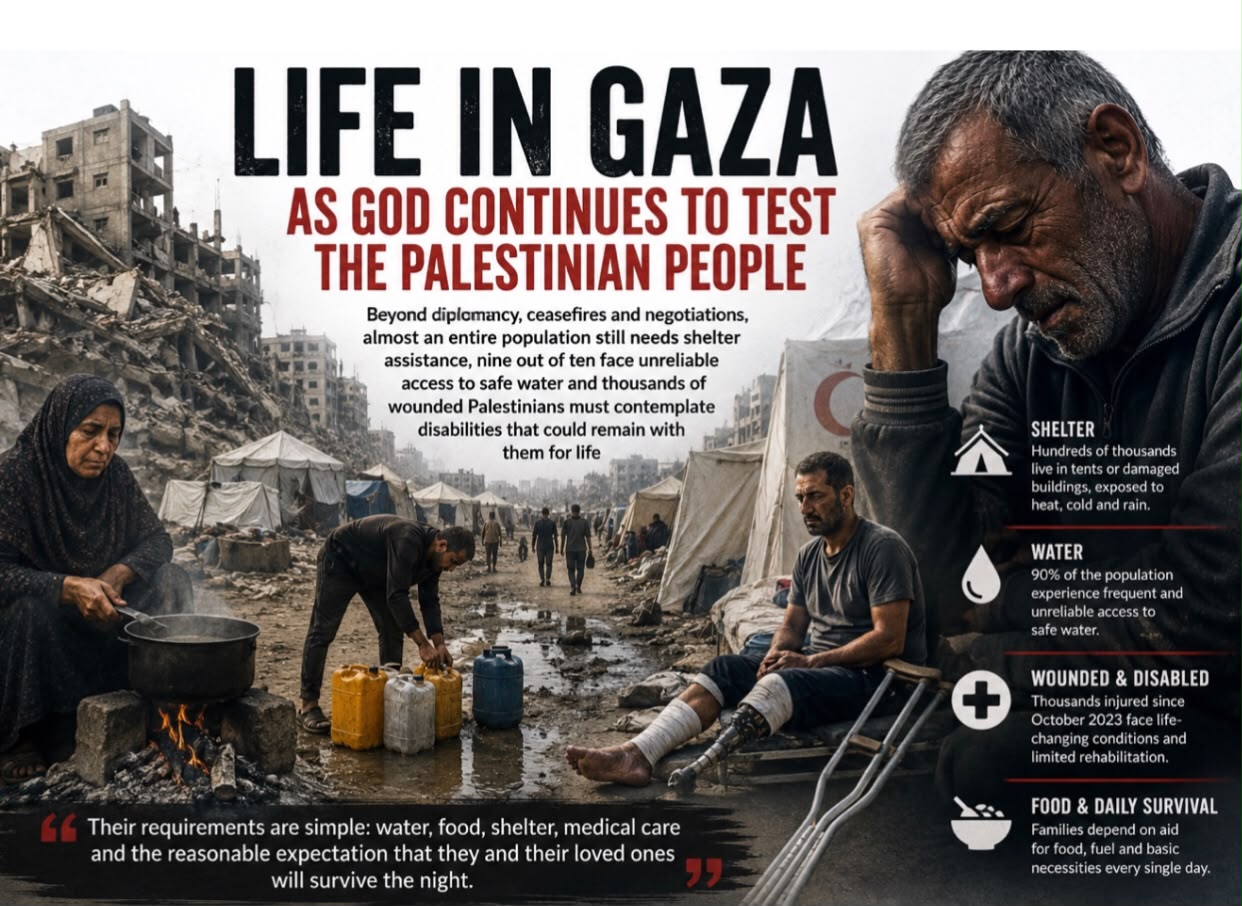
Beyond diplomacy, ceasefires and negotiations, almost an entire population still needs shelter assistance, nine out of ten face unreliable access to safe water and thousands of wounded Palestinians must contemplate disabilities that could remain with them for life
GAZA – For the people of Gaza, survival is increasingly measured through ordinary things which much of the world takes for granted: finding enough clean water for a family, obtaining bread, reaching a doctor, keeping children safe and discovering somewhere sufficiently secure to sleep when darkness arrives.
The international conversation surrounding Gaza is again dominated by negotiations, demilitarisation, reconstruction proposals and the future political administration of the territory. The United States has committed more than USD 206 million towards a proposed international stabilisation force intended eventually to form part of a wider peace arrangement, yet disagreements between Israel and Hamas continue to obstruct implementation of the plan.

For Palestinians living inside Gaza, those arguments concern a future which has yet to arrive. Their present circumstances remain defined by displacement, damaged infrastructure and an extraordinary dependence upon humanitarian assistance, even after the intensity of fighting was reduced under the ceasefire announced in October 2025.
The latest detailed United Nations humanitarian assessment says most people in Gaza remain internally displaced and continue living in harsh conditions while exposed to military activity. A survey completed in July found that 90 per cent of the population experienced frequent and unpredictable disruption to safe and reliable water for drinking, cooking and hygiene, up from 84 per cent only a month earlier. In Gaza City, 92 per cent of surveyed households were classified as moderately to highly water insecure.
Water scarcity describes only part of daily existence. Sewage or sludge was reported within ten metres of the shelters of 43 per cent of households surveyed, while humanitarian agencies continue to struggle with access, spare parts, fuel and the ability to reach damaged infrastructure. For a displaced family, sanitation therefore becomes another daily calculation alongside food and shelter.
Humanitarian organisations continue to provide food on an enormous scale. During the first days of August, partners distributed general food assistance to about 189,000 people, while 97 kitchens were producing approximately 691,000 meals every day across more than a thousand locations. Twenty-eight subsidised bakeries were producing about 100,000 two-kilogram bundles of bread daily, supplemented by private bakeries operating with humanitarian fuel support.
Those figures reveal both the achievement of the humanitarian operation and the scale of Gaza’s continuing dependency. Hundreds of thousands of meals must be prepared every day because the normal economic system through which people earn money, purchase food and provide for their families has been profoundly damaged.
Health presents an even longer-lasting challenge. The UN’s humanitarian agencies estimate that approximately one-quarter of Palestinians injured since October 2023 may be living with potentially life-changing conditions including amputations, spinal-cord injuries and traumatic brain injuries. Children account for 18 per cent of amputations and almost a third of recorded spinal-cord and traumatic brain injuries, while specialised paediatric rehabilitation services are unavailable inside Gaza.
For those children, the war will consequently not end when the politicians declare that the war has ended. A child who has lost a limb, suffered a spinal injury or experienced serious neurological trauma may require rehabilitation, assistive equipment and medical treatment for decades, long after Gaza has disappeared from the front pages of the world’s newspapers.
Healthcare itself continues to operate under considerable pressure. The World Health Organization recorded 45 attacks affecting healthcare in Gaza during 2026 by the time of the latest UN reporting, with medical transport frequently affected and evacuation operations obstructed, delayed or subjected to searches. Patients and accompanying relatives were detained in some reported incidents.
Violence has also continued despite the ceasefire. Gaza’s Ministry of Health reported seven Palestinians killed and 28 injured between August 5 and 12, bringing its reported toll since the October 10, 2025 ceasefire announcement to 1,259 fatalities and 4,148 injuries. The figures underline that a ceasefire has reduced the scale of warfare without creating the ordinary security which the word “peace” might suggest.
There is consequently a danger in allowing Gaza to become another geopolitical argument conducted exclusively through the language of governments. Israel speaks of security and the disarmament of Hamas, Hamas maintains its own political and military demands, Washington advances a post-war framework and regional governments debate who should administer, police and reconstruct the territory.
The Palestinian family trying to obtain drinking water lives somewhere beneath all of those arguments.
So does the child waiting for rehabilitation, the parent trying to obtain bread and the displaced family wondering whether another temporary shelter will have to become home. Their requirements are neither ideological nor complicated: water which is safe to drink, sufficient food, medical care, somewhere secure to live and the reasonable expectation that their children will survive the night.
Gaza will eventually require billions of dollars for reconstruction, but rebuilding roads and buildings will be only one part of what is required. Schools, hospitals, businesses and utilities must return, while a generation of children carrying physical injuries, interrupted educations and memories of repeated displacement will require support long after the concrete has been replaced.
For now, the people of Gaza continue with the far more immediate business of living. As God continues to test the Palestinian people, their endurance is found not in the declarations of politicians but in families continuing to feed children, doctors continuing to treat patients and communities continuing to function in circumstances under which ordinary life itself has become an act of perseverance.