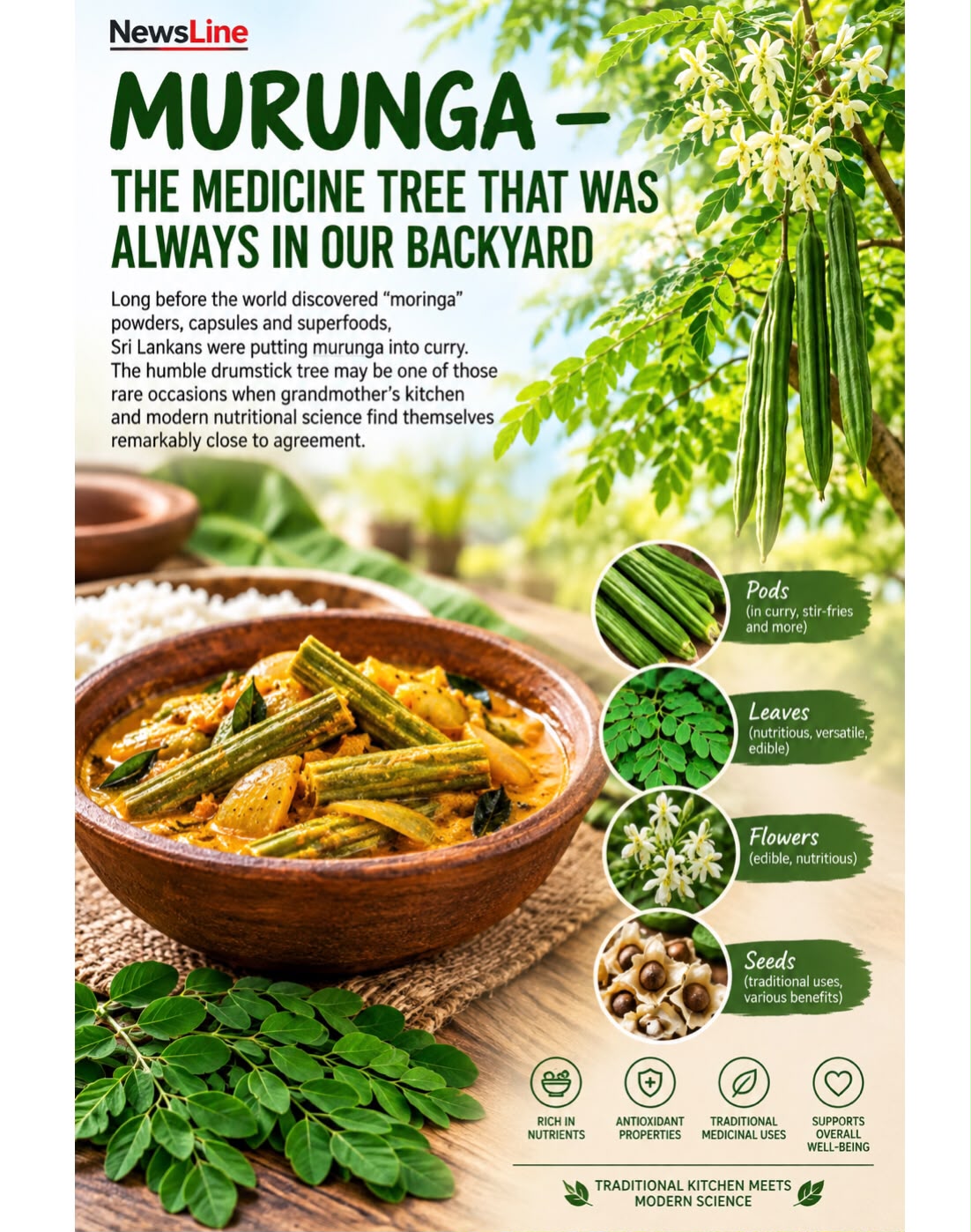
Long before the world discovered “moringa” powders, capsules and superfoods, Sri Lankans were putting murunga into curry. The humble drumstick tree may be one of those rare occasions when grandmother’s kitchen and modern nutritional science find themselves remarkably close to agreement.
There is something wonderfully Sri Lankan about murunga. It grows without much ceremony, appears regularly at the pola, finds its way into a curry and, for generations, has been treated as an entirely ordinary vegetable.
Except that Moringa oleifera, to give murunga its botanical name, is anything but ordinary.
Submit Your Press Release
Get your company news, announcements, launches, appointments and events in front of a wider audience.


Across the world it has acquired considerably grander descriptions: the drumstick tree, the horseradish tree and, inevitably, the “miracle tree.” Moringa powders, teas, capsules and extracts have become part of an international health-food industry. Yet much of what is now being marketed abroad as an exotic superfood has been growing in South Asian gardens and being eaten at South Asian tables for generations.
The interesting part is that underneath some of the marketing hype lies a genuinely impressive food.
MORE THAN THE DRUMSTICK
For most Sri Lankans, murunga means the long green pods cooked in curry. The pleasure is almost ritualistic: split the cooked pod, scrape the soft flesh and seeds from inside with the teeth, and leave the fibrous outer skin behind.
But the pod is only part of the story.
The leaves are edible. So are the flowers and immature seeds, while different parts of the tree have long been used in traditional systems of medicine. Modern research has concentrated particularly heavily on the leaves because of their combination of nutrients and biologically active plant compounds.
Moringa leaves contain protein, carotenoids, vitamins and minerals as well as compounds including flavonoids, phenolic acids, glucosinolates and isothiocyanates. Researchers have consequently become interested not simply in moringa as a vegetable, but as a potentially valuable functional food.
That distinction matters.
Calling murunga nutritious is supported by substantial evidence. Calling it a medicine capable of curing a catalogue of diseases is an altogether bigger claim.
WHAT CAN IT ACTUALLY DO?
Laboratory and animal studies involving moringa have produced intriguing findings concerning antioxidant and anti-inflammatory activity and possible effects on blood glucose, blood lipids and other metabolic processes. There has consequently been considerable interest in its potential relevance to diabetes, cardiovascular disease and other chronic illnesses.
But here is where the miracle-tree enthusiasm needs some restraint.
A major systematic review concluded that although moringa has a long history in traditional medicine and possesses a large collection of interesting phytochemicals, the evidence from human clinical trials remains limited. Much of the pharmacological evidence comes from laboratory or animal studies rather than the large, rigorous human trials needed before something can legitimately be described as a treatment.
Indeed, a 2026 systematic review and exploratory meta-analysis examining moringa in relation to high blood sugar and hypertension found that human studies remain small and their findings contradictory.
In other words, eat your murunga. Just don’t throw away your prescription medicine because somebody on the internet calls it a miracle tree.
A SERIOUS NUTRITIONAL FOOD
Where the argument becomes considerably stronger is nutrition.
Moringa leaves have attracted attention as a potentially useful food in communities affected by nutritional deficiencies. A systematic review examining moringa leaf supplementation found some promising human results involving haemoglobin and vitamin A status, although the researchers stressed that the evidence remained limited and that larger, better trials were required.
That may ultimately be murunga’s greatest value.
Sri Lanka does not need to turn an inexpensive local food into an expensive bottle of imported-looking capsules before appreciating it.
The tree grows in tropical conditions. Different parts can be eaten. The leaves can be incorporated into ordinary food. The pods are already part of Sri Lankan cuisine. And the plant contains precisely the sort of micronutrients and phytochemicals that have made nutrition researchers take it seriously.
There is also something economically interesting here.
The world has managed to take Moringa oleifera, package it as a wellness product and sell it back to consumers in powdered, bottled and branded form. Scientific reviews now describe moringa not only in terms of nutrition and pharmacology but also as having substantial commercial potential in functional foods, nutraceuticals and other products.
Sri Lanka already has the tree, the climate, the culinary tradition and the agricultural knowledge.
Perhaps the question is whether we have recognised the value.
AND WHAT ABOUT THE MURUNGA CURRY?
There may be a lesson here about the way we think about food.
The modern wellness industry has a habit of searching distant cultures for the next extraordinary ingredient. A familiar plant receives an unfamiliar English name, becomes a powder, acquires fashionable packaging and suddenly commands a price completely unrelated to what it once cost in the village market.
Murunga has travelled much the same road.
There is nothing wrong with developing moringa as an export crop or producing properly regulated value-added products from it. Quite the opposite: that could represent an opportunity for Sri Lankan agriculture.
But the science also suggests something considerably simpler.
A varied diet containing vegetables, leaves, pulses, fruit and other minimally processed foods remains rather more important than any single supposed superfood. Murunga can make a useful contribution to that diet because it happens to be nutrient-rich not because it possesses magical properties.
There are cautions too. Concentrated extracts and supplements are not the same thing as eating normal quantities of the vegetable, and reviews have identified potential toxicity at sufficiently high doses of some preparations. Anyone taking medication, particularly for conditions such as diabetes or hypertension, should therefore be wary of treating concentrated moringa products as harmless substitutes for medical treatment.
For generations Sri Lankans did something rather less complicated.
They picked it. They cooked it. And they ate it.
Now science is examining in laboratories what generations discovered through food and experience: murunga is an unusually interesting tree and an exceptionally useful food.
Perhaps we became so accustomed to seeing it hanging over the garden fence that we stopped noticing what was there.
The world calls it Moringa oleifera and increasingly sells it as a superfood. We simply called it murunga. And, be that as it may, sometimes grandmother Jazeema knew rather more than the marketing department.