Prime Melwa’s Port City development has been presented as a US$127.6 million investment and its marina-front project as a major vote of confidence in Sri Lanka. The project itself appears substantial and potentially valuable. But NEWSLINE went looking behind the headline number and the Government’s own Gazette tells a rather more complicated story.
There is little doubt that Prime Melwa’s proposed luxury waterfront development at Colombo Port City is a significant project. Cabinet has granted Prime Melwa Port City (Pvt) Ltd the status of a Primary Business of Strategic Importance, while the developer has subsequently signed an agreement for what has been described as the remaining marina and waterfront residential development within Port City.
The figure widely attached to the project has been US$127.6 million.
Submit Your Press Release
Get your company news, announcements, launches, appointments and events in front of a wider audience.


That sounds like US$127.6 million being invested in constructing a new luxury development in Sri Lanka.
The Government’s own Gazette, however, provides considerably more detail.
Gazette Extraordinary No. 2488/04 of May 11 identifies Prime Melwa Port City (Pvt) Ltd as the authorised business, specifies its Port City plot as 1-02-04 and gives the land area as 16,406.35 square metres.
More importantly, it breaks the proposed investment into its constituent parts.
The proposed investment for the lease of the land is Rs 16,586,608,397.
The proposed investment in development is US$75,770,000.
The project is expected to generate 835 employment opportunities and carries an implementation period of four years.
Those figures help explain how the much larger US$127.6 million headline number appears to have been reached.
Convert approximately Rs 16.59 billion into dollars at the relevant exchange rate and the land component is worth roughly US$52 million. Add the US$75.77 million development investment and the result comes remarkably close to US$127.6 million.
That is an important distinction.
It suggests that the US$127.6 million figure should not necessarily be understood as US$127.6 million of new foreign capital arriving in Sri Lanka to construct the development. A substantial part of the headline project value represents the cost of obtaining the Port City land.
There is nothing improper about including land in the total value of a development. Developers routinely calculate project costs that way.
But when Sri Lanka is measuring foreign direct investment, the distinction between the total value of a project and actual foreign currency entering the country matters enormously.
Port City’s own subsequent announcement makes that distinction particularly interesting.
In June the Colombo Port City Economic Commission said three Primary Businesses of Strategic Importance Prime Melwa, Marina Hotel Holdings and Home Lands Port City had combined land and development costs of approximately Rs 125 billion.
But it separately said those projects included approximately US$262 million in foreign inflows over the following five years.
That is arguably the more important number.
Sri Lanka does not simply need projects with impressive valuations. It needs dollars coming into the country, productive investment, construction, employment and eventually economic activity capable of generating recurring foreign exchange.
Prime Melwa’s development may well deliver all of those things. The marina-front location is among Port City’s most valuable pieces of real estate and the project is being positioned at international high-net-worth buyers and expatriates as well as the luxury domestic market.
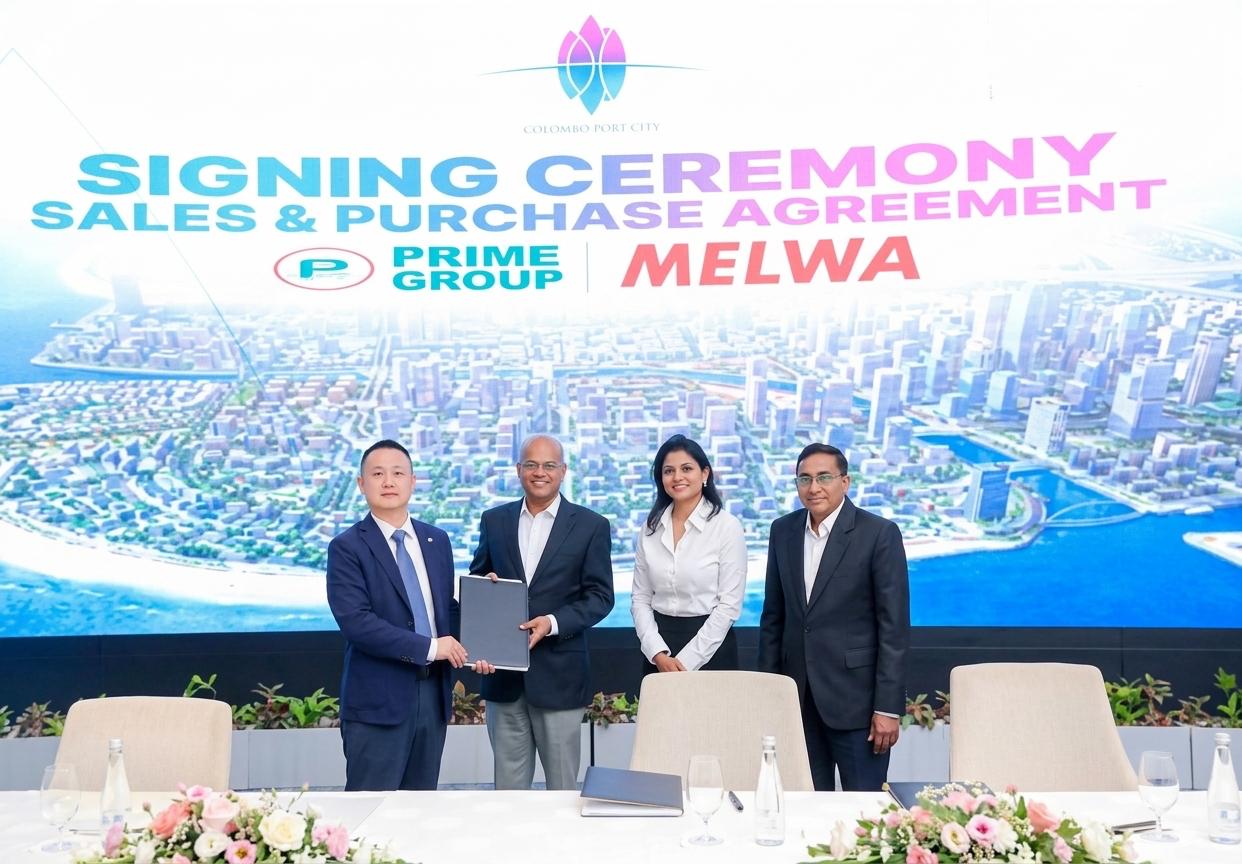
Prime Melwa subsequently signed a Sales and Purchase Agreement with CHEC Port City Colombo for what was described as the only remaining marina and waterfront residential development within Port City. The proposed development is expected to contain a luxury residential tower overlooking the marina and Indian Ocean.
That appears consistent with the Prime Melwa development which received strategic status earlier in May rather than evidence, by itself, of an entirely separate second investment.
And this is where NEWSLINE believes some clarification is necessary.
Reports have subsequently referred to a US$112.2 million waterfront development together with a substantial rupee component. NEWSLINE has searched the official Cabinet material presently available, the Gazette governing Prime Melwa’s strategic status, Port City Commission announcements and the developer’s own material.
We have not presently located an official Cabinet decision establishing that this represents an additional US$112.2 million Prime Melwa investment separate from the already approved project.
Until that is clarified, simply adding US$112.2 million to the previously reported US$127.6 million risks counting investment that may overlap.
There is a second issue worth considerably more public attention: the incentives.
Prime Melwa has been designated a Primary Business of Strategic Importance. That status matters because it provides access to exemptions and incentives under the Port City regulatory regime.
The present Government has actually tightened that regime.
The earlier framework permitted extraordinarily long tax concessions, including a 25-year full exemption for qualifying Primary Businesses followed by another ten years at a reduced rate. The revised framework substantially shortened those concessions, with the maximum corporate income-tax holiday for Primary Businesses reduced to 15 years.
That is an important improvement in fiscal discipline.
But the public should still be able to see the bargain.
If Sri Lanka grants a developer tax concessions worth millions of dollars, the relevant question is not simply whether tax has been forgone. It is whether the investment, employment, foreign-exchange
earnings and wider economic activity created by the concession are worth more to the country than the revenue sacrificed.
The 2026 amendments to the Port City legislation have strengthened that principle. Businesses receiving strategic incentives are required to file tax returns, while the Finance Ministry must publish annual information concerning the tax expenditure associated with Businesses of Strategic Importance.
That creates the possibility of measuring Port City by something rather more meaningful than press releases.
How much tax did Sri Lanka give up? How much genuine foreign capital came in? How many jobs were created? How much foreign exchange was subsequently earned?
And did the country receive more economic value than it surrendered in concessions?
Prime Melwa’s project therefore remains potentially good news.
A major Sri Lankan private-sector consortium committing capital to Port City, constructing a landmark marina development and attempting to sell Sri Lankan property internationally would be a welcome sign of confidence after the economic collapse.
But confidence should not require creative arithmetic.
A US$127.6 million project is not necessarily the same thing as US$127.6 million of foreign investment. The official documentation tells us that Prime Melwa’s project includes approximately Rs 16.59 billion for land and US$75.77 million for development.
And before another US$112.2 million is added to the Port City investment scoreboard, somebody should establish whether it really represents another project and another pot of money or another description of investment already announced.
Be that as it may, Port City has spent years selling Sri Lanka a very large promise. As buildings finally begin moving from artists’ impressions towards reality, the Government now has an opportunity to do something equally important.
Show us the money not merely the headline number.