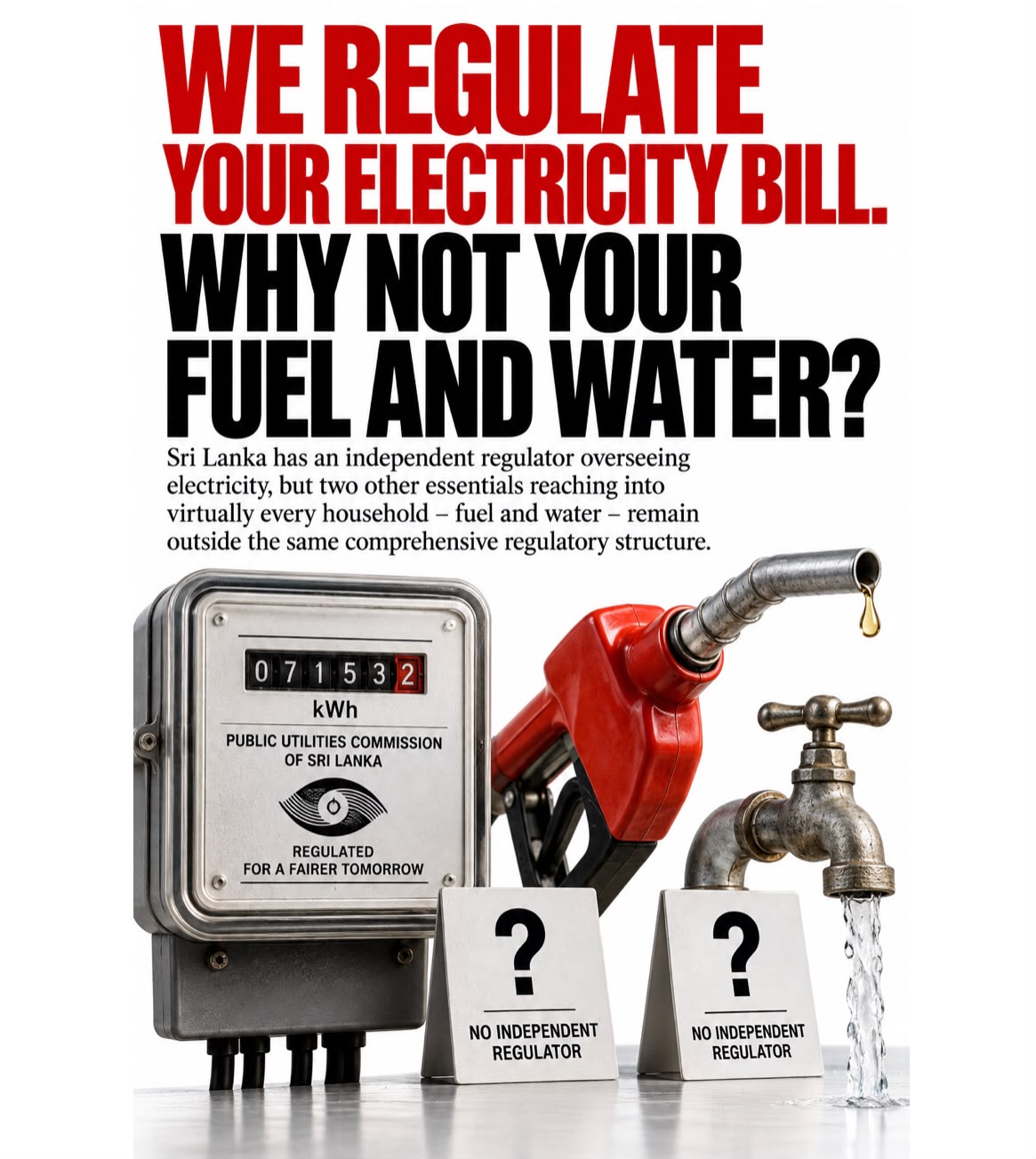
Sri Lanka has an independent regulator overseeing electricity, but two other essentials reaching into virtually every household fuel and water remain outside the same comprehensive regulatory structure. A proposal before Parliament wants to change that. It raises a deceptively simple question: who independently protects the consumer when the State is also the supplier?
Every time the price of petrol changes in Sri Lanka, millions of people feel it almost immediately. The motorist sees it at the filling station, but within days it travels through bus fares, three-wheelers, delivery charges, food prices and eventually much of the economy.
Water is even more fundamental. It arrives through a State-controlled system and the consumer has little practical choice about where to buy it.
Submit Your Press Release
Get your company news, announcements, launches, appointments and events in front of a wider audience.


Yet neither petroleum nor water presently sits within the same comprehensive independent regulatory framework that applies to electricity.
A proposal placed before Parliament by Opposition MP Nalin Bandara Jayamaha seeks to bring industries connected with petroleum, fuel and water under the regulation of the Public Utilities Commission of Sri Lanka.
It deserves considerably more attention than an ordinary Private Member’s Motion because behind it lies an important question about how Sri Lanka regulates monopolies and essential services.
The Public Utilities Commission is already familiar to electricity consumers. It examines tariff proposals, holds public consultations, considers costs and can require the electricity industry to justify what consumers are being asked to pay.
That system is by no means perfect. Consumers may disagree violently with a tariff decision and governments inevitably remain involved in energy policy. But there is at least an institution standing between the producer and the person receiving the bill.
Petroleum presents a rather different picture.
Sri Lanka now has more than one fuel supplier following the entry of international operators, but the market remains heavily influenced by Government policy, taxation, import costs, exchange rates and the pricing formula. Fuel prices are announced periodically and the public is essentially presented with the result.
The consumer sees the number on the filling-station board.
What he does not necessarily see in equally accessible form is every component which produced it.
How much represents the international cost of the product? How much is freight? What is the exchange-rate impact? What are the distribution margins? What taxes and levies have been imposed by the State? What return is being permitted to suppliers, and is that return reasonable?
There may be perfectly legitimate answers to all those questions.
Independent regulation provides a mechanism for asking them.
The issue becomes particularly important because Government occupies several positions simultaneously. It makes policy, imposes taxes, regulates aspects of the industry and, through State entities, participates commercially in the market.
That does not automatically produce abuse, but it does create an obvious argument for independent scrutiny.
The principle is straightforward. The institution selling an essential product should not effectively be the only institution determining whether the price charged for that product is reasonable.
Water presents an even stronger case.
Most households receiving piped water cannot choose another supplier. There is no competing water company offering a better tariff next door. The National Water Supply and Drainage Board therefore occupies the position of a natural monopoly for much of the population it serves.
Monopolies are precisely where independent economic regulation can matter most.
The Water Board has genuine costs. Water must be collected, treated, pumped and distributed. Infrastructure has to be maintained and expanded. Electricity costs alone can be substantial, while old pipelines and non-revenue water impose further costs on the system.
Nobody seriously suggests clean drinking water can be produced and delivered without somebody paying for it.
The question is who decides what constitutes an efficient cost and how much of inefficiency should be passed to the consumer.
If a utility loses an excessive proportion of its product through leaking infrastructure, should consumers simply pay more? If staffing costs become excessive, should they automatically appear in the tariff? If capital expenditure is poorly managed, who independently examines whether the resulting cost should be transferred to households?
Those are regulatory questions rather than political ones.
There is also an important protection for the utilities themselves.
Independent regulation does not necessarily mean lower prices. Sometimes an independent regulator may conclude that a tariff actually needs to increase because the existing price does not cover the legitimate cost of providing the service.
That can make the regulator unpopular.
But it also makes the decision more credible.
Sri Lanka has repeatedly damaged State enterprises by allowing politicians to suppress prices for electoral reasons, only for losses eventually to emerge somewhere else in the public finances. Consumers may temporarily enjoy an artificially cheap service, but taxpayers eventually receive the bill.
A genuinely independent regulator should protect consumers from unjustified prices while also protecting utilities from politically manufactured prices.
There is, however, a danger in simply adding petroleum and water to the PUCSL’s responsibilities without first ensuring the regulator has the technical expertise, statutory authority and institutional independence to perform those additional functions properly.
Regulating electricity is already complicated. Petroleum markets require different expertise involving international commodity prices, refining, storage, distribution and retail margins. Water regulation requires knowledge of treatment, networks, quality standards, infrastructure investment and the economics of natural monopolies.
Giving an institution a bigger nameplate without the people and expertise necessary to do the work achieves very little.
There is another question Parliament should address. If petroleum and water are brought under independent economic regulation, how transparent will the process actually be?
Consumers should be able to see the calculations.
If a litre of petrol costs a particular amount, publish the components in a form an ordinary motorist can understand. If a water tariff rises, show how much relates to electricity, wages, infrastructure, debt and losses in the network.
Transparency does not guarantee that people will like the price.
It allows them to understand why they are paying it.
Sri Lanka is attempting to rebuild confidence in the State after an economic collapse in which opaque decisions, badly managed public enterprises and enormous accumulated losses eventually landed on the population.
Independent regulation is one way of preventing that happening again.
The proposal before Parliament may therefore be worth developing beyond a Private Member’s Motion and into a serious discussion about the architecture governing essential public services.
The Government does not have to accept the proposal exactly as presented. There may be better institutional arrangements, separate regulators or amendments necessary to the existing law.
But the underlying question is difficult to dismiss.
A Sri Lankan switching on a light has an independent regulator somewhere in the system examining what he is being charged.
The same Sri Lankan can drive to a filling station and fill his tank, then return home and open the water tap.
Why should the principle of independent consumer protection suddenly disappear?
Be that as it may, petroleum and water are too important to become political footballs whenever prices have to change. If the Government believes the prices consumers are being charged are fair, efficient and economically justified, independent scrutiny should not frighten it.
It should prove it.