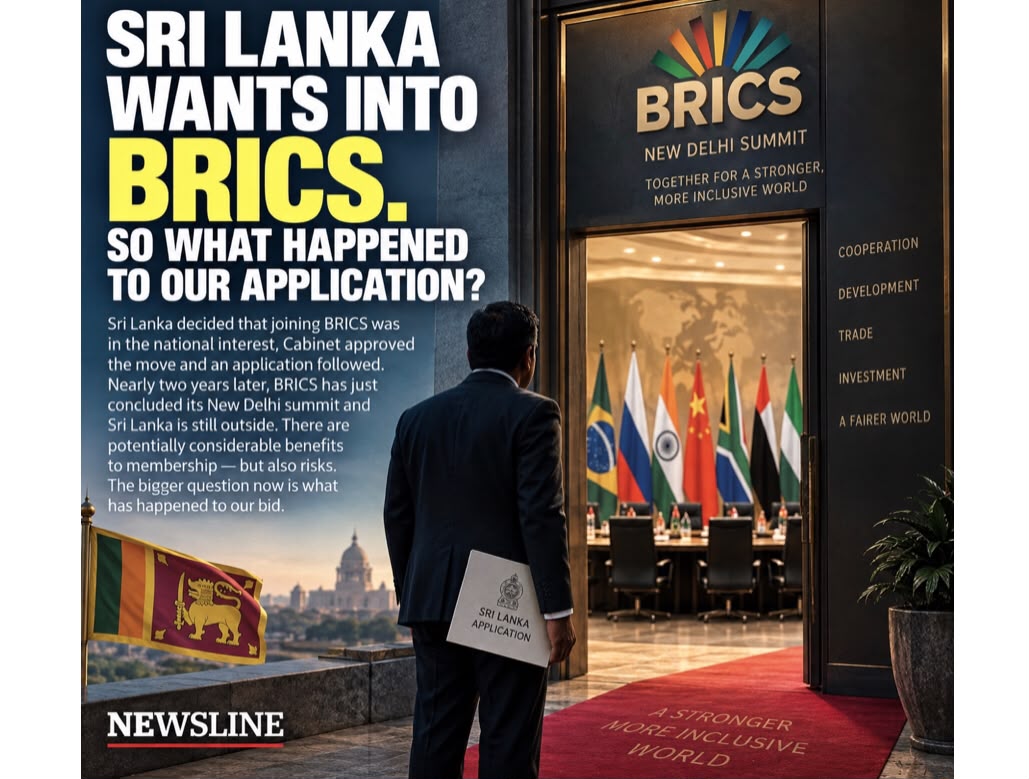
Sri Lanka decided that joining BRICS was in the national interest, Cabinet approved the move and an application followed. Nearly two years later, BRICS has just concluded its New Delhi summit and Sri Lanka is still outside. There are potentially considerable benefits to membership but also risks. The bigger question now is what has happened to our bid.
Sri Lanka wants to join BRICS, the increasingly influential grouping of emerging economies which began with Brazil, Russia, India, China and South Africa and has since expanded considerably. The attraction for a small economy recovering from sovereign default is understandable: some of the world’s biggest emerging markets, important sources of investment and several of Sri Lanka’s most important economic partners sit around the same table.
But Sri Lanka is not sitting there yet. Despite deciding in 2024 to seek membership, formally communicating its interest and approaching BRICS governments for support, Sri Lanka remains neither a full BRICS member nor one of its partner countries.
Submit Your Press Release
Get your company news, announcements, launches, appointments and events in front of a wider audience.


That is particularly striking after the BRICS summit held in New Delhi on September 12 and 13. India, the country Sri Lanka specifically approached for assistance with its membership ambitions, chaired the gathering, but there was no announcement that Sri Lanka had been admitted.
The original decision to apply was not made casually. An officials’ committee examined the advantages and disadvantages of joining BRICS and its New Development Bank before Cabinet approved the proposal. Foreign Minister Vijitha Herath subsequently sought the support of BRICS countries, while Sri Lanka participated in BRICS outreach discussions in Russia.
President Anura Kumara Dissanayake went further during his December 2024 visit to India. In discussions with Prime Minister Narendra Modi, he sought India’s support for Sri Lanka’s BRICS application. With India subsequently assuming the BRICS presidency, New Delhi was therefore always going to be important to Sri Lanka’s ambitions.
The argument for joining remains persuasive. Sri Lanka needs markets, investment, technology, tourists, development finance and, perhaps above all, economic options. BRICS offers access to a political and economic network extending through Asia, Africa, the Middle East and Latin America.
India and China alone make membership significant for Colombo. They are already central to Sri Lanka’s trade, investment, infrastructure and geopolitical calculations. The grouping also includes countries such as the United Arab Emirates, Russia, Indonesia, Egypt and other economies with which Sri Lanka could potentially deepen commercial relations.
Membership would not automatically produce exports or foreign investment. But international economic diplomacy is partly about access, and having Sri Lanka represented inside an organisation containing some of the world’s largest emerging economies would provide another platform from which to pursue trade, tourism, investment and technology partnerships.
There is also the New Development Bank, established by the original BRICS countries to finance infrastructure and sustainable development. Sri Lanka separately expressed its intention to join the NDB, which potentially offers another source of long-term development financing at a time when the country has enormous requirements in energy, transport, water and other infrastructure.
But this is where expectations need to be controlled. BRICS membership does not produce free money and neither does membership of the New Development Bank. Loans remain debts, projects must make economic sense and somebody eventually has to repay the money.
Sri Lanka should understand that lesson better than most. Changing the nationality of the lender does not change the arithmetic of an unsustainable project.
There is nevertheless a legitimate argument for widening the country’s financing options rather than remaining dependent upon a relatively narrow group of institutions and markets. Competition between credible sources of development finance could ultimately work to Sri Lanka’s advantage, particularly if financing is attached to commercially productive projects rather than political monuments.
BRICS is also encouraging greater use of national currencies in trade and developing mechanisms intended to improve cross-border payments between its economies. This has sometimes produced dramatic claims that BRICS is about to replace the US dollar with a new currency, but the present reality is considerably less revolutionary.
What is developing is greater interest in settling some transactions in national currencies and improving connections between payment systems. For a country that has experienced a catastrophic shortage of dollars, diversification is worth examining, although conducting a transaction in another currency does not solve Sri Lanka’s fundamental foreign-exchange problem.
We still have to earn enough from exports, tourism, services, remittances and investment to pay for what we import. BRICS cannot repeal arithmetic any more than the IMF can.
There are geopolitical disadvantages as well. BRICS includes Russia and Iran, both involved in profound confrontations with Western governments, while China and the United States are engaged in a much broader strategic competition that extends increasingly into the Indian Ocean.
Sri Lanka cannot afford to become collateral damage in somebody else’s geopolitical contest. The United States and Europe remain critically important export markets, particularly for garments, while Western countries, Japan and Western-led multilateral institutions remain important sources of investment, finance and economic support.
Joining BRICS therefore cannot sensibly be presented as Sri Lanka choosing the East over the West. The intelligent policy would be East and West.
India itself demonstrates how that can work. New Delhi sits at BRICS with China, Russia and Iran while simultaneously maintaining deep economic and strategic relationships with the United States, Europe, Japan and Australia. India calls that strategic autonomy.
Sri Lanka needs its own version of it, although as a much smaller and economically weaker country our margin for diplomatic error is considerably narrower.
China presents another complication. Its sheer economic size inevitably gives Beijing enormous influence within BRICS, and closer participation could create considerable opportunities for Sri Lanka. But this country has already discovered how quickly ports, infrastructure, research vessels and investment can become issues in the strategic competition between China, India and the United States.
BRICS membership should therefore increase Sri Lanka’s options rather than reduce them. Colombo gains little if joining one organisation is interpreted internationally as entering another country’s geopolitical camp.
That brings us back to the more immediate question: what has happened to Sri Lanka’s application?
When reports emerged in late 2024 suggesting Sri Lanka’s membership request had been rejected, the Foreign Ministry disputed them. The Government’s position was that Sri Lanka had not been rejected; BRICS had simply decided not to undertake another immediate expansion and Sri Lanka’s application remained among those to be considered.
That was an important distinction then. Nearly two years later it becomes reasonable to ask what has happened since.
BRICS now operates with both full members and a category of partner countries. Sri Lanka currently belongs to neither. The New Delhi summit specifically referred to expanding engagement with BRICS partner countries, yet Sri Lanka has not so far entered even that group.
There is a similar question surrounding the New Development Bank. Sri Lanka’s intention to join was welcomed publicly in 2024, but the Bank’s current published membership information does not list Sri Lanka among either its members or prospective members.
That does not necessarily mean either application has failed. It does mean the Government should tell the country precisely where they stand.
Is Sri Lanka’s application for full BRICS membership still formally under consideration? Has Colombo been offered or discussed partner-country status? Does every existing BRICS member support our admission? Has any country raised an objection? What diplomatic effort was undertaken ahead of the New Delhi summit, and what was the response? There is an especially obvious question for New Delhi. President Dissanayake personally asked Prime Minister Modi for India’s support in December 2024. India has now chaired BRICS and hosted its leaders virtually on Sri Lanka’s doorstep. Does India support Sri Lanka becoming a member, and if so, what is preventing the application from moving forward?
On balance, there remains a good case for Sri Lanka joining. Membership could widen our diplomatic reach, deepen access to important emerging economies, create another avenue for investment and development finance and give a small country another forum in which to advance its interests.
But BRICS will not rescue Sri Lanka’s economy. It cannot make inefficient state enterprises efficient, manufacture competitive exports, eliminate corruption, restore investor confidence or compensate for bad economic policy. Those remain Sri Lanka’s responsibility.
What BRICS can provide is another table and another set of relationships. For a strategically located island of some 22 million people attempting to navigate an increasingly divided world, having more serious economic relationships rather than fewer is generally an advantage.
Sri Lanka should be capable of working with China without antagonising America, deepening its relationship with India without surrendering its independence, maintaining relationships with Russia without abandoning Europe and seeking BRICS financing without walking away from the IMF, World Bank or Asian Development Bank.
That is not choosing sides. It is pursuing Sri Lanka’s interests.
Be that as it may, Colombo decided almost two years ago that joining BRICS was sufficiently important to make a formal application, seek support from member governments and ask the Indian Prime Minister personally to help. The BRICS leaders have now met in New Delhi and gone home, while Sri Lanka remains outside.
The question is no longer simply whether BRICS would be good for Sri Lanka. It is what happened to our application and does BRICS actually want us?