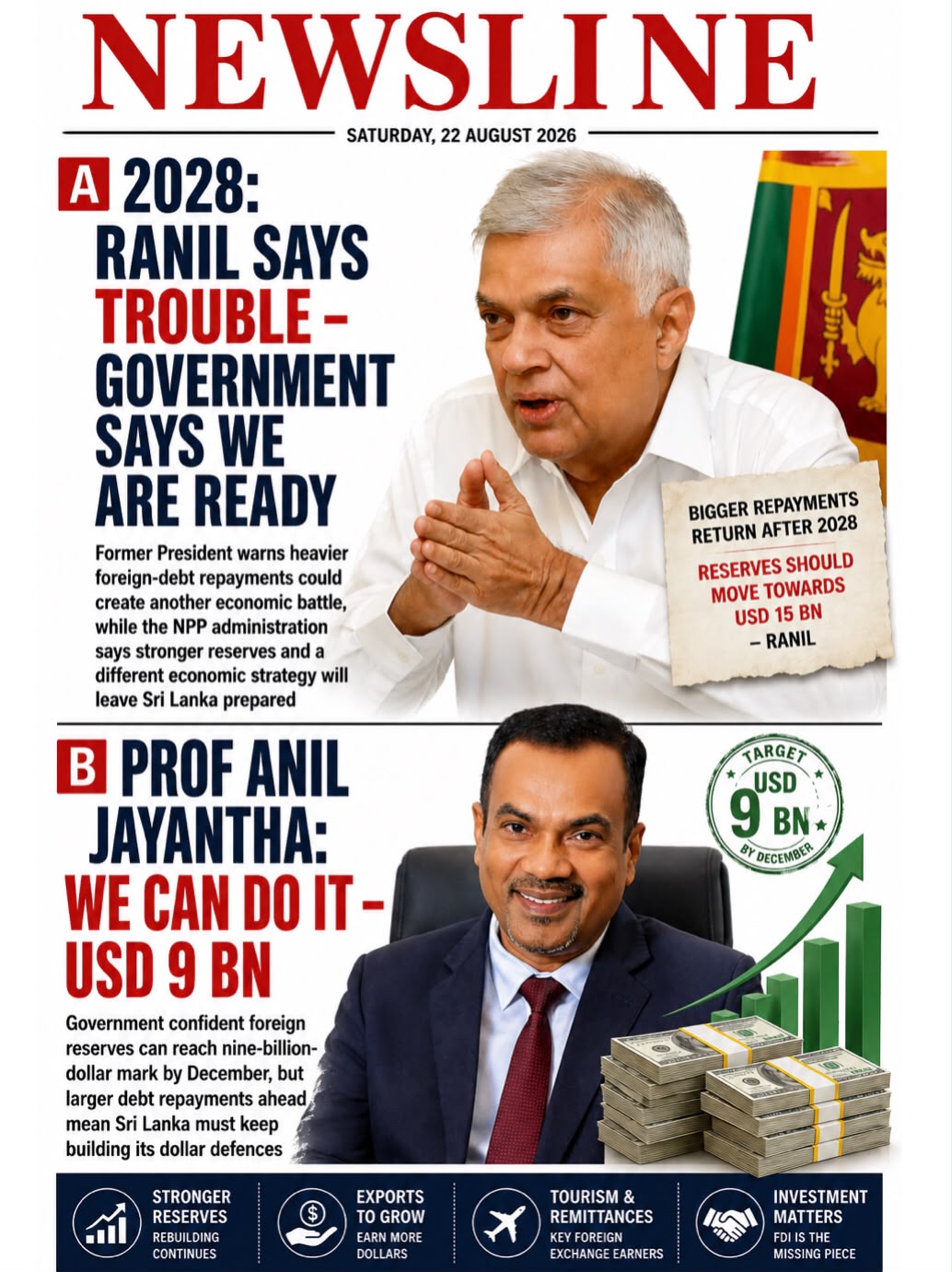
Government confident foreign reserves can reach nine-billion-dollar mark by December, but larger debt repayments ahead mean Sri Lanka must keep building its dollar defences
COLOMBO – Sri Lanka can end 2026 with foreign-exchange reserves of USD 9 billion, Deputy Finance Minister Prof. Anil Jayantha Fernando has told Parliament, placing an ambitious year-end target on the country’s continuing recovery from the foreign-currency crisis which brought the economy virtually to a standstill four years ago.
Fernando said the Government remained confident of reaching the USD 9 billion mark by December, supported by stronger foreign-worker remittances and other foreign-exchange inflows. Sri Lankans working overseas had sent home more than USD 5 billion during the first seven months of the year, providing one of the country’s most important sources of foreign currency. For Sri Lanka, the size of its reserves is considerably more than another statistic on the Central Bank’s balance sheet. In 2022 the country discovered the consequences of allowing usable reserves to disappear as fuel ships waited offshore, letters of credit became difficult to open, medicines became scarce, cooking-gas queues lengthened and lengthy power cuts became part of daily life. Eventually Sri Lanka suspended foreign-debt repayments.
Submit Your Press Release
Get your company news, announcements, launches, appointments and events in front of a wider audience.


Four years later, the conversation has changed substantially. Instead of asking whether the country possesses enough dollars to finance its next essential shipment, policymakers are debating how large a reserve cushion can be accumulated while normal economic activity and imports resume.
Fernando has said reserves continued to improve despite the reopening of vehicle imports, increasing economic activity and the country’s continuing external obligations. The return of vehicle imports is particularly significant because it represents a substantial source of demand for foreign exchange which was deliberately suppressed during the most difficult years of the crisis.
The encouraging headline, however, needs to be considered alongside what happens after the present period of relative breathing space. Former President Ranil Wickremesinghe has warned that Sri Lanka will require substantially stronger reserves when external debt servicing gathers pace again, arguing that the country should eventually be looking towards a reserve position closer to USD 15 billion.
The Government disputes elements of Wickremesinghe’s assessment, but there is considerably less disagreement over the underlying challenge. Sri Lanka must substantially increase its capacity to earn foreign exchange through exports, tourism, remittances and foreign direct investment if today’s economic stabilisation is to survive tomorrow’s larger debt repayments.
That places particular pressure on investment policy. Successive governments have announced ambitious foreign-investment targets while Sri Lanka has continued to attract substantially less capital than many competing Asian economies. If reserves are to move sustainably beyond USD 9 billion, attracting export-oriented investment will have to become an economic achievement rather than a recurring government promise.
The reserve target is nevertheless significant. A country which only four years ago was effectively counting its remaining dollars shipment by shipment is now discussing whether its foreign-exchange buffer can reach nine billion dollars before the year is over.
Prof. Anil Jayantha has therefore given the country a measurable target against which the Government can be judged. If USD 9 billion is achieved by December, it will represent another important stage in Sri Lanka’s recovery, although the greater achievement will be ensuring that the reserves continue growing when the heavier bills begin arriving.