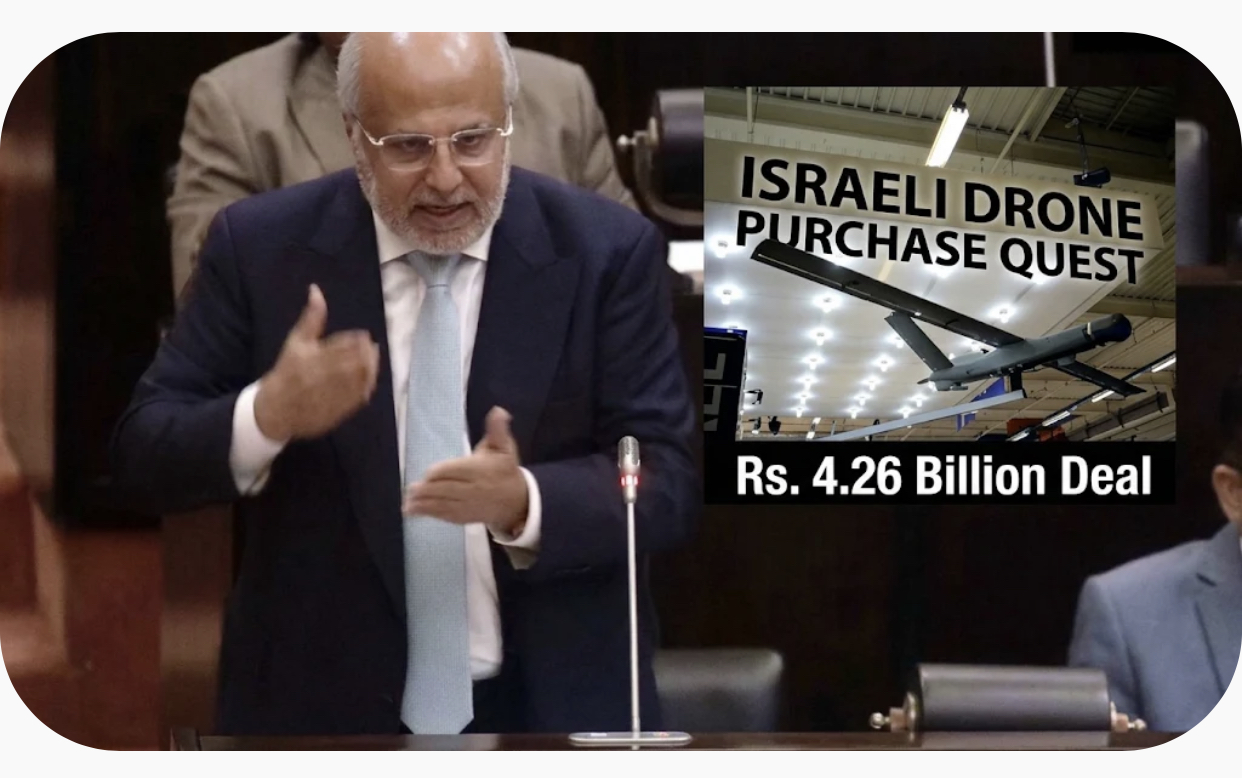
When a cash-strapped government pushes through a multi-billion-rupee defense purchase without calling for competitive tenders, questions in Parliament are guaranteed. When that deal involves Israeli defense technology and allegations of intelligence gathering for Washington, the political temperature rises considerably. During the parliamentary budget debate this week, Sri Lanka Muslim Congress (SLMC) Leader MP Rauff Hakeem launched a blistering attack on the administration’s 4.261 billion rupee procurement of four surveillance drones from Israel, questioning both the lack of open bidding and the geopolitical wisdom of the purchase.
Taking the floor in the legislature, Hakeem zeroed in on the speed and opacity of the transaction, which passed via a supplementary estimate on November 5 to establish an unmanned aerial vehicle (UAV) system for the Sri Lanka Air Force. “Why the sudden urgency? Without calling for tenders, they are proceeding directly with the purchase,” Hakeem demanded, before floating unsubstantiated suspicions over potential commissions tied to the government-to-government deal.
More explosively, the veteran parliamentarian accused the government of turning Sri Lanka’s military into an intelligence proxy in the Indian Ocean. Alleging that the aircraft were actually intended to track Iranian vessels and feed intelligence to the United States, Hakeem warned ruling party MPs against dragging the Sri Lanka Navy and Air Force into foreign power rivalries. “Don’t get yourselves into trouble by engaging in such activities. You have already created enough problems,” he cautioned, while slamming the government’s broader foreign policy posture on global flashpoints ranging from Iran and Venezuela to the ongoing humanitarian suffering of Palestinians in Gaza.
Submit Your Press Release
Get your company news, announcements, launches, appointments and events in front of a wider audience.


The government’s official rationale, laid out earlier this month by Deputy Defence Minister Aruna Jayasekera, paints a far more domestic and operational picture. According to Jayasekera, Sri Lanka’s Exclusive Economic Zone spans 517,000 square kilometers, an oceanic expanse roughly 27 times larger than the island’s landmass, making round-the-clock patrols with conventional manned aircraft prohibitively expensive. Under the revised government-to-government arrangement with Israeli manufacturer BlueBird Aero Systems (a subsidiary of state-owned Israel Aerospace Industries), the Air Force is slated to receive four tactical drones rather than the two originally envisioned, alongside operator training and three years of maintenance support.
Technically, the fleet includes two ThunderB drones capable of 14-hour flights and two vertical take-off and landing (VTOL) platforms with up to 20 hours of endurance, designed to operate from constrained spaces to monitor suspicious vessels, assist with cyclone and flood response, and locate missing fishermen. Financially, the Defence Ministry insists the 4.261 billion rupee (roughly $12.8 million) tab requires zero fresh Treasury cash, as the funds are being reallocated under Financial Regulation 66 from existing savings in the Air Force’s helicopter maintenance budget.
Even if every rupee comes from internal Air Force savings and every flight hour is spent watching fishing trawlers and storm fronts, Hakeem’s intervention highlights a recurring vulnerability in Sri Lankan statecraft. Bypassing open tenders under the banner of “emergency procurement” while signing off on sensitive foreign defense contracts ahead of a planned December agreement leaves the door wide open to accusations of backroom dealing and geopolitical alignment. In a region where every radar ping is watched closely by rival powers, transparency is not a luxury the government can afford to skip.