
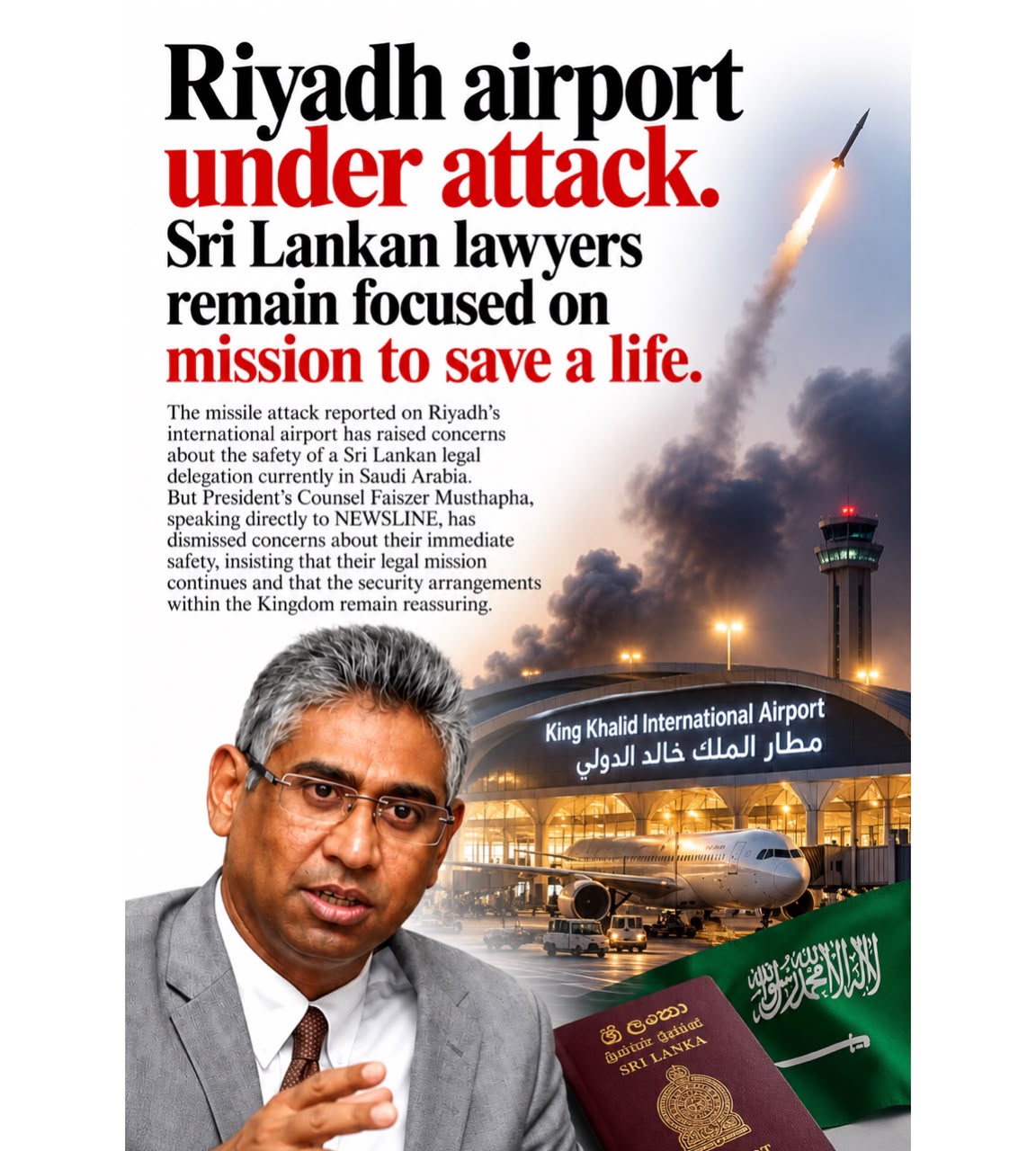
The missile attack reported on Riyadh’s international airport has raised concerns about the safety of a Sri Lankan legal delegation currently in Saudi Arabia. But President’s Counsel Faiszer Musthapha, speaking directly to NEWSLINE, has dismissed concerns about their immediate safety, insisting that their legal mission continues and that the security arrangements within the Kingdom remain reassuring.
The reported attack on Riyadh’s King Khalid International Airport has brought fresh uncertainty to international air travel in Saudi Arabia, raising questions about the circumstances of a four-member Sri Lankan legal delegation currently visiting the Kingdom in an effort to save a fellow citizen from execution.
The delegation includes President’s Counsel Faiszer Musthapha and Upul Kumarapperuma, together with Additional Solicitor General Azard Navavi PC and Attorney-at-Law Hafeel Farisz. Their visit concerns the case of Sivarasa Anojan, a Sri Lankan national facing the death penalty in Saudi Arabia.
Submit Your Press Release
Get your company news, announcements, launches, appointments and events in front of a wider audience.


With reports of the airport coming under attack and flights being disrupted, questions naturally arose about whether the Sri Lankan lawyers might find themselves stranded in Riyadh.
However, speaking directly to NEWSLINE, Faiszer Musthapha PC made clear that the delegation’s legal work was continuing and that there was no immediate cause for alarm.
Asked specifically about the attack on Riyadh Airport and whether the delegation had concerns about its safety, Musthapha expressed confidence in the security arrangements maintained by the Saudi authorities.
He said the security of the Kingdom, and of everyone within it, was being very well maintained. In his assessment, there was nothing to be concerned about.
Importantly, Musthapha also clarified that the delegation had never intended to return to Sri Lanka on either Saturday or Sunday. Their presence in Saudi Arabia was therefore not the consequence of cancelled flights or an inability to leave the country.
The lawyers remain in the Kingdom because their work is unfinished.
Musthapha described the legal undertaking as very much a work in progress, emphasising that the purpose of the visit was to ensure that the fullest and most appropriate legal representations were made on behalf of the Sri Lankan national facing execution.
That distinction is important. While an attack on a major international airport understandably generates concern for foreign nationals in the affected country, it would be inaccurate to characterise the Sri Lankan delegation as stranded when its members had not planned to depart and remain engaged in their original assignment.
The legal mission itself carries considerable significance.
Sivarasa Anojan’s case has attracted attention in Sri Lanka because of the severity of the punishment he faces and the efforts being undertaken to secure relief through the Saudi legal system.
The involvement of two senior President’s Counsel, an Additional Solicitor General and another experienced attorney reflects the seriousness with which the matter is being pursued.
Their task is not simply to make a symbolic humanitarian appeal. It is to work within the applicable legal framework, in consultation with Saudi legal representatives, to identify and pursue the strongest available grounds for challenging the sentence.
Musthapha’s comments suggest that the delegation is determined not to allow the wider regional security situation to distract from that responsibility.
There is also an important distinction between diplomatic representations seeking clemency and legal submissions seeking relief through the courts. Both may be relevant, but each requires its own preparation, procedures and engagement with the appropriate authorities.
The lawyers remain in the Kingdom because their work is unfinished.
Musthapha described the legal undertaking as very much a work in progress, emphasising that the purpose of the visit was to ensure that the fullest and most appropriate legal representations were made on behalf of the Sri Lankan national facing execution.
That distinction is important. While an attack on a major international airport understandably generates concern for foreign nationals in the affected country, it would be inaccurate to characterise the Sri Lankan delegation as stranded when its members had not planned to depart and remain engaged in their original assignment.
The legal mission itself carries considerable significance.
Sivarasa Anojan’s case has attracted attention in Sri Lanka because of the severity of the punishment he faces and the efforts being undertaken to secure relief through the Saudi legal system.
The involvement of two senior President’s Counsel, an Additional Solicitor General and another experienced attorney reflects the seriousness with which the matter is being pursued.
Their task is not simply to make a symbolic humanitarian appeal. It is to work within the applicable legal framework, in consultation with Saudi legal representatives, to identify and pursue the strongest available grounds for challenging the sentence.
Musthapha’s comments suggest that the delegation is determined not to allow the wider regional security situation to distract from that responsibility.
There is also an important distinction between diplomatic representations seeking clemency and legal submissions seeking relief through the courts. Both may be relevant, but each requires its own preparation, procedures and engagement with the appropriate authorities.
For the Sri Lankan lawyers, the immediate priority remains the preparation and presentation of the strongest possible legal case.
The reported airport attack may have disrupted international aviation, but it has not, according to Musthapha, interrupted the delegation’s determination to complete its work.
Indeed, his comments indicate that the lawyers regard the time available in Saudi Arabia as an opportunity to pursue the legal avenues open to their client rather than an occasion to contemplate an early departure.
For Anojan and his family, the stakes could scarcely be higher. The outcome of the legal proceedings may determine whether a death sentence is carried out or whether the Saudi judicial system grants relief.
Be that as it may, Faiszer Musthapha and his colleagues did not travel to Saudi Arabia merely to make representations and return home. They went to pursue every appropriate legal avenue to save a Sri Lankan life. Despite the reported attack on Riyadh Airport, Musthapha’s message to NEWSLINE is unequivocal: the legal work continues, the delegation is confident about its safety, and the mission remains unfinished.



