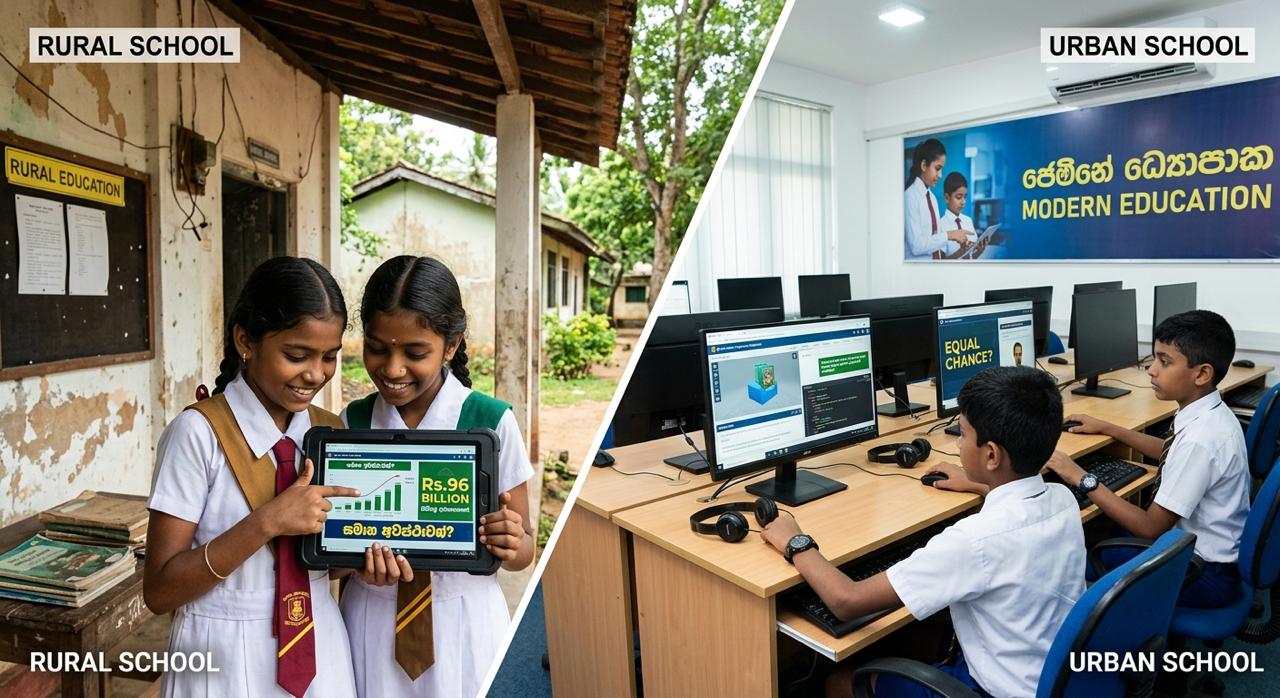
The Government has approved a series of education reforms, including a proposed five-year digital education programme estimated to cost Rs. 96 billion. The initiative could transform learning opportunities across Sri Lanka, but without adequate infrastructure, properly trained teachers and transparent procurement, it could also deepen the divide between children who already enjoy educational advantages and those who do not.
Sri Lanka has long regarded education as one of its greatest national achievements. Free education created opportunities for generations of children whose families might otherwise have been unable to afford schooling, helping establish a comparatively strong foundation of literacy and educational attainment.
But the existence of free education does not mean that every child receives an equal education.
Submit Your Press Release
Get your company news, announcements, launches, appointments and events in front of a wider audience.


The differences between well-resourced urban schools and those serving disadvantaged rural communities remain substantial. Access to qualified teachers, science laboratories, libraries, modern technology and supplementary educational resources can vary dramatically depending on geography and family circumstances.
Against this background, the Government’s proposed Rs. 96 billion digital education programme represents a significant commitment of public resources.
The initiative forms part of a broader package of education reforms that includes changes to curriculum development, student assessment and the administration of educational institutions.
Digital technology has the potential to improve access to educational material, support teachers, expand learning opportunities and help students acquire skills increasingly required in modern employment.
But technology alone cannot correct structural inequalities.
A computer or digital learning platform is of limited value in a school without dependable electricity, adequate internet connectivity or teachers trained to incorporate technology into classroom instruction.
The first responsibility of the Government must therefore be to establish the actual requirements of the school system.
How many schools currently possess adequate digital infrastructure? How many classrooms have reliable connectivity? What proportion of teachers has received appropriate training? How many students lack access to suitable devices outside school hours?
Without reliable answers, the risk is that a substantial programme will be designed around assumptions rather than demonstrated needs.
The proposed expenditure also demands close scrutiny.
Rs. 96 billion is a considerable sum for a country still confronting serious fiscal constraints and competing demands involving healthcare, transport, agriculture and social protection.
The public is entitled to know how the money will be allocated.
How much will be spent on hardware, software, connectivity, teacher training, maintenance and technical support? Will equipment be purchased through competitive procurement? Who will own the educational platforms and the data they generate?
The experience of other countries demonstrates that digital education programmes can become expensive exercises in purchasing equipment that subsequently remains underutilised, becomes obsolete or cannot be maintained.
Sri Lanka must avoid repeating those mistakes.
Teacher training is particularly important. Effective education depends on the ability of teachers to explain, guide, challenge and encourage students. Digital technology should strengthen those relationships rather than reduce education to the passive consumption of electronic content.
There are also legitimate concerns about children’s privacy, cybersecurity and excessive screen exposure. Any national digital education programme must include safeguards appropriate to the age and circumstances of the students concerned.
Equity must remain central to the initiative.
A child attending a remote rural school should not receive an inferior version of digital education simply because the school lacks infrastructure or the family cannot afford additional devices and connectivity.
The Government should publish a detailed implementation plan, including annual expenditure, school-level priorities, procurement arrangements and measurable educational outcomes.
Independent evaluation should be built into the programme from the beginning, rather than introduced only after substantial public funds have been committed.
Be that as it may, Sri Lanka’s ambition to modernise education is welcome. But the true achievement will not be the amount spent on technology or the number of devices distributed. It will be whether a child in an underprivileged village receives educational opportunities comparable to those available to a child attending one of the country’s best-equipped schools.