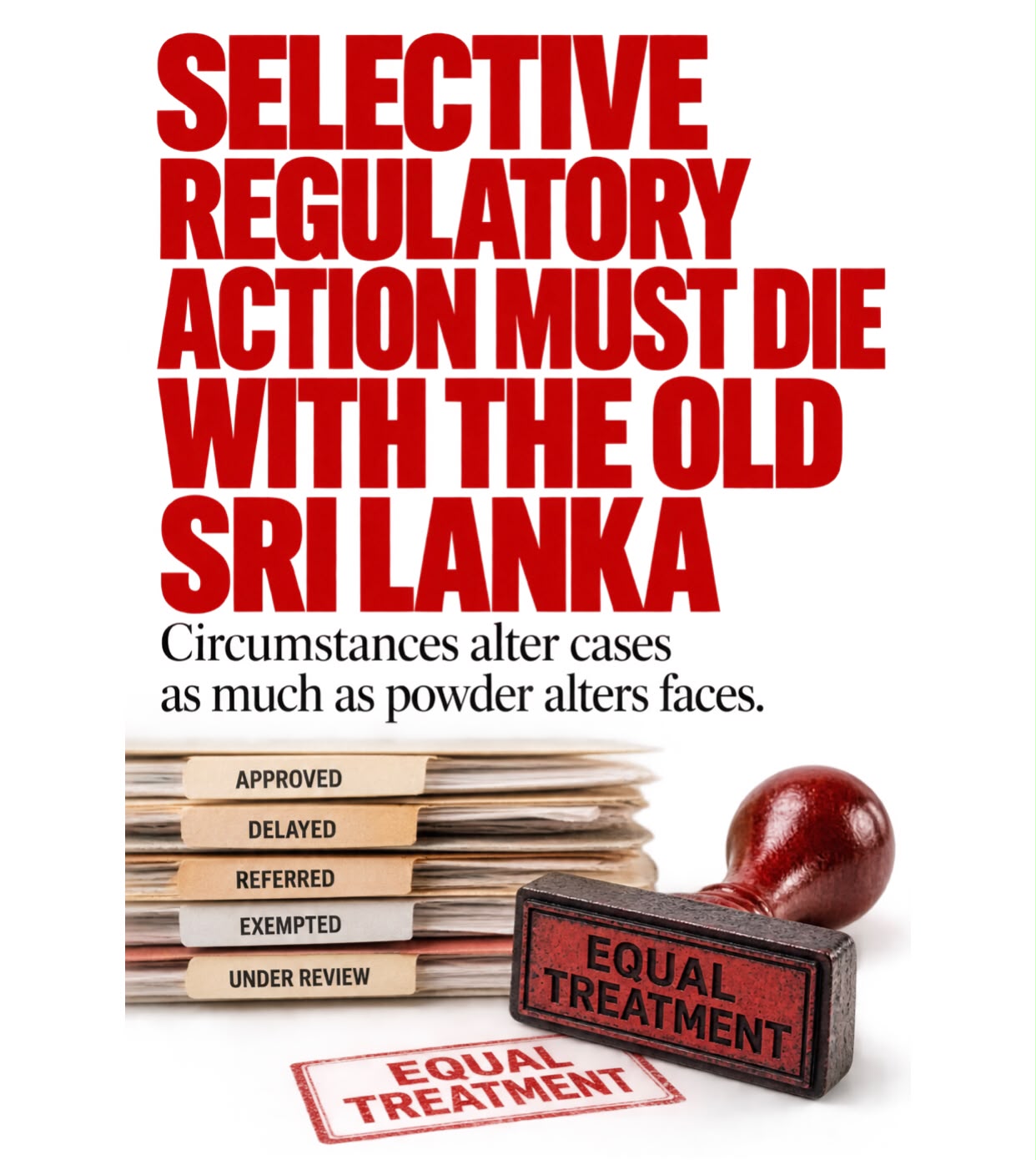
Circumstances alter cases as much as powder alters faces.
For 76 years Sri Lankans learned that when the system failed, you went upstairs. Find the Minister, the Chairman, the Secretary or ultimately the Boss. The Change Sri Lanka voted for requires something fundamentally different: the system itself must work, and it must work equitably for everyone.
There is a concept that many Sri Lankans are understandably finding difficult to comprehend: selective regulatory action. For most of our 76 years since Independence, Sri Lanka developed a peculiar method of solving problems. When something went wrong, we did not necessarily ask what the rule said. We asked who could fix it.
Submit Your Press Release
Get your company news, announcements, launches, appointments and events in front of a wider audience.


If the clerk could not resolve it, one found the supervisor. If the supervisor could not, one found the director, the Secretary, the Chairman or the Minister. If the problem was sufficiently serious and the connections sufficiently good, somebody would eventually attempt to reach the President. In other words, find the Boss.
This became so deeply embedded in our national existence that it almost entered the DNA of how Sri Lanka functioned. People did not always go upwards because they wanted the law bent in their favour. Frequently they went upwards because experience had taught them that this was the only way to make the machinery move at all.
A pension delayed for months, a licence trapped on somebody’s desk, a container sitting at the port, a hospital requiring medicine, a businessman unable to obtain an approval or an ordinary citizen confronting an official unwilling to make a decision could produce the same instinctive response. Find somebody higher who could intervene and get the thing done.
It would therefore be simplistic, and perhaps unfair, to assume that everyone who still instinctively seeks intervention from above is necessarily attempting to manipulate the system. Habits built over three-quarters of a century do not disappear because an election has taken place. Sri Lanka is traversing from one culture into another, and that inevitably takes some getting used to.
But Change must ultimately mean considerably more than changing the people occupying the offices at the top. It must change what happens inside those offices and, more importantly, what happens without anybody needing to telephone them.
A citizen should not require the President to make a regulator regulate. A businessman should not require a Minister to make a department follow its own procedure. A patient should certainly not require political influence to make the health system treat an urgent medical question with urgency, and nobody should require the friendship of somebody important to receive the same treatment that the law already promises everybody else.
This is where selective regulatory action becomes dangerous. A regulator cannot be ferocious about a requirement in one case and flexible about an equivalent requirement in another simply because the personalities, institutions or circumstances surrounding the decision have changed.
If a defect requires independent scientific testing in one case, comparable defects should ordinarily attract comparable scientific scrutiny in another. If one deviation can be assessed through evidence, proportionality, risk and patient need, the same reasoning should be available when the next product arrives. Where different treatment is justified by materially different facts, the regulator should be able to explain clearly what those differences are.
The principle extends far beyond medicine. If Customs investigates one importer over a particular transaction, another importer undertaking materially the same transaction should face the same standard. If a bank flags one suspicious transfer, another politically connected customer cannot receive a different rule. If a planning authority refuses one developer because regulations prohibit something, influence should not make the identical prohibition disappear for somebody else.
The same applies to the administration of justice. If the criminal law pursues one politician, it must be equally capable of pursuing another. President Anura Kumara Dissanayake has now declared in unmistakable terms that nobody is above the law, no matter who it may be. That is precisely how it should be.
But equality before the law is not demonstrated merely by the prominence of the people who are prosecuted. It is demonstrated by the consistency with which the law is applied when the names, politics and circumstances change. The same principle must govern regulatory and administrative action throughout the State.
Selective regulation destroys confidence because citizens eventually stop asking what the rule is and start asking who the rule is for. Once that happens, the credibility of the institution itself begins to disappear.
Regulators are entrusted with considerable powers precisely because society requires independent institutions to protect the public interest. A medicines regulator protects patients. A financial regulator protects the integrity of markets. Customs protects revenue and the border. Environmental regulators protect resources that belong not merely to today’s politicians but to generations not yet born. Their legitimacy ultimately comes from the fairness and consistency with which those powers are exercised.
Equitable treatment does not mean mindless bureaucracy or pretending every case is identical. Different facts can properly produce different decisions. Regulators must exercise judgement, assess risk and sometimes act with exceptional urgency. What equity requires is that comparable circumstances are judged by comparable standards and, where the treatment differs, the institution is capable of explaining why.
That explanation should exist in the file, not in somebody’s telephone records.
This may be one of the hardest parts of the Change Sri Lanka says it wants. For generations we personalised government and looked for the individual powerful enough to solve the problem. The new culture must institutionalise government instead.
The President should not have to fix it, nor should the Minister, Chairman or Secretary. The system should fix it because that is what the system exists to do.
When it does not, there must be a transparent avenue of appeal that works just as effectively for “Kanthi” travelling hundreds of kilometres for cancer treatment as it does for the chairman of a billion-rupee company.
That is Change. It is not replacing yesterday’s telephone numbers with today’s.
Sri Lanka has spent 76 years learning whom to call. Be that as it may, perhaps the next chapter should be about building a country where nobody needs to make the call.