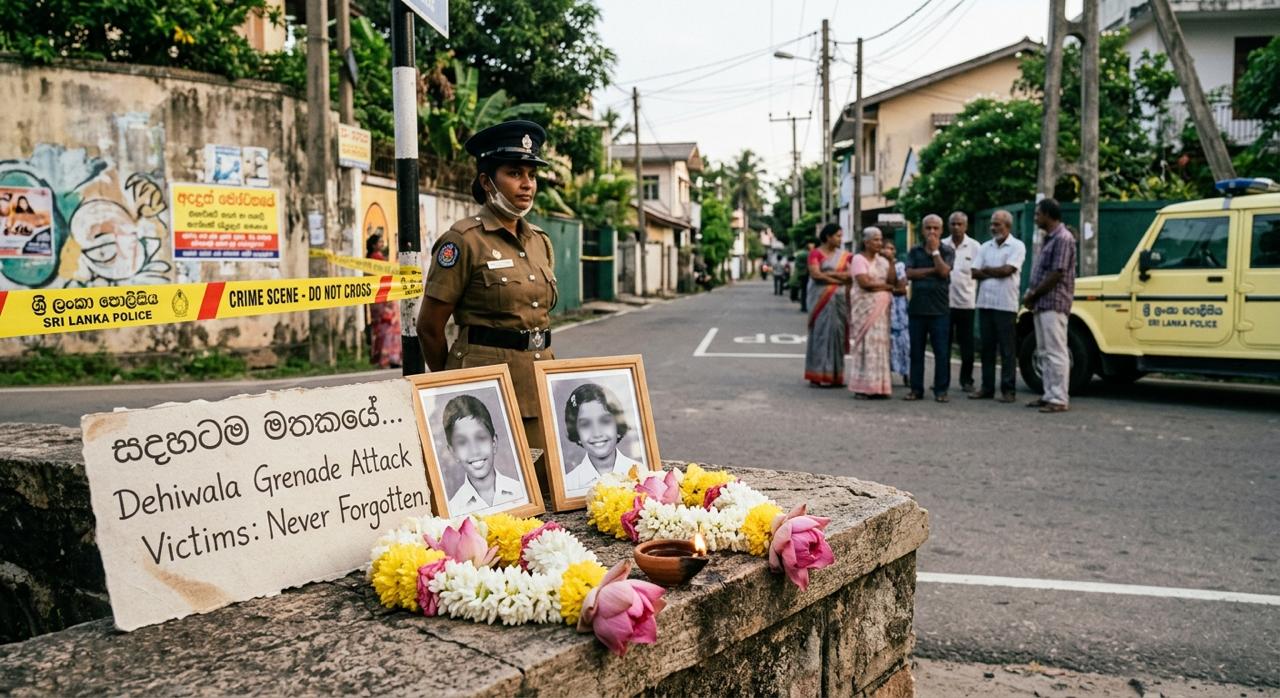
The grenade attack in Dehiwala that killed two children shocked Sri Lanka. Police now say three suspects, including the alleged principal attacker, have been arrested. An arrest is not a conviction, but the investigation has moved significantly forward. The next question is the most important one: why were children caught in what investigators believe was organised criminal violence?
The investigation into the grenade attack in Dehiwala that killed two children has taken a significant turn, with police reporting the arrest of three suspects including the man alleged to have carried out the attack. NEWSLINE reported the original incident when the deaths of the children brought home, with particular brutality, the consequences of organised criminal violence spilling into ordinary communities. This is therefore not another account of the attack but an examination of where the investigation has moved since.
Police believe the grenade was thrown as part of a criminal dispute and that the children were not the intended targets. If that account is eventually established, it makes their deaths no less terrible and perhaps even more senseless. Two children would have died because somebody else’s dispute apparently reached the point where a grenade became an acceptable instrument for settling it.
Submit Your Press Release
Get your company news, announcements, launches, appointments and events in front of a wider audience.


The arrests now place a greater responsibility on investigators to move beyond identifying the alleged physical participants and establish the entire chain behind the attack. Who ordered it, what was the intended target, where did the grenade originate, was anybody paid and were others involved in planning, financing or facilitating what happened?
There is a larger issue here that extends beyond Dehiwala. Sri Lanka has spent years confronting organised crime, contract killings and underworld networks whose operations increasingly demonstrate access to firearms and other weapons. A grenade is not an improvised knife or something casually purchased over a counter; it is a weapon manufactured principally for warfare. When one appears in an urban criminal dispute, the State should be interested not merely in the person alleged to have thrown it but in every hand through which it passed before reaching him.
Arresting an alleged gunman or attacker deals with the final link in what may be a considerably longer chain. Somebody supplies the weapon, somebody transports it, somebody finances the operation and somebody decides who is to be attacked. An investigation capable of travelling through that chain is considerably more valuable than one which ends with the person alleged to have carried out the final act.
The suspects are entitled to the presumption of innocence and the allegations against them will ultimately require proof before a court. That principle should remain intact regardless of the horror surrounding the crime. The strength of the justice system is demonstrated precisely by its ability to prosecute the most disturbing allegations without abandoning the standards it expects everybody else to observe.
The deaths of two children should nevertheless make this investigation about considerably more than another entry in Sri Lanka’s organised-crime statistics. If police can establish where the weapon originated, who commissioned the attack and how the operation was organised, the investigation may expose something more important than the identities of the alleged attackers.
Police may now have some of the men they believe were responsible. Sri Lanka still needs the rest of the chain.