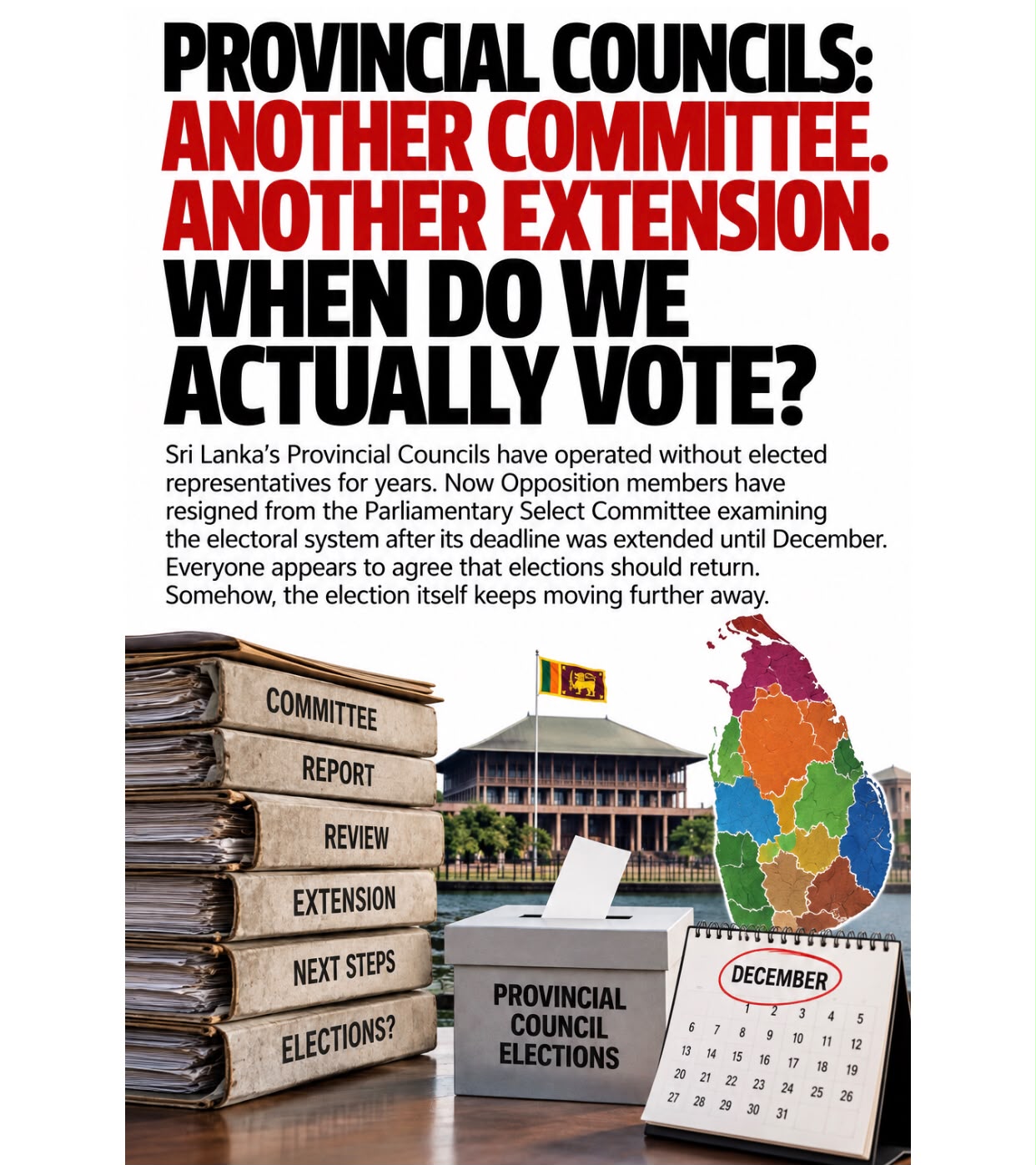
Sri Lanka’s Provincial Councils have operated without elected representatives for years. Now Opposition members have resigned from the Parliamentary Select Committee examining the electoral system after its deadline was extended until December. Everyone appears to agree that elections should return. Somehow, the election itself keeps moving further away
There are Sri Lankan voters who have now gone so long without voting for a Provincial Council that the absence of elections has almost begun to appear normal. It should not. The country’s nine Provincial Councils have been functioning without elected representatives since their terms progressively expired between 2017 and 2019, with administration continuing through Governors and officials while the democratic component of the system has remained suspended.
Another attempt to resolve the electoral impasse is now generating controversy. Opposition representatives serving on the Parliamentary Select Committee appointed to examine the Provincial Council electoral system have resigned after the committee’s timeframe was extended until December 17. Their complaint is straightforward: another extension means another delay in creating the mechanism necessary to return Provincial Councils to elected government.
Submit Your Press Release
Get your company news, announcements, launches, appointments and events in front of a wider audience.


The argument surrounding Provincial Councils themselves is considerably older. Sri Lanka has debated the effectiveness, expense and constitutional purpose of the provincial system almost from the moment it was created under the 13th Amendment. There are legitimate arguments about whether devolution works, whether powers should be changed and whether the structure provides sufficient value for the enormous administrative machinery it requires.
Those arguments, however, are different from the question of whether elections should be held. If Provincial Councils remain part of Sri Lanka’s constitutional structure and continue to exercise governmental functions, leaving them indefinitely without elected representatives creates a democratic anomaly that becomes harder to defend with every passing year.
The original electoral difficulty followed changes to the voting system and the subsequent failure to complete the delimitation process necessary to make the new arrangements operational. What followed has been a remarkable demonstration of political procrastination. Governments changed, Presidents changed and Parliaments changed while committees were appointed, proposals discussed and promises repeatedly made, yet the Provincial Council voter continued waiting. There are arguments for temporarily returning to the previous proportional representation system in order to hold elections without waiting for the unresolved new system. Other 17. Their complaint is straightforward: another extension means another delay in creating the mechanism necessary to return Provincial Councils to elected government.
The argument surrounding Provincial Councils themselves is considerably older. Sri Lanka has debated the effectiveness, expense and constitutional purpose of the provincial system almost from the moment it was created under the 13th Amendment. There are legitimate arguments about whether devolution works, whether powers should be changed and whether the structure provides sufficient value for the enormous administrative machinery it requires.
Those arguments, however, are different from the question of whether elections should be held. If Provincial Councils remain part of Sri Lanka’s constitutional structure and continue to exercise governmental functions, leaving them indefinitely without elected representatives creates a democratic anomaly that becomes harder to defend with every passing year.
The original electoral difficulty followed changes to the voting system and the subsequent failure to complete the delimitation process necessary to make the new arrangements operational. What followed has been a remarkable demonstration of political procrastination. Governments changed, Presidents changed and Parliaments changed while committees were appointed, proposals discussed and promises repeatedly made, yet the Provincial Council voter continued waiting.
There are arguments for temporarily returning to the previous proportional representation system in order to hold elections without waiting for the unresolved new system. Others want the mixed electoral arrangement completed before the country votes again. That is precisely the kind of disagreement Parliament exists to resolve, but what becomes increasingly difficult to justify is allowing disagreement over how people should vote to become the reason they do not vote at all.
The issue carries particular significance in the North and East, where Provincial Councils remain intertwined with the much larger debate over devolution, reconciliation and implementation of the 13th Amendment. Tamil political parties have again been calling for Provincial Council elections and a meaningful settlement of questions surrounding devolution. Repeated delay therefore carries political consequences extending considerably beyond local administration.
The Government has promised a different political culture and this is an opportunity to demonstrate it. Parliament should settle the electoral system, establish the legislative route necessary to conduct the poll and provide the Election Commission with sufficient certainty to prepare for it.
Sri Lanka has spent years discussing how Provincial Councils should be elected. Perhaps it is time to remember that the important word in that sentence is elected.