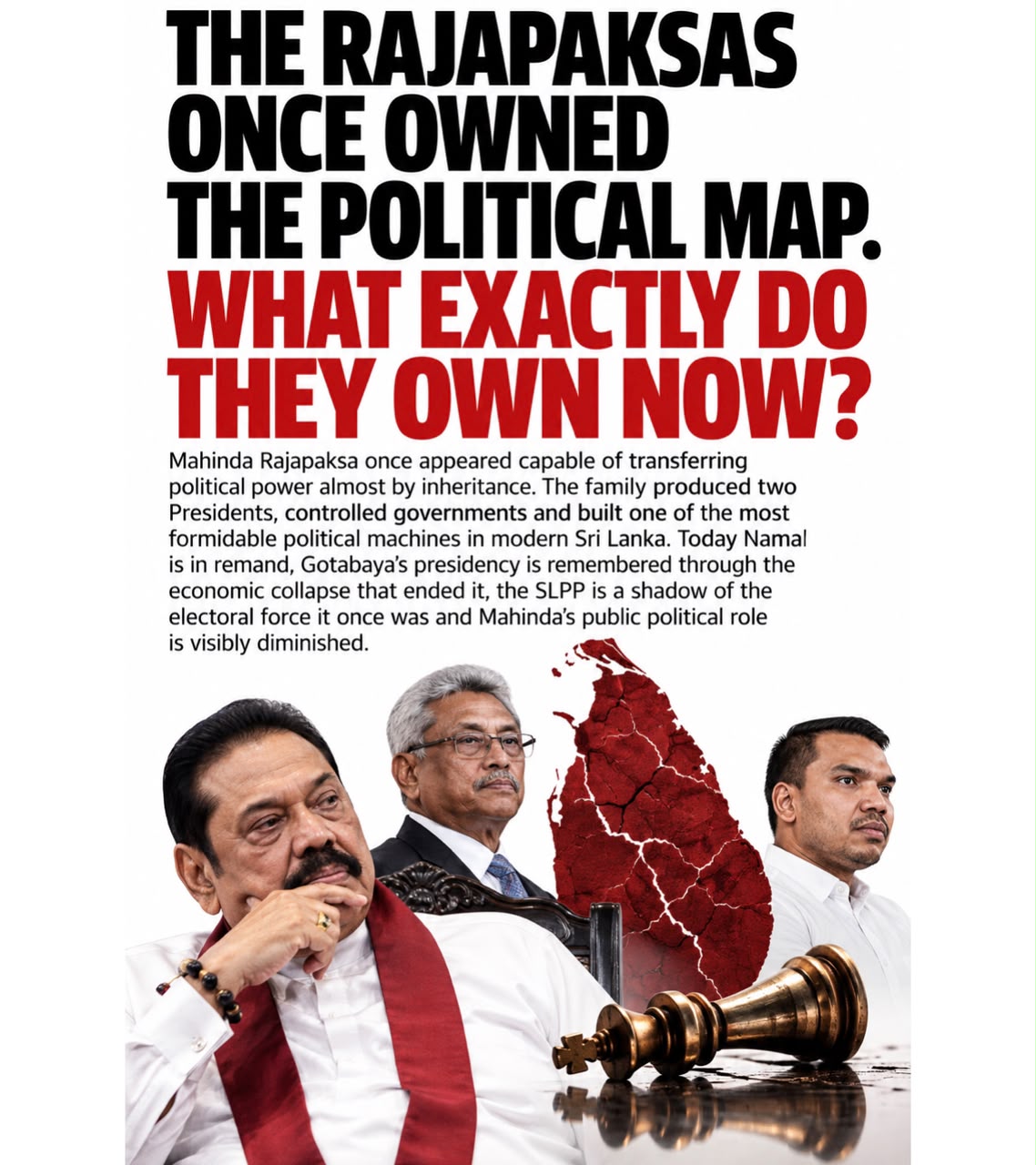
Mahinda Rajapaksa once appeared capable of transferring political power almost by inheritance. The family produced two Presidents, controlled governments and built one of the most formidable political machines in modern Sri Lanka. Today Namal is in remand, Gotabaya’s presidency is remembered through the economic collapse that ended it, the SLPP is a shadow of the electoral force it once was and Mahinda’s public political role is visibly diminished. Has Sri Lanka finally moved beyond the Rajapaksas or is writing their political obituary precisely the mistake their opponents have made before?
There was a period in Sri Lankan politics when asking whether the Rajapaksas had a future would have sounded faintly ridiculous.
They appeared to be the future.
Submit Your Press Release
Get your company news, announcements, launches, appointments and events in front of a wider audience.


Mahinda Rajapaksa emerged from the ending of the civil war in 2009 with political authority few Sri Lankan leaders had possessed. His defeat in 2015 initially appeared to have ended that era, but within a remarkably short period the Rajapaksa political machine rebuilt itself.
The comeback was extraordinary.
The Sri Lanka Podujana Peramuna was transformed into an electoral juggernaut, sweeping the 2018 local government elections before Gotabaya Rajapaksa won the presidency in 2019. The parliamentary election that followed produced an overwhelming mandate and once again placed the family close to the centre of virtually every important political decision.
Then came 2022.
Economic collapse, fuel queues, power cuts, shortages and the extraordinary public uprising fundamentally changed the political equation. Gotabaya Rajapaksa fled the country before resigning the presidency, and a family that had built much of its political appeal around strength and stability suddenly became associated by many voters with the most severe economic crisis in independent Sri Lanka.
The electoral consequences followed.
The SLPP that once dominated Parliament emerged from the 2024 general election with only a small parliamentary presence. Anura Kumara Dissanayake and the National People’s Power occupied political territory that only a few years earlier would have seemed almost inaccessible to them.
Now the family faces another difficulty.
Namal Rajapaksa, the man around whom the next generation of Rajapaksa politics was expected to be constructed, is in remand custody and confronting two separate legal proceedings connected with the SriLankan Airlines Airbus procurement. Other members of the wider family have also faced investigations and court proceedings.
None of that establishes guilt, and legal allegations should not be converted into political verdicts before courts have determined them.
But politics operates on perception as well as judgments.
The Rajapaksa brand that once represented victory, authority and national security to millions of voters now carries considerably heavier baggage. For younger Sri Lankans especially, memories of 2022 may compete with and sometimes overwhelm memories of 2009.
Mahinda Rajapaksa remains the emotional centre of that political tradition.
At 80, however, his public political role is plainly not what it once was. At the recent SLPP rally in Anuradhapura he appeared on stage but did not address the gathering. It would be improper to diagnose his health from public appearances, but it is entirely legitimate to recognise the political reality that the movement can no longer assume Mahinda Rajapaksa will personally carry it indefinitely.
That leaves Namal.
At 40, he has time that his father no longer possesses. He also carries a surname that remains simultaneously his greatest political asset and potentially his greatest political liability.
The question is whether there remains a sufficiently large Rajapaksa constituency waiting to be reassembled.
Sri Lankan politics has repeatedly demonstrated that public anger can be intense without necessarily being permanent. Political parties declared finished have returned. Leaders written off have re-emerged. Mahinda Rajapaksa himself demonstrated precisely that after his 2015 defeat.
There are also conditions under which the Rajapaksa political narrative could find an audience again. If the present Government fails to deliver meaningful improvements in living standards, if economic reform becomes associated principally with taxation and austerity, or if prosecutions of former political opponents are perceived as selective rather than even-handed, the political environment could change.
That does not mean a Rajapaksa revival will occur. Nor does it mean the family has become politically irrelevant.
Both conclusions go beyond what the evidence presently establishes.
What can be said is that the family no longer commands the political system it once dominated. Its electoral base has contracted dramatically, its principal younger standard-bearer is fighting serious legal proceedings and the towering personality around whom the movement was originally built cannot remain its permanent answer to the future.
The Rajapaksas therefore face a problem considerably larger than winning the next election.
They must explain what Rajapaksa politics actually means without Mahinda Rajapaksa at its centre.
Dynasties survive when the idea becomes larger than the founder.
They disappear when the founder was the idea.