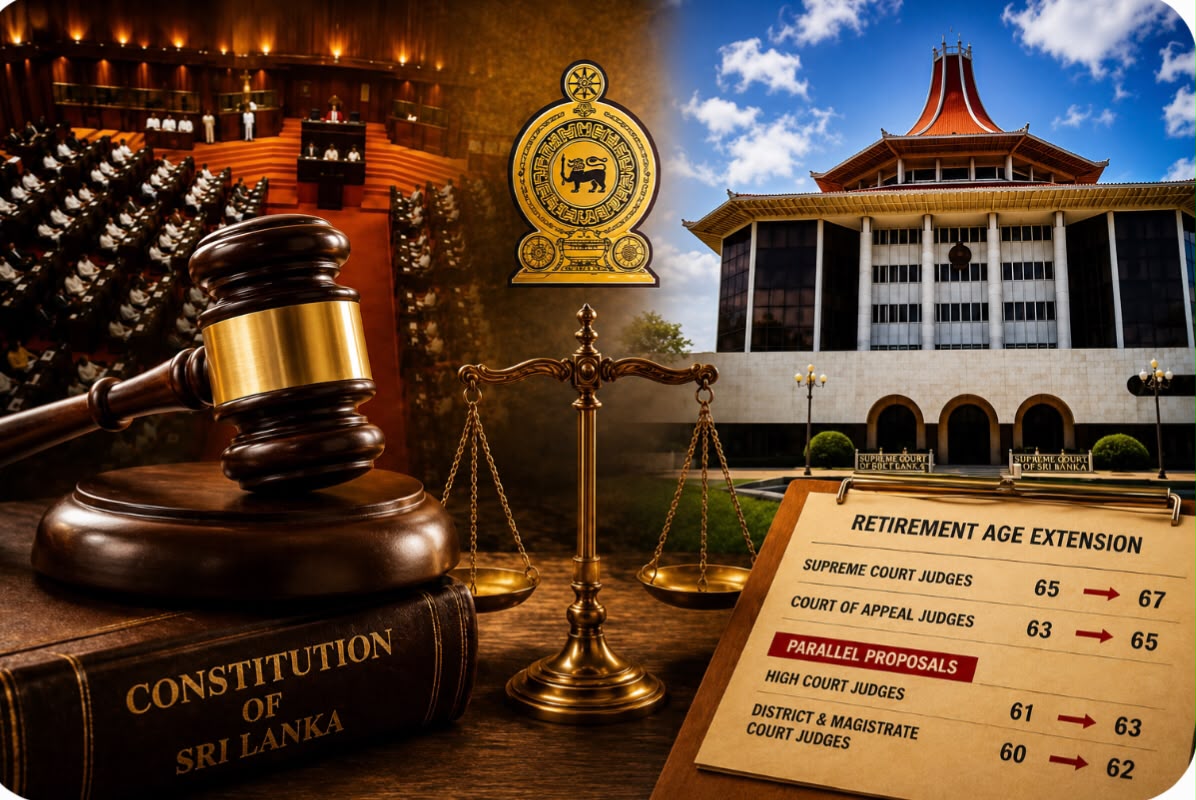
The opposition case rests heavily on Article 3 and an earlier Supreme Court determination – but the present 22nd Amendment must still face its own constitutional test
COLOMBO, Sunday – It is perhaps the most intriguing question in the entire controversy over extending the retirement ages of Sri Lanka’s superior-court judges: what happens if the Supreme Court itself determines that the People do not have to vote on it? Much of the constitutional opposition to the proposed 22nd Amendment rests upon the argument that altering the tenure of incumbent judges affects judicial independence, thereby engaging Article 3 of the Constitution and triggering the requirement for approval at a referendum.
There is substantial constitutional reasoning behind that position, reinforced by an earlier Supreme Court Special Determination concerning judicial tenure. But until the Supreme Court determines the constitutionality of the present Bill, the precise requirements governing 22A remain to be decided.
Submit Your Press Release
Get your company news, announcements, launches, appointments and events in front of a wider audience.


It is therefore entirely legitimate to examine the opposite possibility.
Suppose the present amendment is challenged and the Supreme Court concludes that increasing the retirement age of Supreme Court judges from 65 to 67 and Court of Appeal judges from 63 to 65 does not diminish judicial independence and consequently does not violate Article 3.
The constitutional consequences would be significant.
The Bill would still require a two-thirds majority of the whole membership of Parliament because Article 107 of the Constitution itself is being amended. In the 225-member Parliament, at least 150 votes would therefore remain necessary.
But there would be no referendum.
A possible Government argument is relatively straightforward. Article 107 establishes retirement ages, but Article 107 is not itself one of the provisions expressly protected by the referendum requirement under Article 83.
The critical question therefore becomes whether changing those ages also infringes the sovereignty of the People protected by Article 3. A Supreme Court could conceivably determine that uniformly extending the retirement age of an entire category of judges is fundamentally different from political interference with individual judges.
Nobody is being dismissed. Nobody’s existing tenure is being shortened. No individual judge has to seek an extension from the President, Cabinet or Parliament. If enacted, the Constitution itself would provide the additional two years to everyone falling within the relevant category.
Under that reasoning, the amendment might be characterised as an institutional reform rather than an interference with judicial independence.
Indeed, the Government could make the provocative counterargument that security of tenure is not being weakened at all. It is being lengthened.
The opposition answer is equally substantial. Judicial independence does not merely protect judges against dismissal. It also protects the stability of the constitutional conditions under which they hold office.
If Parliament can alter the tenure of incumbent judges after their appointment, critics ask whether that creates a precedent capable of being used differently by another Government in another set of circumstances.
An extension may be beneficial to a judge, but critics argue that this does not eliminate the institutional concern. Judges decide cases involving the Government and State. If the political branches subsequently legislate to give serving judges additional tenure, questions of appearance and public confidence may arise even where everybody involved acts with complete integrity.
That is why the apparently simple alternative of prospective application has assumed such importance.
If the Government’s long-term policy is that Supreme Court judges should retire at 67, Parliament could theoretically establish that age for future appointments without changing the tenure of anyone presently sitting.
The Government can respond that this would defeat part of the immediate purpose of the reform – retaining the experience of existing judges while the judicial system is expanded.
That is a legitimate policy disagreement. Whether it also becomes a constitutional problem is the question the Supreme Court may have to answer.
The composition of the Court hearing a challenge could itself attract considerable attention. Given the exceptional importance of the issue, there has been discussion about whether a larger bench might ultimately consider it.
A larger bench does not possess some greater power to dispense with constitutional requirements. Five or seven judges cannot avoid a referendum if the Constitution requires one, just as a three-member bench cannot require one merely because it considers a referendum politically desirable.
The importance of a larger bench would lie in the institutional authority of its determination on an issue affecting the judiciary itself.
Nor should the matter be simplistically described as a larger bench “overruling” an earlier three-member bench.
A Supreme Court considering 22A would be exercising its constitutional jurisdiction over the Bill presently before it. Earlier Supreme Court reasoning would undoubtedly carry considerable weight and would almost certainly be relied upon by those challenging the amendment.
The Court could accept that reasoning and apply it to 22A. It could distinguish the earlier circumstances from the present legislation. Or its constitutional analysis of the Bill before it could lead to a different conclusion.
If the Court ultimately determines that Article 3 is not infringed and no referendum is necessary, that would settle the referendum requirement for the present Bill.
It would not settle the political argument.
The Bar Association could continue opposing 22A. Civil society could continue criticising it. Religious leaders could continue asking the Government to withdraw it. Opposition MPs could vote against it and citizens could campaign against the policy.
That is because there is an essential distinction between something being constitutionally permissible and something being politically desirable.
Nor would a Supreme Court determination that no referendum is necessary compel Parliament to enact 22A. It would merely establish the constitutional conditions under which Parliament may do so.
MPs would still have to vote.
Conversely, if the Supreme Court determines that Article 3 is engaged and a referendum is necessary, even an overwhelming parliamentary majority could not substitute for the approval of the People.
That is perhaps the most important point in the entire debate.
Sri Lanka has not yet necessarily reached a constitutional crisis. It has reached a profound constitutional disagreement for which the Constitution itself provides a mechanism.
The Government proposes.
Its opponents object.
Citizens may challenge.
Lawyers argue. The Supreme Court determines.