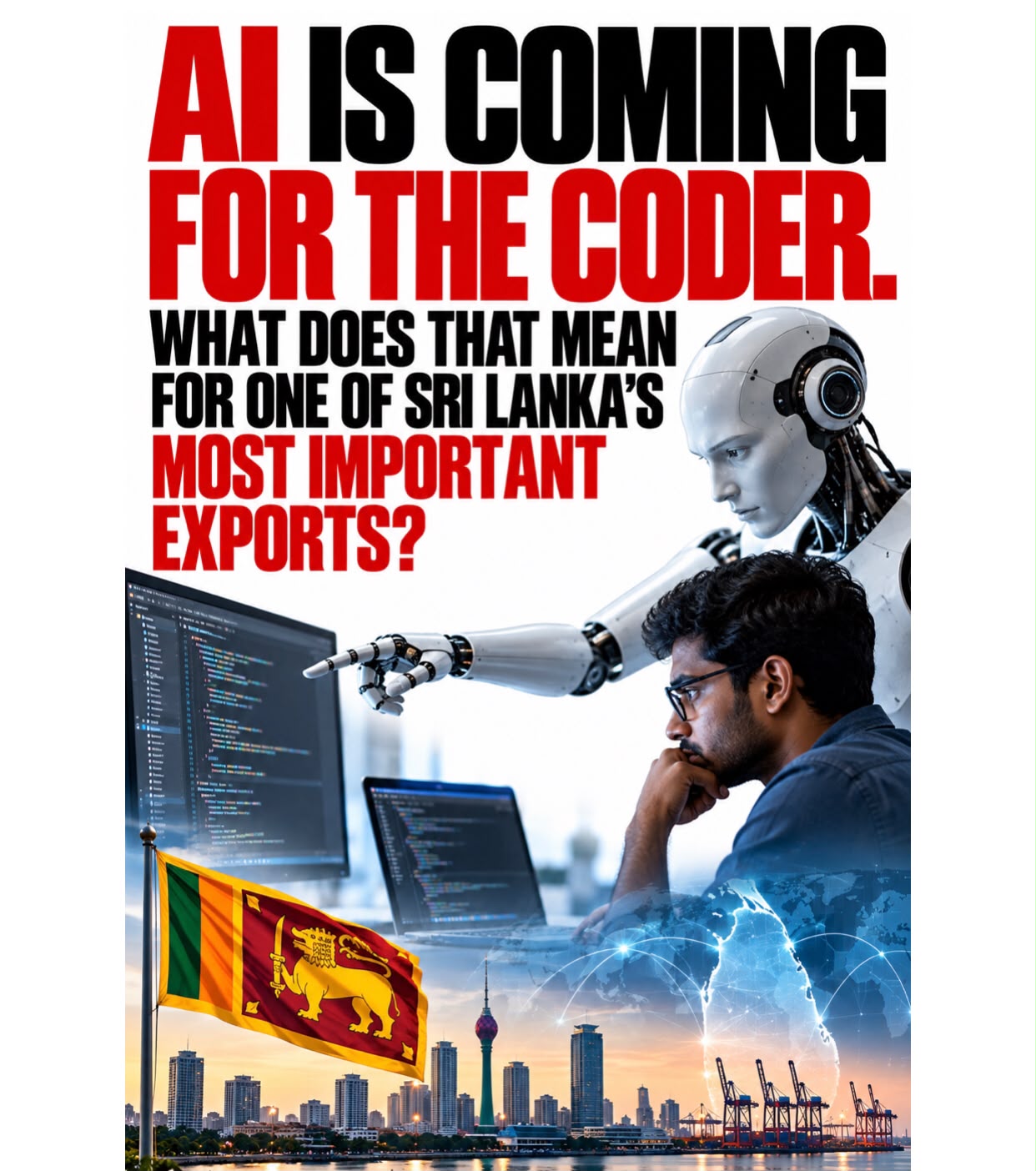
Sri Lanka has spent years building an IT and business-process industry around something the country has in abundance: educated people able to sell their skills to the world. Artificial intelligence is now beginning to perform some of the work those people were trained to do. The question is no longer whether Sri Lanka embraces AI. It is whether we can move up the value chain before AI moves underneath us.
Sri Lanka does not manufacture enough of what the world buys. But there is one export that does not require a container, a port or even a ship.
People. More precisely, their knowledge.
Submit Your Press Release
Get your company news, announcements, launches, appointments and events in front of a wider audience.


Sri Lanka’s IT and business-process industries have grown by selling software development, engineering, accounting, financial services, back-office operations and other professional skills to overseas customers. It is one of the few areas in which geographical distance becomes almost irrelevant.
A programmer sitting in Colombo can work for a company in London. An accountant in Kandy can service a client in Australia. A software team in Sri Lanka can develop something being used thousands of kilometres away.
Artificial intelligence is now disturbing that model.
AI Week 2026 has brought together Government, technology companies and industry participants around the proposition that Sri Lanka must develop a new generation of AI capability. That objective is difficult to quarrel with.
The more interesting question is why the urgency exists.
AI is rapidly becoming capable of performing tasks which companies previously paid human beings to perform. Software code can be generated, tested and corrected with AI assistance. Documents can be analysed. Routine customer interactions can be automated. Research that once consumed hours can be completed in minutes.
This does not mean the programmer disappears tomorrow.
It does mean the economic value of merely being able to write conventional code may change.
That matters particularly to countries such as Sri Lanka because part of our international competitiveness has historically rested upon a simple equation: a well-educated Sri Lankan professional can perform high-quality work at a lower cost than an equivalent professional in many developed economies.
AI alters that equation.
If one highly skilled engineer assisted by artificial intelligence can accomplish work previously requiring five people, the overseas customer may still require Sri Lankan talent. It may simply require less of it.
The opportunity lies on the other side of the same equation.
A Sri Lankan company using AI intelligently may suddenly be capable of delivering work that previously required much larger overseas teams. Small local technology businesses could compete for more sophisticated projects. Engineers could spend less time writing repetitive code and more time designing systems, solving difficult problems and understanding what customers actually need.
The distinction is between using AI and being replaced by someone who does.
That places enormous responsibility on education.
Universities and training institutions cannot continue preparing students principally for the technology jobs that existed five years ago. Teaching somebody a programming language is increasingly only the beginning. The valuable worker will need to understand systems, data, security, AI models, business processes and how to identify when an artificial intelligence system has produced something confidently wrong.
Perhaps most importantly, Sri Lanka needs people capable of asking the right questions.
AI can generate an extraordinary amount of output. Knowing what problem should be solved, whether the answer makes sense and how it applies to a real business remains considerably harder.
There is a national economic dimension too.
Sri Lanka desperately needs export earnings that are not dependent upon imported raw materials. Knowledge exports are particularly attractive because much of their value is created domestically.
Losing competitiveness in that sector would therefore hurt.
But trying to protect existing jobs from AI would be equally futile. International customers will use these technologies whether Sri Lanka likes them or not. The only meaningful choice is whether Sri Lankan companies and workers use them earlier and better than their competitors.
This is why the present enthusiasm surrounding artificial intelligence needs to move beyond conferences, speeches and fashionable terminology.
How many schools are preparing children for this economy? How many universities have redesigned courses rather than simply adding an AI module? How many companies are genuinely building AI capability rather than attaching the letters to their marketing material?
And how many young Sri Lankans currently studying conventional software development understand that the job for which they are preparing may look very different by the time they graduate?
Sri Lanka has spent years worrying about artificial intelligence taking jobs. That may be the wrong way to frame the problem.
The larger danger is that AI creates entirely new kinds of high-value work and Sri Lanka discovers that somebody else trained for them first.
Be that as it may, the machines are not waiting for our curriculum to catch up.