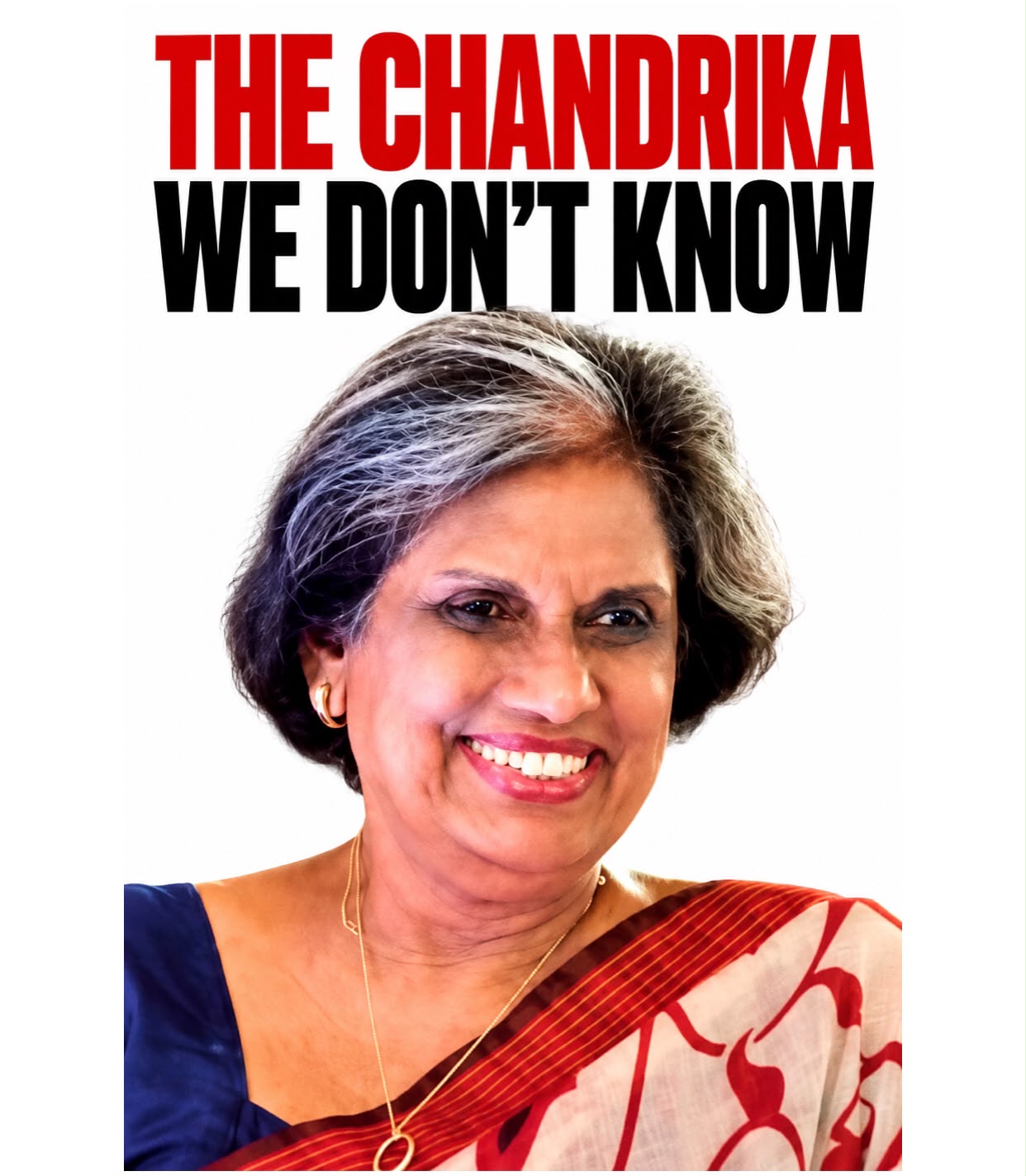
Vimukthi Kumaratunga on his mother
Vimukthi Kumaratunga has spent much of his adult life away from Sri Lanka’s political stage. Now, speaking with unusual candour about his mother, he offers something political biographies seldom manage: a glimpse of Chandrika Bandaranaike Kumaratunga as daughter, widow, mother and President, while delivering his own striking assessment of the political atmosphere into which she stepped.
There are few families in Sri Lanka whose private lives have been so thoroughly entangled with the country’s public history. S.W.R.D. Bandaranaike became Prime Minister and was assassinated. His widow Sirimavo entered politics after his death and became the world’s first woman Prime Minister. Their daughter Chandrika married one of the country’s most celebrated actors, Vijaya Kumaratunga, himself turned politician. He too was assassinated.
Submit Your Press Release
Get your company news, announcements, launches, appointments and events in front of a wider audience.


Chandrika would go on to become Prime Minister and then President, serving as Sri Lanka’s Executive President from 1994 to 2005. Her children, Yasodhara and Vimukthi, therefore grew up in circumstances for which the word “unconventional” may almost seem inadequate.
That is nevertheless precisely where Vimukthi begins.
“Our family isn’t conventional at all,” he says. “There’s nothing conventional about her being born into a family where both parents were world leaders and prime ministers of this country.”
It is the beginning of a revealing description of a woman Sri Lanka knew extremely well in public, but perhaps considerably less well in private.
Vimukthi believes the independence that came to characterise his mother began in her own childhood. Despite Sirimavo Bandaranaike coming from what he describes as a very conservative background, he says his grandmother did not expect her daughters to conform to convention. She did not interfere with whom they married, where they studied or what they studied.
“Convention was never really part of her upbringing or her vocabulary,” he says.
The same freedom, he suggests, was passed to another generation. Chandrika did not attempt to mould Yasodhara and Vimukthi into predetermined versions of themselves. Their parents were hardly conventional either: one a politician born into Sri Lanka’s most celebrated political family, the other an actor who became a politician and developed an enormous popular following of his own.
“Neither of my parents were conventional,” Vimukthi says. “They were ahead of their time in many ways. They were different in many ways. So therefore our childhoods were not conventional either.”
But there was a price.
Vijaya Kumaratunga was assassinated in February 1988. Chandrika was left to raise two children alone while eventually becoming one of the central figures in Sri Lankan politics. And it is here that Vimukthi’s recollection becomes unexpectedly candid.
He describes the difficulties of having “a single parent who is also very absent”.
“As much as she tried,” he says, “she was often very absent in our teenage years.”
There is no apparent bitterness in the observation. It is stated almost matter-of-factly. But behind that single sentence sits a reality rarely recorded in political histories. Presidents have children. Elections, party battles, national crises, security arrangements and the machinery of government do not stop at the front door. Sometimes the children simply grow up around them.
Vimukthi says he and his sister had to “muddle through and find our own way”. Yet he also sees an advantage. They escaped what he describes as the “helicopter parenting” experienced by many of their contemporaries.
Partly, he jokes, that was because their mother was simply not present enough to do it. But he says it was also because interference was not her nature. She did not demand particular marks or prescribe what her children had to achieve. They set those standards themselves.
Then Vimukthi makes the leap that gives this conversation its wider political significance. He believes there was a connection between the way Chandrika Kumaratunga parented and the way she eventually governed.
“I think that translates a lot to the way she found her own way of leading as a politician,” he says.
And it is at this point that Vimukthi ventures into much more contested territory.
He places his mother’s arrival in national politics against his own assessment of the governments that had preceded her. Sri Lanka, he says, had not seen a woman occupying such a powerful leadership position for decades, effectively since the era of his grandmother.
He then describes the political atmosphere of the late 1970s, 1980s and early 1990s in notably stark terms, referring to “periods of quite autocratic, almost dictatorial rule, I suppose” under the presidents and leaders of that period.
It is an important remark, but it is Vimukthi Kumaratunga’s characterisation of that era rather than an uncontested historical conclusion.
The period he is talking about encompassed the executive presidencies of J.R. Jayewardene from 1978 to 1989 and Ranasinghe Premadasa from 1989 to 1993, followed by the shorter presidency of D.B. Wijetunga. Chandrika Kumaratunga assumed the presidency in 1994.
There is plenty for historians and political opponents to debate in Vimukthi’s assessment. Those years encompassed the creation and consolidation of the executive presidency, civil conflict, the second JVP insurrection and its violent suppression, emergency rule and profound political upheaval. Equally, supporters of those administrations would contest any attempt to compress very different presidencies and circumstances into a single description.
But Vimukthi’s words matter precisely because they tell us how he sees the political environment against which his mother’s leadership should be understood.
“So she came in with a storm,” he says. “She came in with something very different that she was offering as a result of her not conforming.”
That does not require NEWSLINE to accept his assessment of either what came before or what followed. It does, however, provide a revealing insight into how Chandrika Kumaratunga’s own son interprets her political arrival.
He remembers a leader who, in his view, attempted to recruit the best people for particular jobs and then give them room to perform. He connects that directly with her approach as a parent: establish expectations, provide opportunity and resist the urge to control every detail.
“Give them the opportunity to blossom and perform,” is how he puts it.
She would show her disappointment when targets were not achieved, he says, but he regards the underlying approach as unusual for its time: “forward thinking” and even “groundbreaking” in Sri Lankan politics.
That is the son’s assessment. The political record inevitably demands a broader lens.
Kumaratunga’s eleven years in office encompassed renewed war, efforts towards a negotiated settlement of the ethnic conflict, constitutional reform initiatives, bitter struggles within Sri Lanka’s political establishment and eventually the extraordinary experiment in political cohabitation after the UNP won the 2001 parliamentary election. Her governments attracted both admiration and fierce criticism. No recollection by a family member can settle the argument over that record, nor should it.
What Vimukthi provides instead is an explanation of the person he believes was operating behind it.
He suspects that senior civil servants initially found his mother’s approach difficult and unconventional because, as he describes her, she was “so liberal and open-minded” and inclined towards lateral thinking. Once officials understood how she worked, he believes the relationship changed.
Whether everyone who served under President Kumaratunga would recognise that portrait is another question entirely. That is what makes personal testimony interesting rather than definitive.
But perhaps the most intriguing thread running through Vimukthi’s account is freedom.
Sirimavo, he says, gave Chandrika freedom. Chandrika gave her children freedom. And Vimukthi believes President Kumaratunga attempted to give those around her freedom to perform.
“Her politics reflecting life, her life reflecting politics,” he says.
There is an irony here that Sri Lanka, with its fascination for political families, should not miss.
Vimukthi Kumaratunga could scarcely have been born with a more politically valuable surname. His grandfather was Prime Minister. His grandmother was Prime Minister. His mother was President. His father was one of the most charismatic political figures of his generation.
Yet Vimukthi chose veterinary medicine.
When speculation emerged in 2021 suggesting that a son from a prominent political family was being prepared for entry into Sri Lankan politics, he publicly rejected it. He said he had devoted more than two decades to veterinary work and specialist training in Britain and declared that he had “no intention whatsoever” of engaging in Sri Lankan politics.
That makes this conversation more interesting, not less.
It would be easy to see a Kumaratunga speaking about Sri Lankan political history and immediately ask whether another member of the dynasty is preparing to enter politics. There is nothing in these remarks that justifies that conclusion, and his previous statement explicitly points in the opposite direction.
This is therefore better understood for what it is: a son looking back at his mother and attempting to explain where the private woman met the public President.
He does not present an immaculate childhood. He acknowledges her absence. He acknowledges that he and his sister sometimes had to find their own way. He does not disguise the extraordinary privilege of the family into which his mother was born either. He calls it “illustrious”.
But his central proposition is more interesting than either privilege or dynasty.
He believes Chandrika Kumaratunga did not conform because she had never really been taught that she had to.
That independence carried her from an extraordinary political family into a marriage of her own choosing, through widowhood and eventually into the presidency. Vimukthi believes it also shaped the way she exercised power.
History is entitled to argue about the result.
It is also entitled to argue vigorously with his description of the political culture of the 1970s, 1980s and early 1990s. Those are political and historical judgments, not neutral facts.
But it is difficult to dismiss the perspective itself. This is a man who observed one of Sri Lanka’s most consequential political figures from a position unavailable to historians, journalists, ministers or civil servants.
He knew her as his mother.
And perhaps the most telling evidence for his description of Chandrika Kumaratunga as a woman who did not insist upon conformity is sitting before us.
She belonged to one of Sri Lanka’s greatest political dynasties.
Her son walked away from politics. She apparently let him.