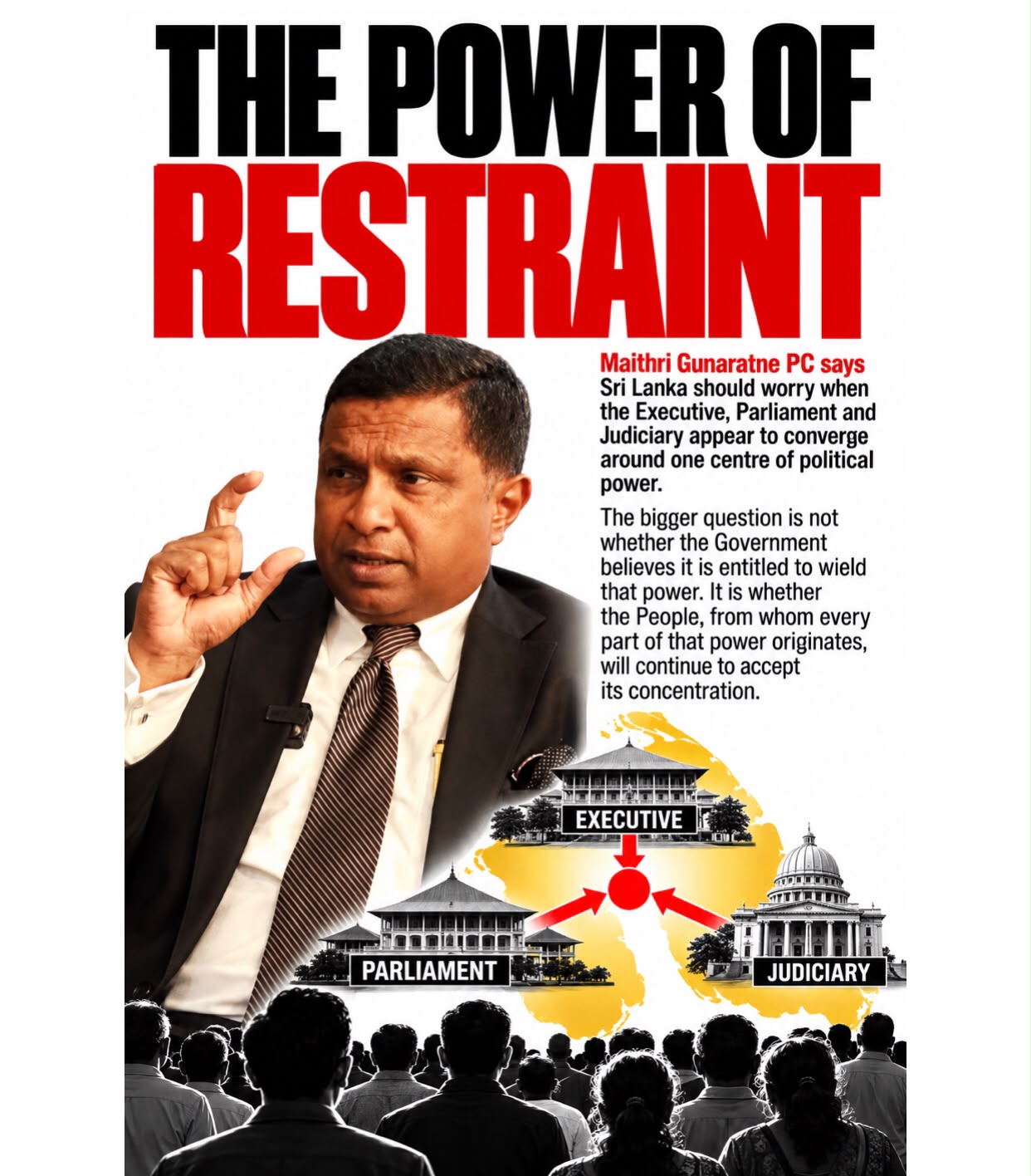
Maithri Gunaratne PC says Sri Lanka should worry when the Executive, Parliament and Judiciary appear to converge around one centre of political power. The bigger question is not whether the Government believes it is entitled to wield that power. It is whether the People, from whom every part of that power originates, will continue to accept its concentration.
Maithri Gunaratne PC, lawyer and twice a Provincial Governor, appearing on NEWSLINE with Faraz, raised an uncomfortable proposition. In his assessment, the traditional boundaries separating Sri Lanka’s Executive, Legislature and Judiciary are becoming dangerously blurred.
Gunaratne went further. He referred to statements he attributed to members of the Government which, in substance, said: we have the Presidency, we have Parliament, and now we want “state power.”
Submit Your Press Release
Get your company news, announcements, launches, appointments and events in front of a wider audience.


The precise political meaning attached to those words is a matter for those who uttered them. Gunaratne’s warning, however, raises a much larger constitutional question.
What happens when the institutions designed to restrain each other begin, or are perceived, to speak with one political voice?
Sri Lanka’s Constitution provides an important starting point. Sovereignty does not belong to the President. It does not belong to Parliament. It certainly does not belong to a political party. Article 3 declares that sovereignty is in the People and is inalienable. Article 4 then distributes the exercise of that sovereignty through legislative, executive and judicial power.
That distribution is not merely decorative constitutional drafting.
The Supreme Court has itself described the three functions of government as distinct, constitutionally equal and independent, stating that one organ should not dominate another. In another constitutional determination, the Court connected the separation of powers directly with the sovereignty protected by Article 3, describing the constitutional arrangement as a “delicate balance.”
That makes Gunaratne’s argument worth examining beyond today’s party politics.
A government winning the Presidency and obtaining a commanding parliamentary majority is entirely democratic. Indeed, the present Government acquired those powers through elections. A large majority does not become constitutionally suspect merely because it is large.
The danger arises elsewhere.
Democracy depends not simply upon who wins elections but upon what those who win are prevented from doing. Courts must remain capable of ruling against governments. Parliament must retain meaningful scrutiny rather than becoming simply the legislative machinery of the Executive. Independent institutions must be able to exercise their statutory functions without first wondering whether their decisions conform to the preferences of the governing political movement.
That is the architecture of restraint.
Remove enough of those restraints and a democracy can retain elections, a Parliament, courts and a Constitution while progressively weakening the practical separation between them.
This is why perception matters almost as much as formal constitutional compliance. Judicial independence, for example, does not require proof that somebody telephoned a judge and instructed him how to decide a case before questions can legitimately be asked. The public must have confidence that judicial decisions, appointments and careers are insulated from political reward or punishment.
The controversy surrounding the Twenty-Second Amendment inevitably gives Gunaratne’s intervention greater resonance. The amendment was passed on September 25 by 158 votes to 63 at its Third Reading, after considerable controversy over changes affecting the superior judiciary.
None of that establishes that Sri Lanka’s three branches have in fact fused. That would be a much more serious allegation requiring considerably more evidence than political criticism or constitutional controversy.
But Gunaratne’s proposition deserves attention precisely because constitutional safeguards are intended to operate before institutional independence disappears, not afterwards.
And there is another player in this constitutional arrangement who is sometimes conveniently forgotten.
The People.
Every institution involved exercises power originating from them. President, Parliament and judiciary are not competing owners of sovereignty. They exercise different aspects of a sovereignty which the Constitution says remains inalienably with Sri Lanka’s citizens.
That brings us to the potentially combustible part of Gunaratne’s warning.
When citizens conclude that normal institutional avenues no longer provide an effective means of challenging power, political disagreement can migrate outside those institutions. Sri Lanka does not need a theoretical lesson in what happens when economic frustration, political alienation and distrust of institutions converge.
But neither should every concentration of political power automatically be portrayed as the precursor to upheaval. Governments with overwhelming mandates can govern constitutionally. Strong government and constitutional government are not opposites.
The dividing line is restraint.
Can Parliament disagree with the Executive? Can independent institutions say no? Can courts decide against the State without fear or favour? Can journalists question all three? Can citizens challenge government action and receive an independent determination?
If the answers remain yes, the constitutional machinery continues to work.
If they progressively become no, the problem is considerably larger than whichever party happens to occupy office.
Because the final check upon governmental power in Sri Lanka was never intended to be another politician.
It is the People themselves.
And that may be the most important element in Gunaratne’s warning. Governments can accumulate authority. Political movements can dominate legislatures. Administrations can seek greater command over the machinery of the State.
But sovereignty itself cannot constitutionally be accumulated by any of them.
It already has an owner.
Be that as it may, those owners are the People.