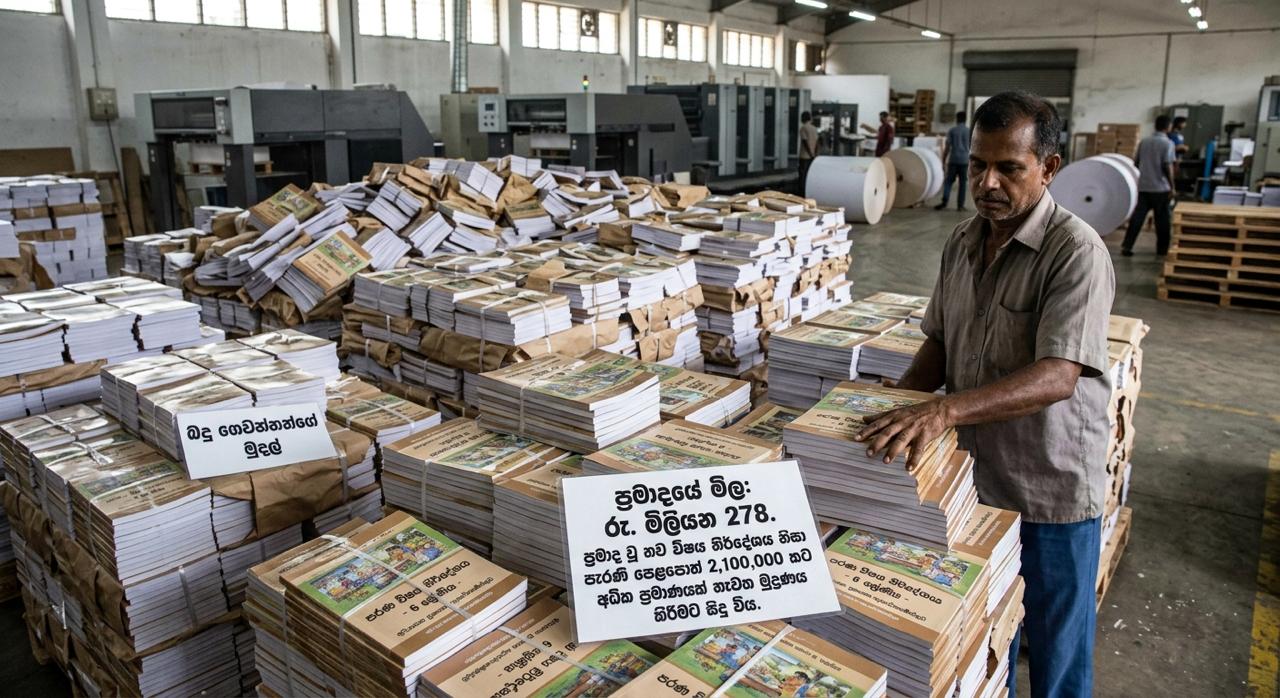
Sri Lanka was supposed to introduce education reforms for Grade 6. It did not happen on schedule. The consequence was rather more tangible than another missed government deadline: more than 2.1 million textbooks from the old syllabus had to be printed again, at a cost exceeding Rs 278 million.
Education reform is one of those expressions that sounds impressive until somebody has to deliver it.
Sri Lanka had planned to introduce reforms affecting Grade 6, which necessarily meant changing what children would be taught and therefore the textbooks from which they would learn. But when implementation did not proceed according to schedule, schools still needed books.
Submit Your Press Release
Get your company news, announcements, launches, appointments and events in front of a wider audience.


The Auditor General has now put a price on what happened next. More than 2.1 million copies of textbooks based upon the old Grade 6 syllabus had to be reprinted, costing the State more than Rs 278 million.
There is nothing particularly complicated about why the books had to be printed. Children cannot reasonably be sent into classrooms without learning material because the adults responsible for reform have missed their timetable.
The more interesting question is how Sri Lanka reached that position in the first place.
Curriculum reform is not an overnight exercise. New syllabuses have to be developed, teaching material prepared, teachers trained and textbooks written, reviewed, printed and distributed. Each part depends upon the one before it being completed on time.
Somewhere in that chain, the timetable failed.
The taxpayer then became the insurer of last resort.
Rs 278 million may not appear enormous when placed beside a national Budget measured in trillions. But public money should not become insignificant merely because governments occasionally waste larger amounts of it.
More importantly, the figure tells us something about the cost of administrative delay.
When a road project is delayed, the cost may appear as escalation in construction prices. When procurement is delayed, the State may pay more for the same equipment. When education reform is delayed, the consequences can be less visible because children continue attending school and teachers continue teaching.
This time there is a convenient receipt.
Rs 278 million.
There is another uncomfortable aspect to the affair. These were not textbooks intended to become part of a long-term educational programme. They had to be produced because the system they supported was supposed to have been replaced but was not replaced in time.
That does not necessarily make printing them the wrong decision. Once the reforms were delayed, reprinting the existing material may have been unavoidable. The question of accountability lies earlier: why was the country placed in the position where spending that money became necessary?
That distinction matters.
Otherwise the official who eventually orders the textbooks risks being blamed for solving the immediate problem while the decisions that created the problem disappear somewhere inside the machinery of government.
Education reform is difficult. Governments can legitimately change implementation dates when teachers, schools or teaching material are not ready. Indeed, delaying an inadequately prepared reform can sometimes be considerably wiser than imposing it upon children merely to satisfy a political timetable.
But changing a timetable has consequences.
Those consequences should have been calculated before announcements were made, implementation dates fixed and expectations created.
Sri Lanka spends a great deal of time debating how much money should be allocated to education. That debate is important. Equally important is what happens to the money after it has been allocated.
Rs 278 million could have purchased books, equipment, laboratory facilities or other educational resources that remained useful for years.
Instead, it purchased more than two million copies of yesterday’s syllabus because tomorrow’s syllabus did not arrive on time.
The children will still receive their textbooks. The taxpayer has simply received another lesson.