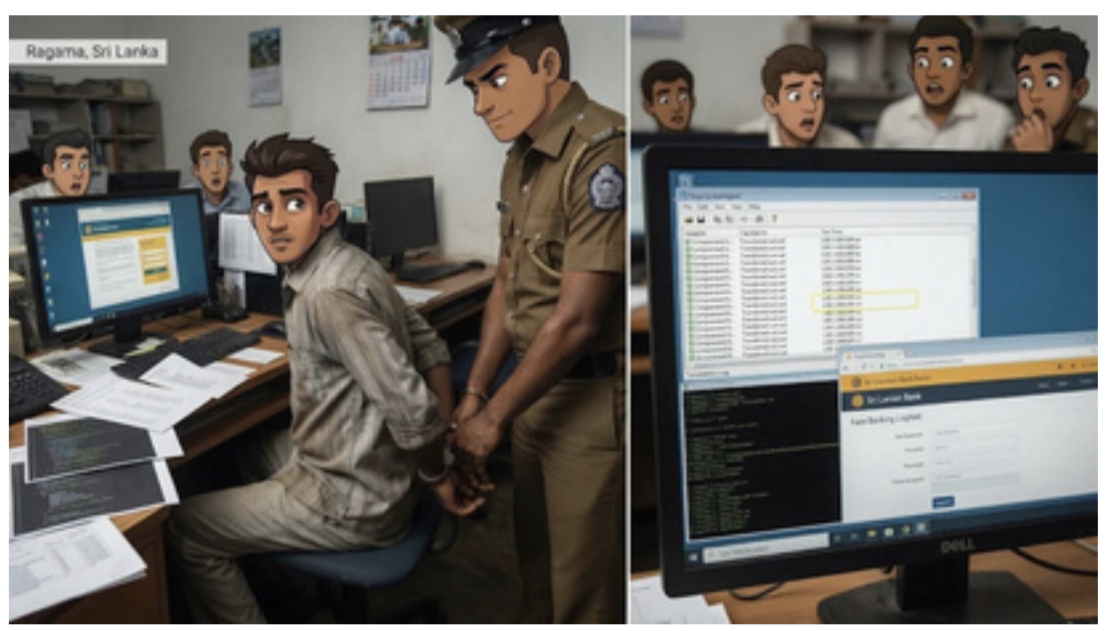
CLONED PORTAL, STOLEN MILLION: DATA ENTRY OPERATOR ARRESTED IN RAGAMA OVER FAKE BANK WEBSITE FRAUD
A 25-year-old data entry operator from Ragama has been arrested by cybercrime investigators over the alleged theft of Rs. 1 million from a customer’s account using a cloned website designed to mimic the official online portal of a Sri Lankan private bank. Officers attached to the Wariyapola Computer Crime Investigation Division took the suspect into custody yesterday afternoon, November 26, following a forensic probe into how the victim’s digital banking credentials were harvested and drained.
According to police investigators, the suspect, who works at a private institution, allegedly engineered a lookalike login page replicating the branding, layout, and authentication fields of the commercial bank. Once the unsuspecting customer entered confidential username and password details into the counterfeit interface, the credentials were captured and used to access the genuine account and transfer Rs. 1 million. Following a formal complaint lodged with the Wariyapola Computer Crime Investigation Division, officers traced the digital footprint of the fraudulent domain and fund movement, leading directly to the suspect’s arrest in Ragama. Further inquiries are continuing to determine whether the suspect operated alone, how the stolen funds were routed, and whether additional account holders fell into the same trap.
Submit Your Press Release
Get your company news, announcements, launches, appointments and events in front of a wider audience.


The Ragama arrest highlights a sharp escalation in credential-harvesting schemes targeting retail banking customers across Sri Lanka during 2026. Cybersecurity advisories issued by Sri Lanka CERT and the Financial Sector Computer Security Incident Response Team (FinCSIRT) have repeatedly warned that fraudsters no longer rely solely on crude, spelling-riddled emails. Instead, perpetrators register domains differing by a single character or country extension from legitimate bank URLs, duplicate authentic login screens pixel for pixel, and promote the deceptive links through sponsored search engine advertisements, SMS alerts, or messaging platforms. Within seconds of a customer typing in login credentials and a one-time password, attackers mirror the session on the real banking server and sweep available balances before transaction alerts register.
Under Sri Lanka’s Computer Crime Act No. 24 of 2007 and the Payment Devices Frauds Act, unauthorized access to computer systems, data interception, and electronic financial fraud carry severe custodial sentences and heavy fines, yet technical enforcement remains locked in a race against low-cost phishing kits. For everyday depositors, the Wariyapola investigation serves as an expensive reminder that a familiar bank logo on a browser screen is no guarantee of authenticity. Navigating exclusively through verified mobile banking applications or manually bookmarked web addresses, rather than clicking links in messages or top search results, remains the simplest barrier between a customer’s savings and a cloned login page.