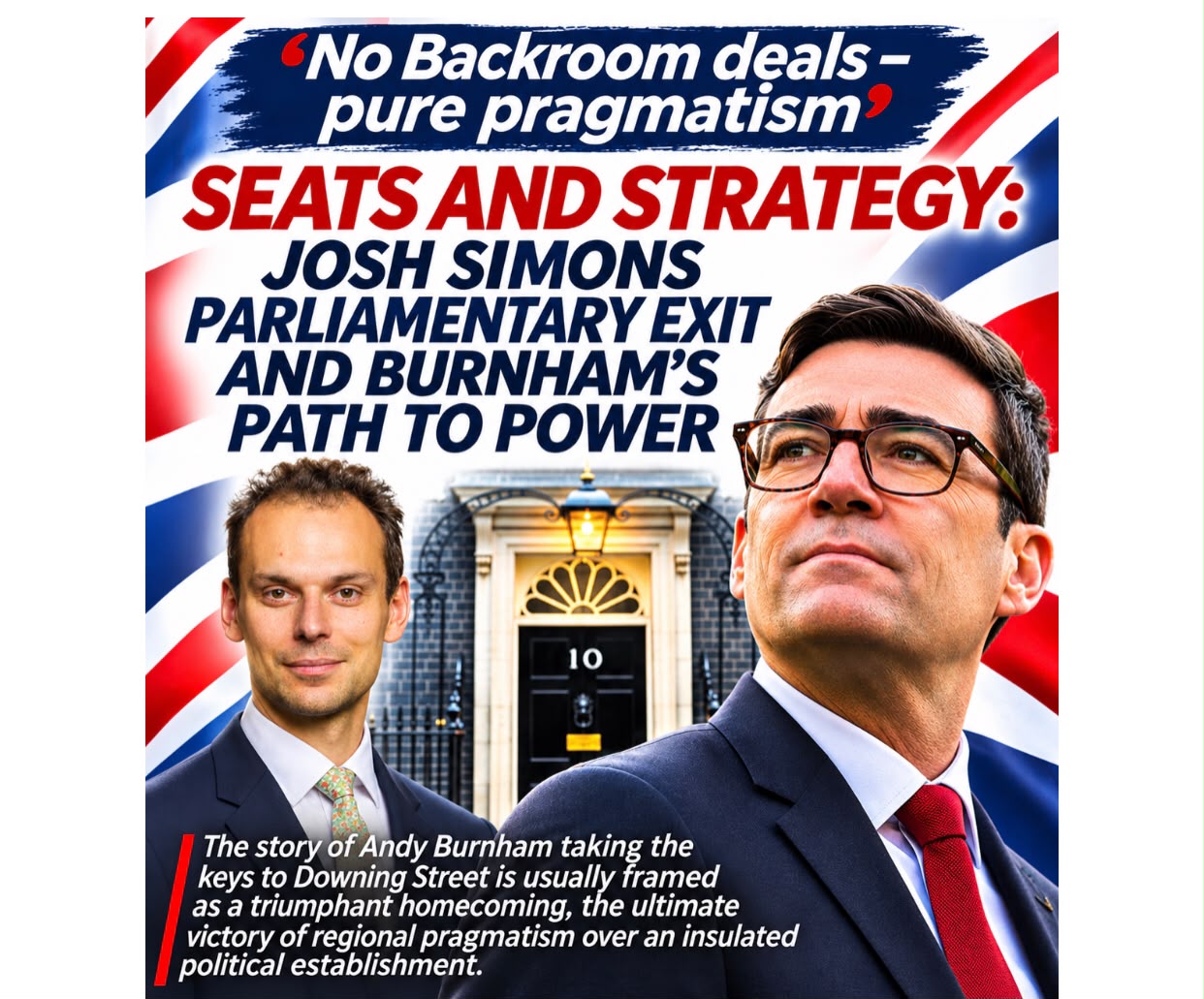
The story of Andy Burnham taking the keys to Downing Street is usually framed as a triumphant homecoming, the ultimate victory of regional pragmatism over an insulated Westminster bubble.
For nearly a decade as Mayor of Greater Manchester, Burnham built a distinct power base outside the capital, seizing control of transport networks and clashing openly with central government.
Yet no matter how much momentum Burnham gathered beyond the M25, his road back to national leadership was completely blocked by a hard reality: under British constitutional law, a sitting Mayor cannot hold a seat in the House of Commons. Worse still, under centuries-old parliamentary procedure, an individual cannot simply run for Parliament without an actual vacancy, and Labour’s National Executive Committee held strict control over selection rules.
Submit Your Press Release
Get your company news, announcements, launches, appointments and events in front of a wider audience.


Enter Josh Simons. To understand how Burnham actually secured his return to the Commons, one has to look directly at the calculated self-sacrifice of a 32-year-old policy strategist. As the former director of the influential think tank Labour Together, Simons had been fast-tracked into Parliament as MP for Makerfield in 2024 and elevated to junior ministerial ranks. But following bruising local election results in May 2026, Simons came to a stark conclusion: the administration was stuck in incrementalism, and the party needed a major structural reboot.
Rather than clinging to his seat or waiting out the political storm on the backbenches, Simons executed a maneuver rarely seen in modern British politics.
On May 14, 2026, he formally applied for the office of Steward of the Chiltern Hundreds, the archaic legal mechanism used by MPs to vacate their seats. Simons publicly declared that he was resigning his Makerfield seat specifically to clear a by-election runway for Burnham, arguing that the Mayor was the only leader capable of rescuing the party’s fortunes. By stepping down without demanding peerages or backroom trade-offs, Simons triggered an immediate parliamentary writ. His public sacrifice effectively forced the party hierarchy’s hand, leaving them no choice but to authorize Burnham’s candidacy for the June by-election.
Burnham’s victory in Makerfield set off a rapid political chain reaction. Within weeks, he mounted an unstoppable leadership bid, earned the endorsement of the overwhelming majority of Labour MPs, and took office as Prime Minister on July 20, 2026. Drawing comparisons to past prime ministerial ascents, Burnham’s path stands apart. Where leaders like James Callaghan or Theresa May advanced through traditional Cabinet progression, Burnham staged an outside-in takeover, using regional executive leverage to build public demand, but relying on a backroom ally to open the physical door to Parliament.
While Westminster rumors suggested that Josh Simons surrendered his seat to secure a top advisory desk inside No. 10, those arrangements never materialized. Today, while Burnham commands the floor of the House of Commons as Prime Minister, Simons has returned to private life and high-level policy commentary, operating as an influential external voice in the broader Labour ecosystem.
The historic transition from Greater Manchester to Downing Street proves that while public populism and regional track records build political momentum, it takes the cold, sacrificial gambit of a trusted strategist to turn that momentum into actual power.