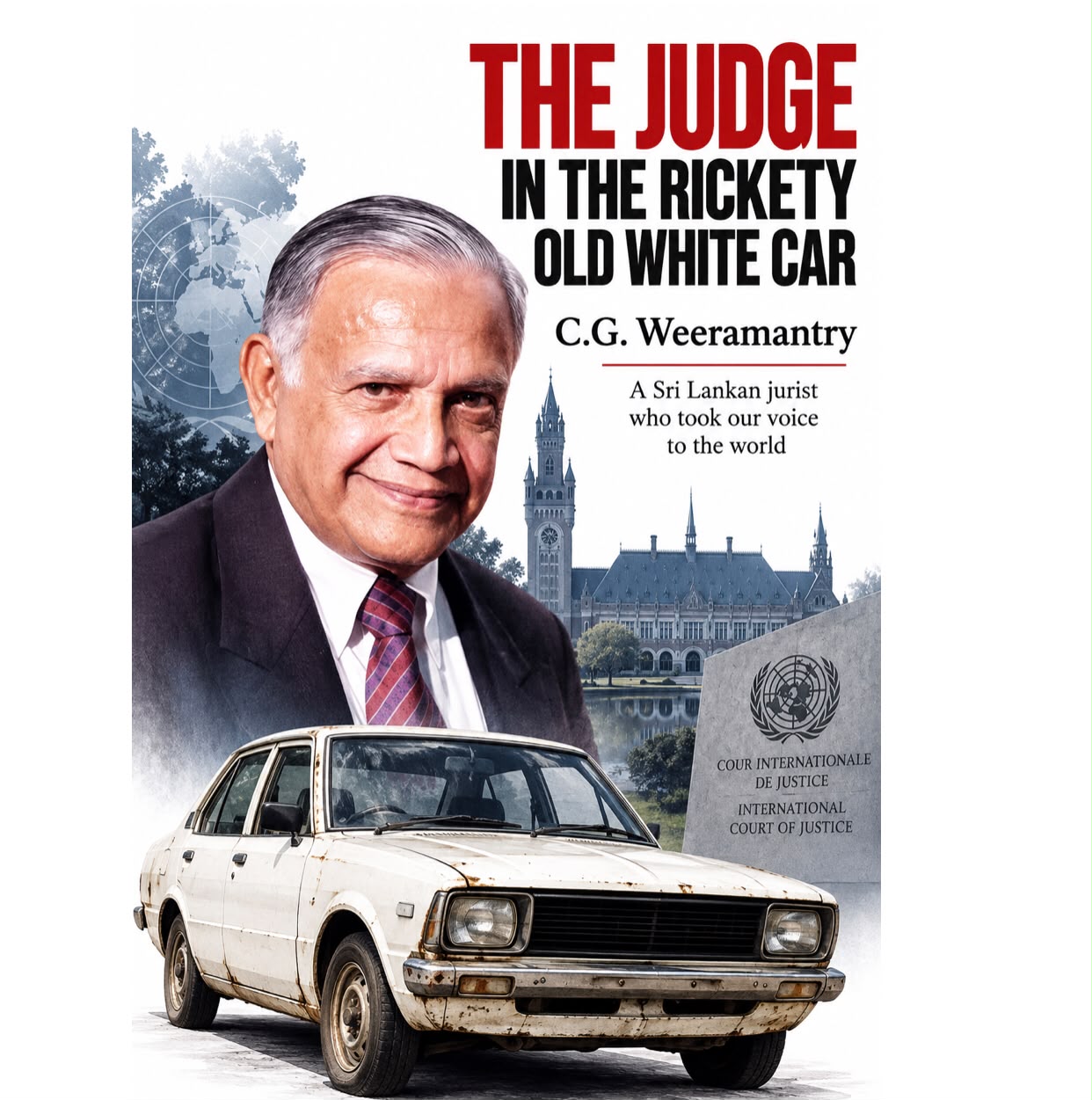
C.G. Weeramantry reached the Supreme Court of Sri Lanka and then the International Court of Justice, eventually becoming its Vice-President. His judgments travelled the world. Yet one Sri Lankan family who knew him remembers something considerably less imposing: Justice Weeramantry and his wife regularly arriving at their home in a rickety old white car. Perhaps that little car tells us something important about a very considerable man.
There was nothing remotely grand about the car. It was old, white and, according to a family whom Christopher Gregory Weeramantry and his wife visited regularly, decidedly rickety. They would arrive to see their friends without great ceremony, the distinguished judge emerging from a vehicle which apparently had little interest in advertising the international importance of its occupant.
Except that the man getting out of it had travelled about as far as it was possible for a Sri Lankan lawyer to travel.
Submit Your Press Release
Get your company news, announcements, launches, appointments and events in front of a wider audience.


Born in Colombo on November 17, 1926, C.G. Weeramantry built an extraordinary career in law. He became a judge of what was then the Supreme Court of Ceylon in 1967, serving until 1972. He subsequently moved to Australia, becoming the Sir Hayden Starke Professor of Law at Monash University.
Then came The Hague.
In 1991 Weeramantry became a judge of the International Court of Justice, the principal judicial organ of the United Nations. From 1997 until 2000 he served as its Vice-President. For a Sri Lankan jurist, it was an extraordinary journey.
But simply listing the offices he occupied rather misses the point.
Weeramantry became internationally significant because he was prepared to ask what law should do when humanity confronted questions larger than those for which conventional legal rules had originally been designed. Nuclear weapons, environmental destruction, sustainable development, peace and the responsibilities of one generation towards another all occupied his attention.
His most famous intervention arguably came in 1996 when the International Court of Justice delivered its advisory opinion on the legality of the threat or use of nuclear weapons.
The Court’s conclusion was carefully qualified. Weeramantry went further. In a lengthy dissenting opinion he concluded that the threat or use of nuclear weapons was illegal in any circumstances.
What made his reasoning particularly interesting was its breadth. He did not approach the problem simply as a matter of weapons and treaties. He examined humanitarian law, environmental consequences, civilian protection and the legal and moral traditions developed across different civilisations.
That was characteristic of Weeramantry.
He resisted the notion that international law was essentially a Western intellectual product to which everybody else had subsequently been invited. His scholarship explored principles found across Christianity, Buddhism, Hinduism, Islam and other philosophical traditions.
For a Sri Lankan sitting at the world’s highest international court, that mattered. He was bringing perspectives from outside the traditional centres of international legal thought into the courtroom.
His environmental jurisprudence was equally important.
In the 1997 Gabčíkovo-Nagymaros case between Hungary and Slovakia, involving a major project on the Danube, Weeramantry wrote separately about sustainable development. Development and environmental protection, he argued in substance, could not sensibly be treated as mutually exclusive objectives. The law had to reconcile them.
Today the words “sustainable development” are everywhere. Governments insert them into policy statements. Companies place them in annual reports. International organisations build programmes around them. Weeramantry was helping to give the concept serious jurisprudential meaning when much of the world was still learning how urgently it would be needed.
Underlying his thinking was an even more interesting proposition: people alive today cannot behave as though the planet belongs exclusively to them.
Future generations have interests too.
That sounds almost self-evident until one considers how governments and businesses actually make decisions. A forest can be destroyed today and the economic benefit recorded immediately. The consequences may arrive decades later. A river can be polluted by people who will never meet those eventually affected by it. Carbon can be emitted now while much of the cost is handed to people not yet born.
Weeramantry’s jurisprudence asked law to look beyond the immediate transaction.
Sri Lanka might usefully revisit that thinking.
We remain remarkably capable of treating environmental protection as an obstacle to development rather than one of its essential conditions. Wetlands become interesting when someone wants to build on them. Forests acquire a monetary value when somebody discovers what can be extracted from them. Coastlines become commercial opportunities.
Then come the floods, landslides, water shortages and arguments over who allowed what to happen.
Weeramantry was not arguing against development. His more sophisticated point was that development which destroys the foundations upon which future prosperity depends cannot simply be declared successful because today’s balance sheet looks attractive.
And perhaps that brings us back to the old white car.
Sri Lanka is not entirely unfamiliar with the theatre of office. The title, official vehicle, security detail, entourage and assorted manifestations of importance can sometimes become almost as important as the job itself.
Weeramantry had reached a level at which he scarcely needed to prove his importance to anybody.
Those who knew him repeatedly spoke of his humility. His achievements were formidable, yet the personal accounts left behind describe a man strikingly free of pomposity.
The rickety car does not prove that. Nor does driving an old car automatically confer virtue upon its owner. But the recollection of a family who knew the Weeramantrys socially provides a wonderfully human detail consistent with what others said about him.
His honours were substantial. In 2006 he received UNESCO’s Prize for Peace Education. In 2007 he received the Right Livelihood Award. Sri Lanka bestowed upon him the Sri Lankabhimanya, the country’s highest national honour.
Yet the greater legacy may lie in the questions he left behind.
What does one generation owe the next? Can technological capability alone justify what humanity chooses to do with it? Can environmental destruction really be called development? Does international law belong principally to those who first wrote its modern textbooks, or can the legal and ethical traditions of many civilisations contribute to it?
Above all, what is law actually for?
Christopher Gregory Weeramantry died in Colombo on January 5, 2017. He was 90.
Nearly a decade later, Sri Lanka could be forgiven for remembering the distinguished judge principally through his titles. Supreme Court Judge. Professor. Judge of the International Court of Justice. Vice-President of that Court. Scholar. Author.
But there was also the man.
Be that as it may, perhaps one of the better images of C.G. Weeramantry comes not from the grandeur of The Hague but from that family’s memories in Sri Lanka.
Justice Weeramantry and his wife had come to visit. Outside sat a rickety old white car.
The car was decidedly ordinary. Its owner had never needed to be.