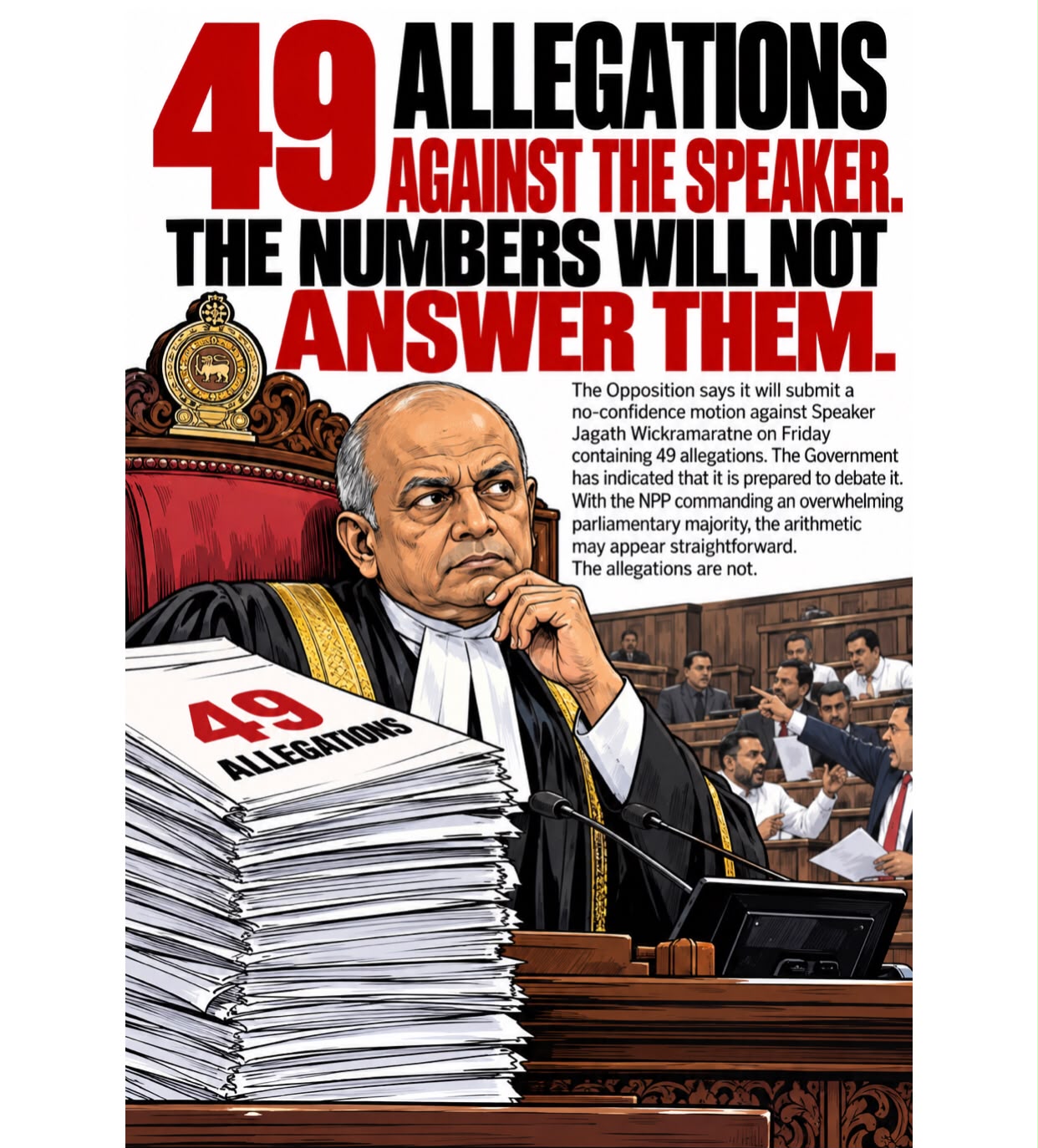
The Opposition says it will submit a no-confidence motion against Speaker Jagath Wickramaratne on Friday containing 49 allegations. The Government has indicated that it is prepared to debate it. With the NPP commanding an overwhelming parliamentary majority, the arithmetic may appear straightforward. The allegations are not.
Sri Lanka’s Opposition is preparing to place the conduct of Speaker Jagath Wickramaratne formally before Parliament.
The Samagi Jana Balawegaya says its no-confidence motion will be submitted on Friday, October 9, with Opposition MP Ajith P. Perera saying the document contains 49 allegations against the Speaker.
Submit Your Press Release
Get your company news, announcements, launches, appointments and events in front of a wider audience.


The Government has indicated that it is prepared to take up the motion for debate without unnecessary delay.
That is welcome.
But the debate will be useful only if Parliament does something more sophisticated than count votes.
The Government entered Parliament with 159 seats following an extraordinary electoral victory. Unless there has been a substantial political change within its own ranks, the Opposition faces an obvious numerical disadvantage in attempting to remove a Speaker elected by that majority.
That does not make the motion meaningless.
Nor does the existence of 49 allegations make any of them true.
The proper question is what the allegations actually are.
If they concern parliamentary procedure, decisions from the Chair, administration of Parliament, use of public resources or the Speaker’s conduct, each should be capable of being stated clearly and answered clearly.
A list containing 49 accusations can sound devastating.
It can also obscure more than it reveals.
Some allegations may be substantial. Some may amount to disagreements over parliamentary procedure. Others may overlap or be variations of the same complaint.
NEWSLINE would therefore prefer Parliament to concentrate on the strongest allegations rather than the largest number.
There is already an additional dimension to the controversy. Separate allegations concerning the Speaker have previously reached the Commission to Investigate Allegations of Bribery or Corruption, including matters concerning official vehicles and allowances. An investigation is not proof of wrongdoing, and those matters should not be conflated automatically with whatever appears in the no-confidence motion.
But they reinforce the need for answers.
The office of Speaker is different from an ordinary government position.
The Speaker is elected by Parliament, but once in the Chair is expected to protect the institution itself. Government MPs must be allowed to govern. Opposition MPs must be allowed to oppose. Parliamentary rules must apply regardless of who has 159 seats and who does not.
Confidence in that neutrality is therefore important. The Opposition also carries a responsibility.
A no-confidence motion should not become a device for converting every disagreement with a ruling from the Chair into an accusation of misconduct. If 49 allegations are being placed before Parliament, the Opposition should substantiate them.
The Government carries an equal responsibility. Its majority can defeat a motion. It cannot, by itself, answer an allegation.
That is why the coming debate may matter even if everybody believes they already know what the division bell will produce.
Parliament should examine the allegations, the Speaker should have the opportunity to answer them and the public should be able to judge the substance of both.
Be that as it may, 159 votes can settle the motion. They cannot settle the facts.