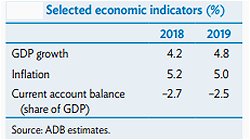
The Asian Development Bank (ADB) says Sri Lanka’s economic growth over the next two years will depend on agriculture and the political climate and forecasts a 4.2% growth for this year and 4.8% for 2019 .
While weather is an obvious concern on growth in agriculture, a major challenge for the government is the bunching in 2018-2024 of $22 billion in debt repayments, with $4.2 billion due in 2019, the ADB says in its report Asian Development Outlook (ADO) 2018.
Assuming normal weather in 2018 and 2019, agriculture is expected to rebound to 6.0% growth in 2018 and recover fully in 2019, expanding by 5.6%.
Industry is expected to expand by 3.9% 2018 and 4.5% in 2019, as apparel will benefit from continued strong global growth and GSP+ and Construction will expand on continuing government projects and new private sector ventures, mainly hotels and apartments, and with construction starting on buildings in the large Colombo Port City financial center project.
Growth in services is forecast at 3.7% in 2018 and 4.6% in 2019 on higher demand as rural areas recover, continued growth in financial services and tourist arrivals, and a small expansion in public administration and professional services.
On balance, growth is forecast to rebound to 4.2% in 2018 and reach 4.8% in 2019.
Inflation is projected to average 5.2% in 2018 and slow further to 5.0% in 2019. Food inflation is expected to abate as agriculture recovers under normal weather.
Revenue collection is expected to continue to improve with the new Inland Revenue Act that went into effect at the beginning of April 2018.
However, a major challenge for the government is the bunching in 2018-2024 of $22 billion in debt repayments, with $4.2 billion due in 2019.
Exports are projected to expand moderately by 6.5% in 2018, still driven by apparel and tea, and by 6.0% in 2019.
The rupee is likely to come under pressure in 2018 from the need to provide for debt repayment.
Imports are expected to expand moderately as oil import volumes drop with normal rainfall enabling hydropower generation. Import growth, mainly to supply construction and the apparel industry, is forecast at 5.5% in 2018 and 6.0% in 2019.
The current account deficit is projected to equal 2.7% of GDP in 2018 and 2.5% in 2019.